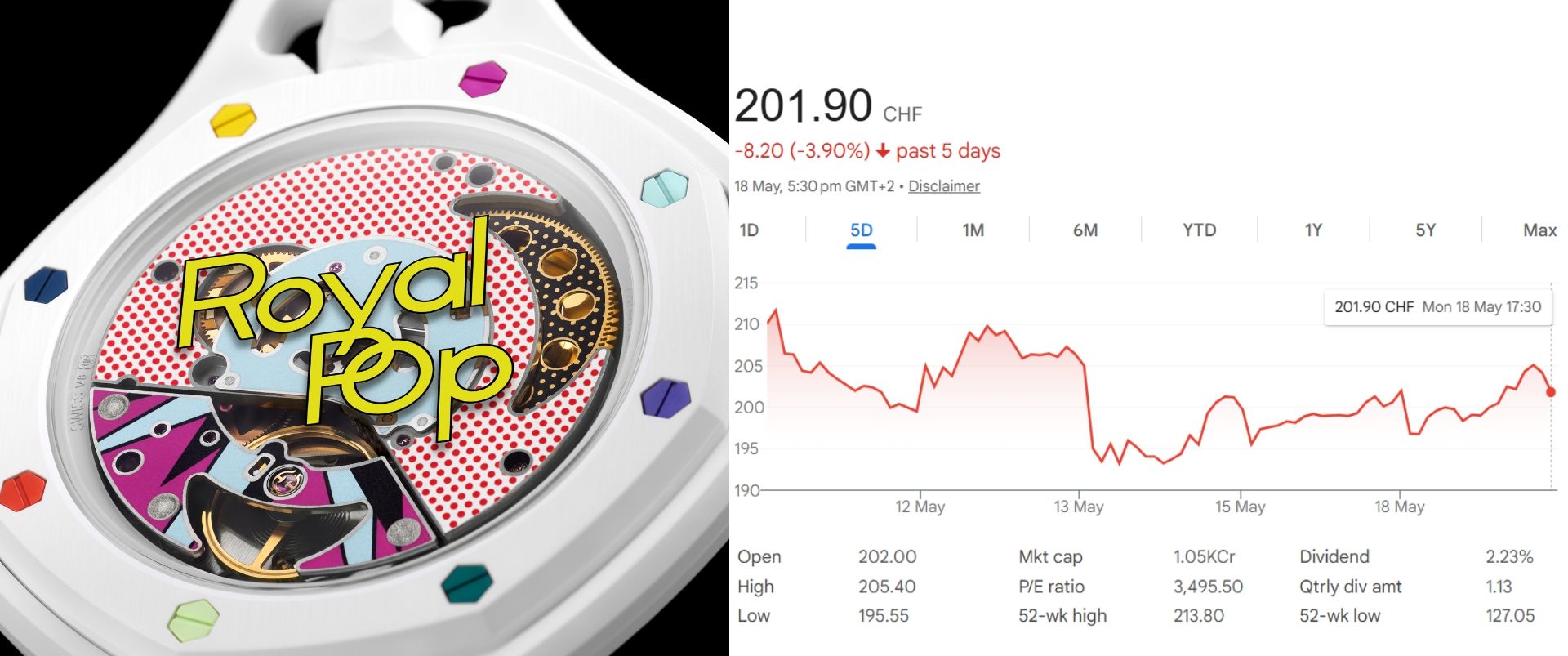
The Royal Pop Effect: What the AP x Swatch Collaboration Did To The Stock
 6 min read

For most of 2025, Swatch Group's stock was a story about everything going wrong at once. China demand was soft. US tariffs hit 39% in August before settling back to 15% in November. The Swiss franc appreciated over 10% against the dollar. Full-year 2025 revenue came in at CHF 6.28 billion, down 6.76% year-on-year. Earnings collapsed 98.45% to just CHF 3 million. The stock reflected all of it. The share price on the SIX Swiss Exchange hit a 52-week low of CHF 127.05.
Then Audemars Piguet entered the picture.
The Baseline: Where Swatch Stood Before the Announcement
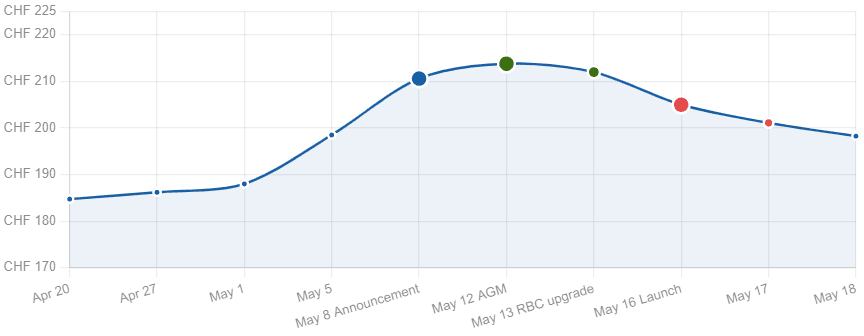
By April 20, 2026, UHR on the SIX Swiss Exchange was trading at CHF 184.75, having fallen 2.58% that day. The 52-week high at that point was CHF 204.80. The stock was in a wide falling trend in the short term, with analysts forecasting a further decline of 2.36% over the following three months. On the OTC market in the US, where Swatch trades as SWGAY, the share price as of early April 2026 sat at approximately $11.08, with the 52-week range spanning $7.26 to $13.10. The average 12-month analyst price target was $9.52, with a majority sell rating. The consensus view was cautious to negative. UBS, Bernstein, and most sell-side analysts saw the stock as facing structural headwinds with no near-term catalyst.
The Announcement: May 8, 2026
On May 8, the Royal Pop collaboration with Audemars Piguet was confirmed. The market responded immediately. Swatch Group AG shares jumped 4.4% to CHF 210.60 on May 8, 2026, on the Swiss exchange, fuelled by product news around the Royal Pop, according to cash.ch market data. It was the stock's single largest single-day gain in months, driven entirely by the announcement rather than any underlying financial result. The scale of the speculative move in the days surrounding the announcement was even more significant. In the week prior to the formal confirmation, the stock had surged nearly 18% amid growing speculation about the tie-up. By the time the collaboration was officially confirmed, the market had already priced in considerable optimism.
The Analyst Response: Divided Opinion
The reaction from institutional analysts split sharply along the lines of what they thought the pocket watch format meant for Swatch's commercial recovery. RBC Capital Markets upgraded Swatch Group from Underperform to Sector Perform. The broker modelled 3.0 million units at an estimated retail price of CHF 350, generating total revenues of CHF 1.05 billion and an EBIT profit share to Swatch Group of CHF 390 million across fiscal 2026 to 2029, under a 50/50 profit-sharing arrangement with Audemars Piguet. RBC noted that the partnership represented a notable first in the Swiss watchmaking industry, as Audemars Piguet had not previously licensed its Royal Oak silhouette. The bear case was equally direct. UBS said on the Monday before launch that the collaboration would be "largely anecdotal and unlikely to offset the group's broader structural challenges." Bernstein noted that investors appeared disappointed by the pocket watch format, and flagged the shareholder governance situation as a concurrent overhang.
The AGM Effect: May 12, 2026
The Royal Pop announcement was not the only catalyst operating on the stock simultaneously. On May 12, Swatch held its Annual General Meeting. Shareholders approved a CHF 4.50 per share dividend, payable May 19, with ex-date May 15. The activist investor Steven Wood's bid to secure a board seat was rejected, with 79.6% of votes cast against it. The stock rose 4.3% on the day. This creates an important analytical complication. The stock's move in May 2026 is not cleanly attributable to the Royal Pop alone. Three distinct catalysts overlapped: the collaboration announcement, the AGM outcome, and the RBC upgrade. Separating each one's contribution to the share price movement is not possible from public data alone.
The Launch: May 16 to 17, 2026
The product launched May 16. The market's reaction to the actual launch was cooler than the anticipation.
On May 17, 2026, UHR on the SIX closed at CHF 201.10, with the day range running from CHF 194.90 to CHF 201.50. The previous close had been CHF 201.90, representing a modest decline.
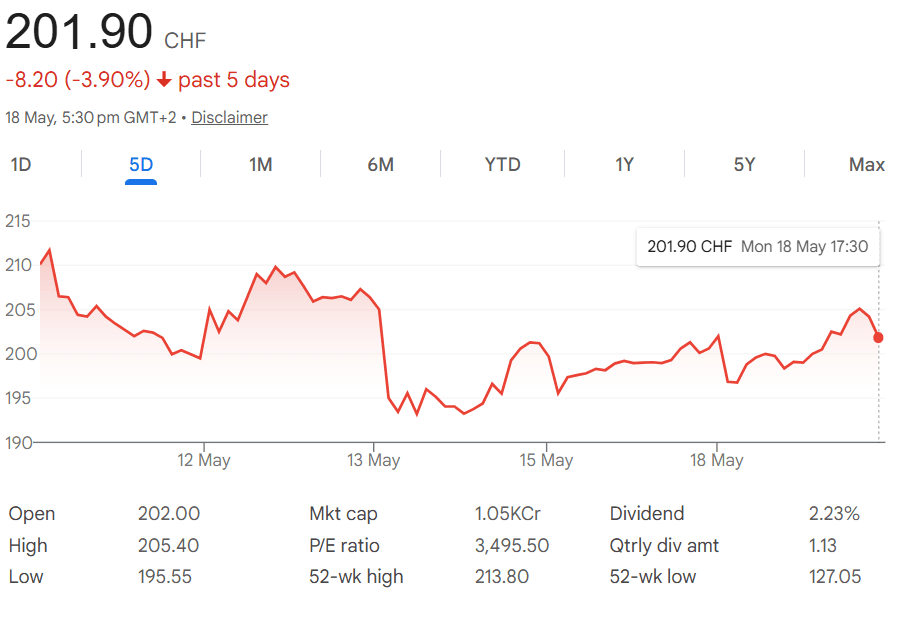
Despite the commercial frenzy on the ground, over 30 Swatch stores temporarily closed globally on May 17 due to overwhelming crowds in cities including New York, London, and Singapore, with police called to manage queues and at least one arrest in Manhattan, the stock pulled back from its post-announcement highs. The sell-the-news dynamic that typically follows speculative run-ups in retail stocks was visible. Swatch shares slumped more than 6% on launch day, on track for their largest single-day drop in over two months. The pocket watch format, which surprised the market, had not fully met expectations formed during the speculative run-up. Tickertape
The Broader Picture: YTD Performance
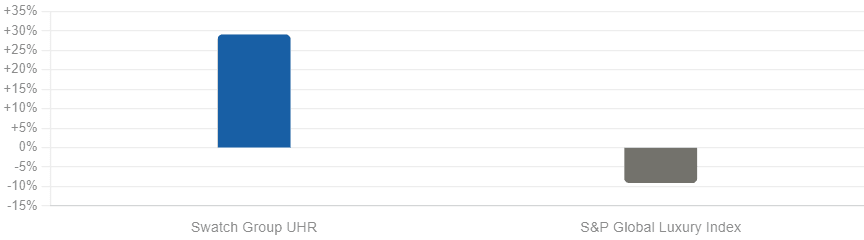
Pulling back to the full 2026 year-to-date picture, the numbers remain compelling. The stock has risen 29% year-to-date as of mid-May 2026, significantly outperforming the S&P Global Luxury Index, which declined 9% over the same period. Over the last year, Swatch Group UHR has posted a 36.94% increase. The month-on-month change is a 9.29% rise. The 52-week range on UHR, CHF 127.05 to CHF 213.80, captures a recovery story. The question is how much of that recovery belongs to the Royal Pop, and how much belongs to the broader luxury sector stabilisation and Swatch's own balance sheet management.
On India
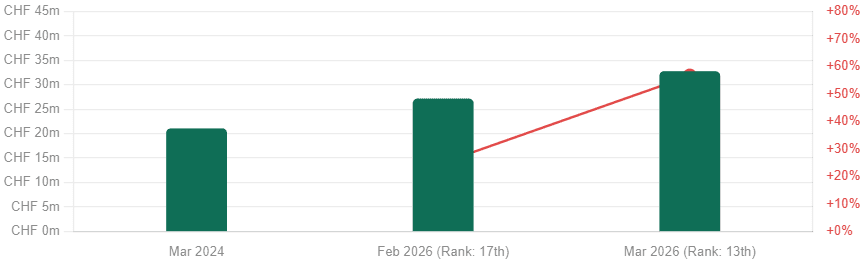
India does not directly trade Swatch Group shares on a domestic exchange. Indian investors access the stock via international brokerage platforms offering SIX Swiss Exchange access, or through global ETFs with Swatch Group exposure. There is no India-listed instrument tracking UHR directly, and no material divergence has been reported between OTC US pricing in SWGAY and the SIX listing that would suggest India-specific trading activity around the Royal Pop event. What India does represent for Swatch Group is commercial rather than financial. Swiss watch exports to India reached CHF 32.7 million in March 2026, a 56.6% year-on-year surge. India moved from 17th to 13th in the global Swiss export rankings in a single month. Swatch Group brands including Omega, Tissot, and Longines are direct beneficiaries of that trajectory. The Royal Pop's India availability was not confirmed at launch, making it an indirect rather than direct market event for Indian consumers.
The Verdict
The Royal Pop collaboration moved Swatch Group's stock materially, but the precise attribution is complicated. The 18% speculative surge in the week before the announcement was the market pricing in expectation. The 4.4% move on May 8 confirmed the trade. The 6% reversal on launch day reflected the pocket watch format disappointment. What sustains the longer-term case, per RBC's modelling, is whether 3 million units at CHF 350 can be maintained across 2026 to 2029 and whether that revenue converts to the CHF 390 million EBIT contribution the bank projects. That answer arrives in the July 9 earnings report. Until then, the Royal Pop remains what it has been since May 8: the most significant single-product catalyst Swatch Group has generated since the MoonSwatch in 2022, delivering a stock move that no quarterly result had managed to produce in the preceding eighteen months.


