The Second Wave: An Analysis Of Rolex’s June 2026 Price Adjustment
 5 min read

The macroeconomic forces of the past months - runaway inflation in precious metals, persistent currency fluctuations, and recalibrated supply chain logistics, have found their ultimate expression in the Rolex catalog. For the first half of 2026, the conversation in horological circles has been dominated by a single, binary question: would Rolex stand pat after its January adjustments, or would it strike again? With the update of the latest price lists on June 1, 2026, we have our definitive answer.
In a strategic move, Rolex has executed a second, targeted price increase for 2026. While the January hike was a broad-spectrum recalibration across virtually every reference, the June revision is comparatively selective. The data reveals a precise strike: models featuring 18k Everose, yellow, white gold, yellow/Everose Rolesor have been elevated, while the vast majority of Oystersteel, platinum, and white Rolesor (steel/white gold bezel) references remain untouched.
Stainless Oystersteel references - including the Submariner, GMT-Master II in steel, Oyster Perpetual, Air-King and Datejust 41 in steel, remain unchanged from their January price points. The selective nature of the increase reinforces a clear, material-driven logic: as gold prices appreciated sharply in the early months of 2026, Rolex is, at least partially, passing those input costs downstream to the consumer.
This analysis dissects the official Rolex India price lists from January and June 2026, providing a forensic, reference-by-reference breakdown of the increases, the percentage deltas, and the underlying market signals this “second wave” transmits to the collector.
The Golden Axle
The central thesis of the June 2026 price list is unequivocal: Precious metals are being re-priced to reflect their soaring commodity value. With the spot price of gold reaching historic highs in Q2 2026, Rolex is passing through a portion of that cost to the end consumer, but only on its most metal-intensive pieces. Two-tone (Rolesor) models saw a modest, single-digit adjustment, while full-gold pieces on Oyster or President bracelets experienced the brunt of the revision.

Notably, the RLX Titanium Deepsea and the Platinum 1908 and Land-Dweller references saw no change, indicating that Rolex is isolating its price risk specifically to gold, rather than applying a blanket inflationary adjustment.
Section 1: The Land-Dweller - Rolex’s New Frontier Feels the Pinch
Rolex’s newest dynasty, the Land-Dweller, launched to critical acclaim but has now been swiftly integrated into the financial reality of 2026. The June adjustments here are the most definitive, showing a clean bifurcation between steel and gold models.
Model | Material | January 2026 Price (₹) | June 2026 Price (₹) | Absolute Increase (₹) | Percentage Change |
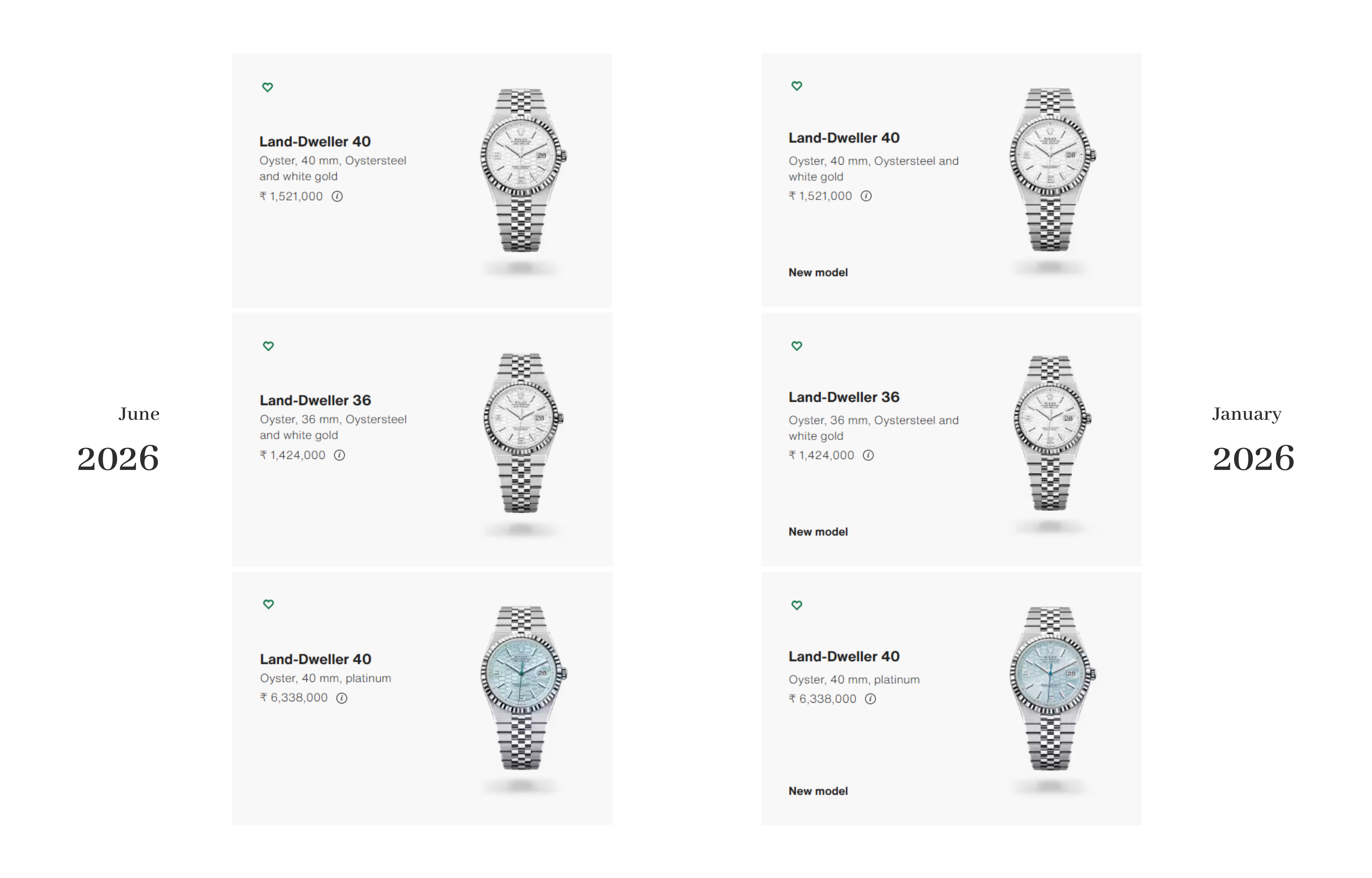
Land-Dweller 36 | Oystersteel & White Gold | 14,24,000 | 14,24,000 | 0 | 0.00% |
Land-Dweller 40 | Oystersteel & White Gold | 15,21,000 | 15,21,000 | 0 | 0.00% |
Land-Dweller 40 | Everose Gold | 47,77,000 | 50,16,000 | 2,39,000 | 5% |
Land-Dweller 36 | Everose Gold & Diamonds | 91,56,000 | 96,15,000 | 4,59,000 | 5.01% |
Analysis: The steel-and-white gold models (the “entry” Land-Dwellers) are untouched. However, the full-Everose variants saw a surge of about 5%. This is a clear signal from Geneva: the new platform commands a premium, and the cost of the gold case and bracelet is subject to immediate commodity recalibration.
Section 2: The Submariner - The Icon’s Two-Tone and Gold Reckoning
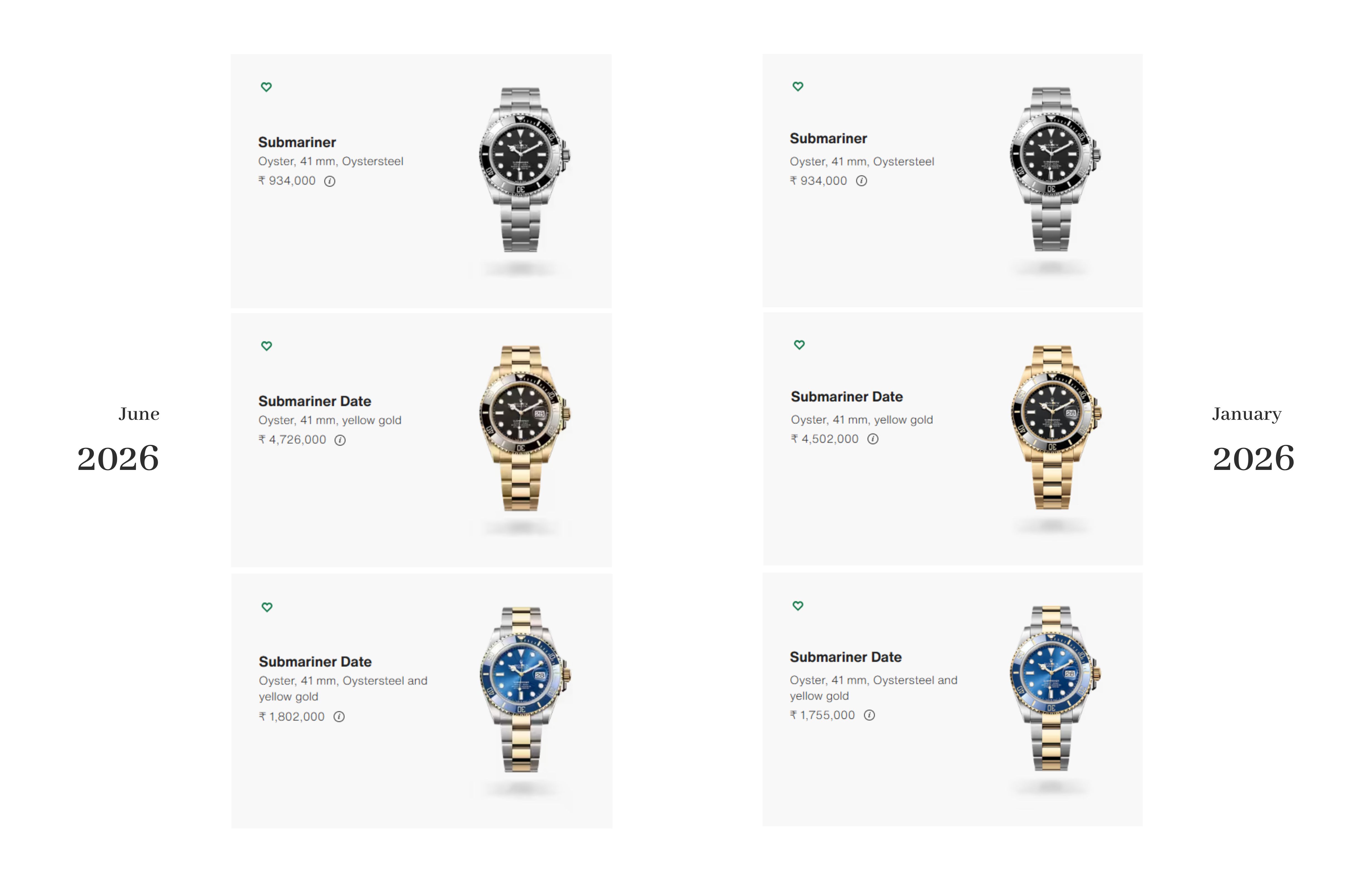
The Submariner, as the brand’s volume icon, offers the most transparent view of Rolex’s pricing logic. The pure Oystersteel Submariner (Ref. 124060) and the steel Submariner Date (Ref. 126610LN) remain at ₹934,000 and ₹1,051,000 respectively. Stability for the purist. However, the luxury variants tell a different story.
Model | Material | January 2026 Price (₹) | June 2026 Price (₹) | Absolute Increase (₹) | Percentage Change |
Submariner Date | Oystersteel & Yellow Gold | 17,55,000 | 18,02,000 | 47,000 | 2.68% |
Submariner Date | Yellow Gold | 45,02,000 | 47,26,000 | 2,24,000 | 4.98% |
Analysis: The two-tone “Bluesy” and its full-yellow gold sibling saw increases of 2.68% and 4.98% respectively. Compared to the Land-Dweller’s 5%, the Submariner’s adjustment is muted. This suggests Rolex is exercising restraint on its high-volume, high-recognition pieces to avoid alienating the core enthusiast base, while passing costs on newer, lower-volume models.
Section 3: The Other Professionals - GMT-Master II and Cosmograph Daytona
The professional catalog reveals a staggered approach. The GMT-Master II, beloved for its travel functionality, and the Cosmograph Daytona, the brand’s halo chronograph, saw increases that perfectly map to their gold content.
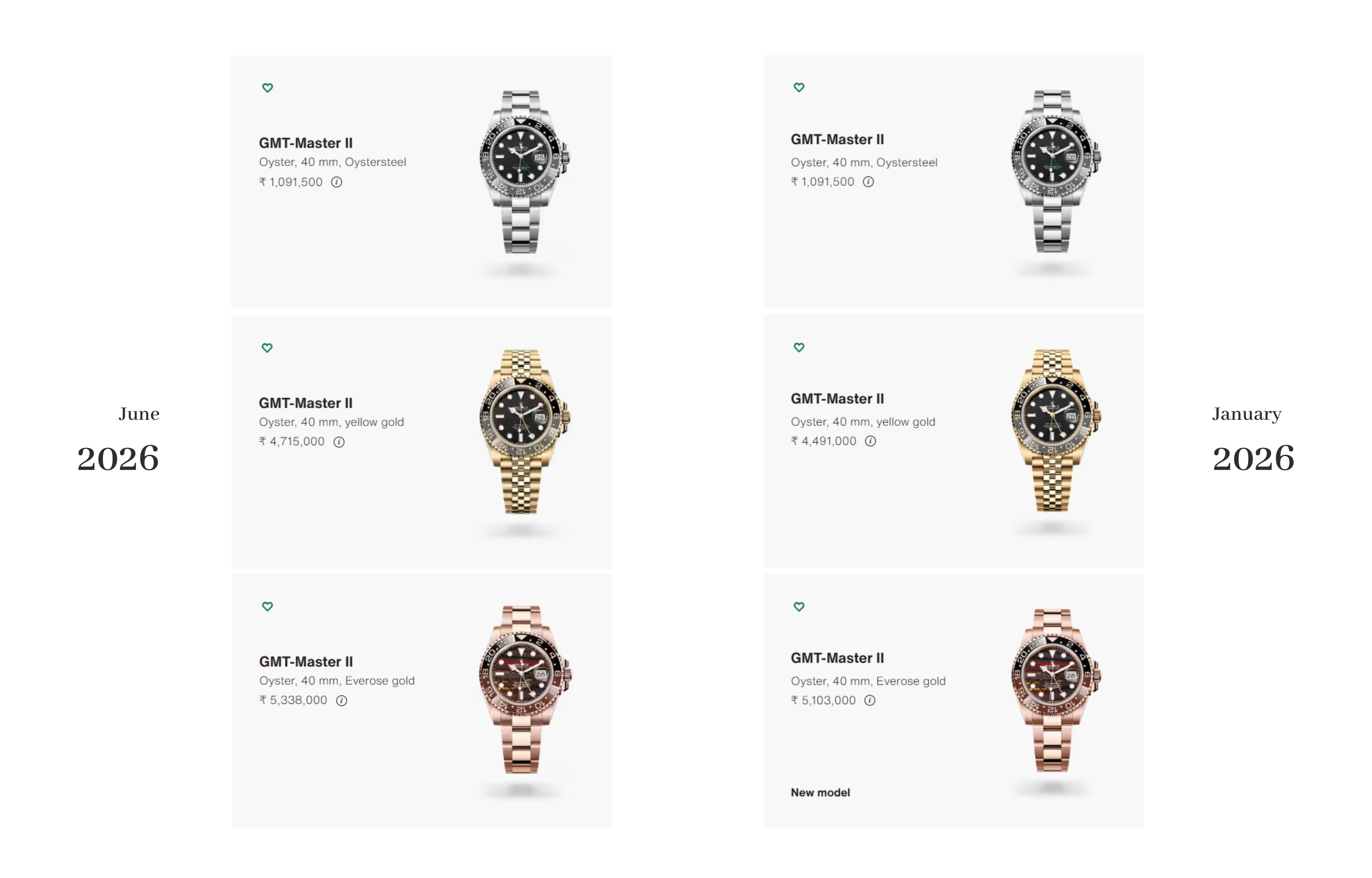
GMT-Master II
Model | Material | January 2026 Price (₹) | June 2026 Price (₹) | Absolute Increase (₹) | Percentage Change |
GMT-Master II | Oystersteel & Everose Gold | 18,17,000 | 18,63,000 | 46,000 | 2.53% |
GMT-Master II | Everose Gold | 46,95,000 | 49,30,000 | 2,35,000 | 5.01% |
GMT-Master II | Oystersteel & Yellow Gold | 18,48,000 | 18,93,000 | 45,000 | 2.43% |
GMT-Master II | Yellow Gold | 44,91,000 | 47,15,000 | 2,24,000 | 4.99% |
Cosmograph Daytona
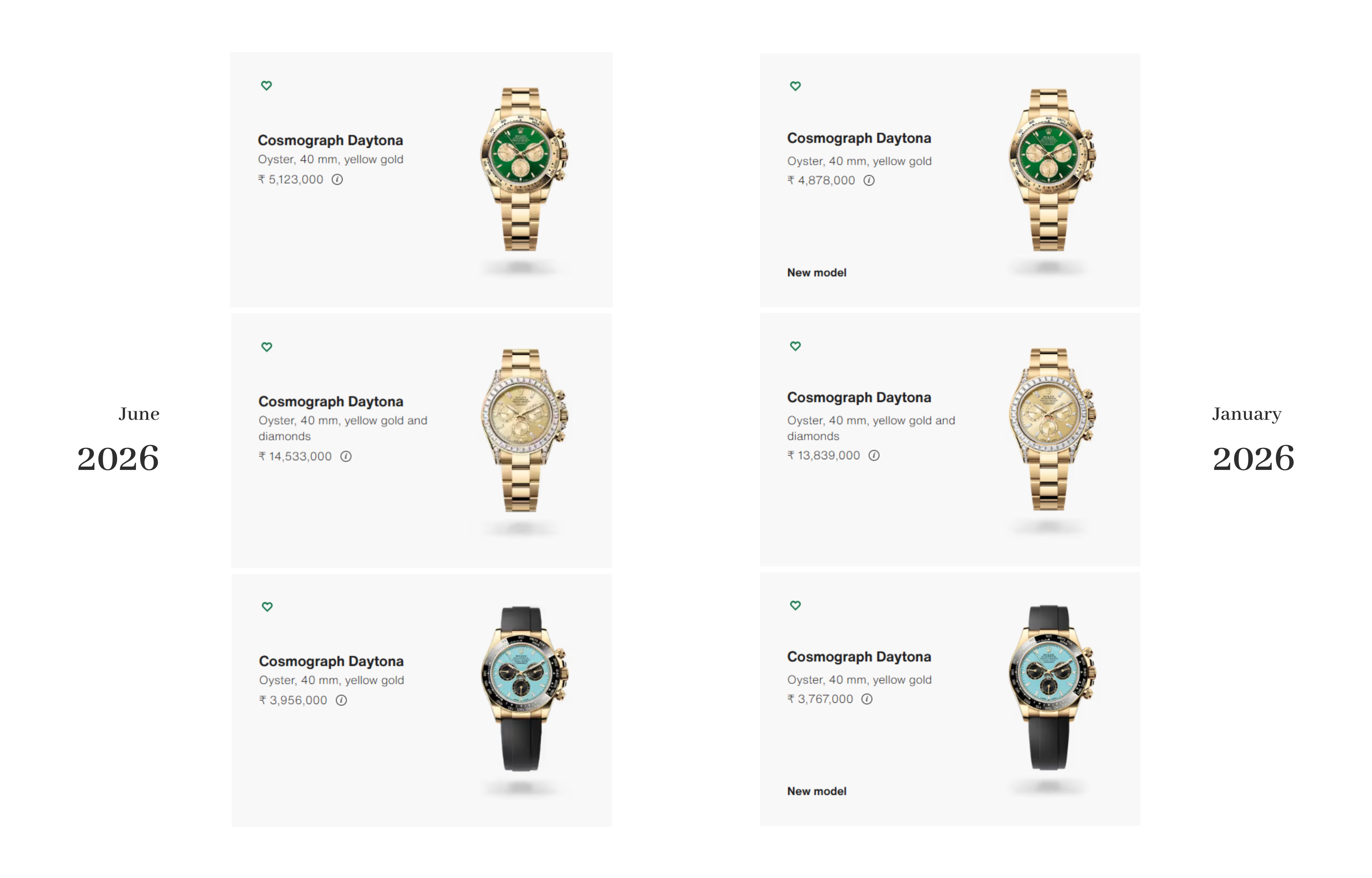
Model | Material | January 2026 Price (₹) | June 2026 Price (₹) | Absolute Increase (₹) | Percentage Change |
Cosmograph Daytona | Yellow Gold (Oysterflex) | 37,67,000 | 39,56,000 | 1,89 ,000 | 5.02% |
Cosmograph Daytona | Yellow Gold (Bracelet) | 48,78,000 | 51,23,000 | 2,45,000 | 5.02% |
Analysis: The GMT line shows a distinct pattern: Rolesor models were raised by ~2.5%, while full-gold models jumped by ~5%. The correlation to gold weight is undeniable. The Daytona, even on an Oysterflex strap (which reduces metal weight), saw a 5.02% increase, suggesting that the demand premium for the Daytona name allows Rolex to apply the full gold surcharge without hesitation.
Section 4: The Classic Apex - Day-Date 36 And Day-Date 40
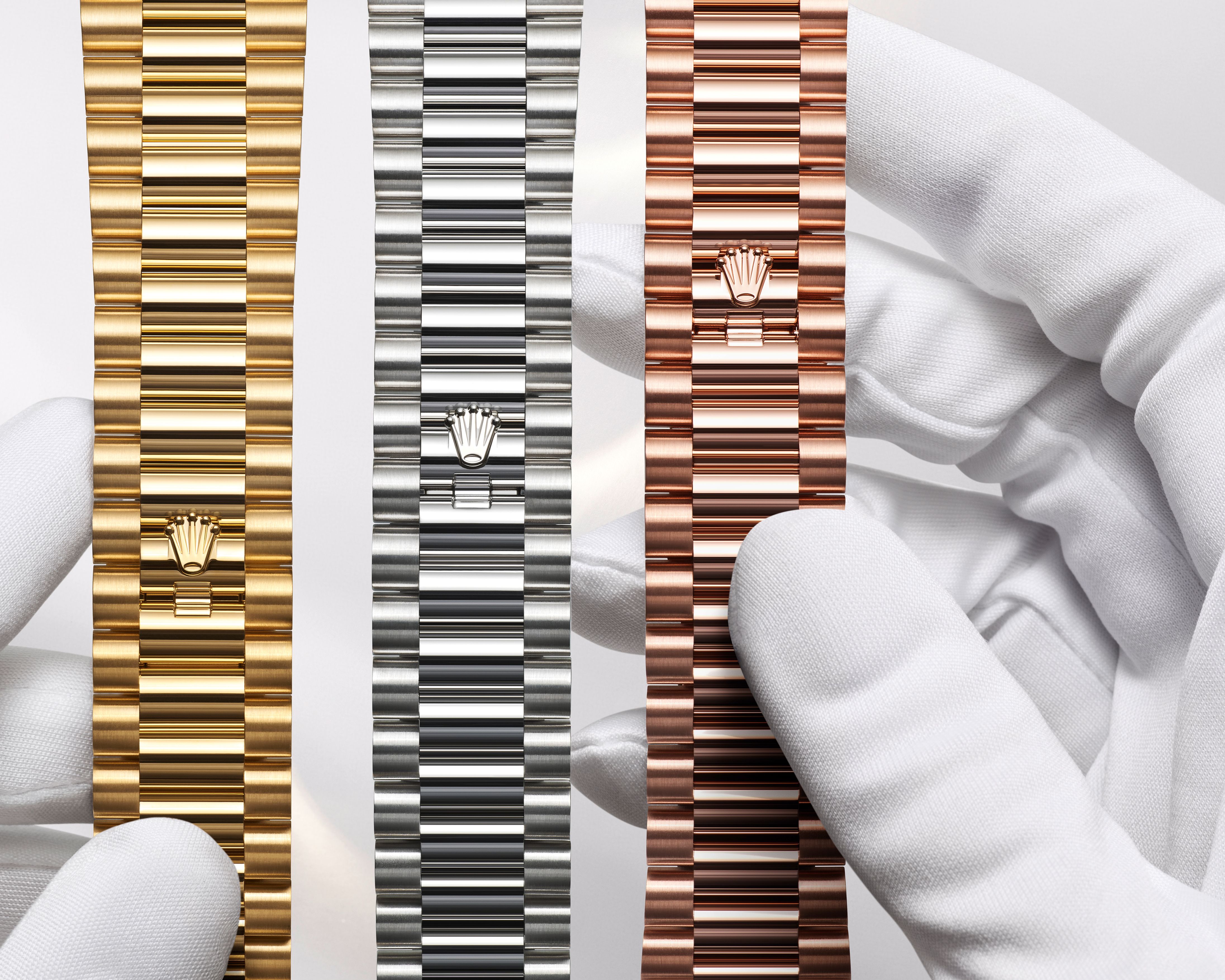
The Day-Date is, and has always been, the collection that best embodies Rolex’s precious metals universe. Offered exclusively in 18-carat yellow gold, white gold, Everose gold, and platinum - and worn on a President bracelet - the Day-Date is the instrument through which the Crown’s gold-market exposure is most directly channeled. The June 2026 revision accordingly hits the Day-Date with full force.
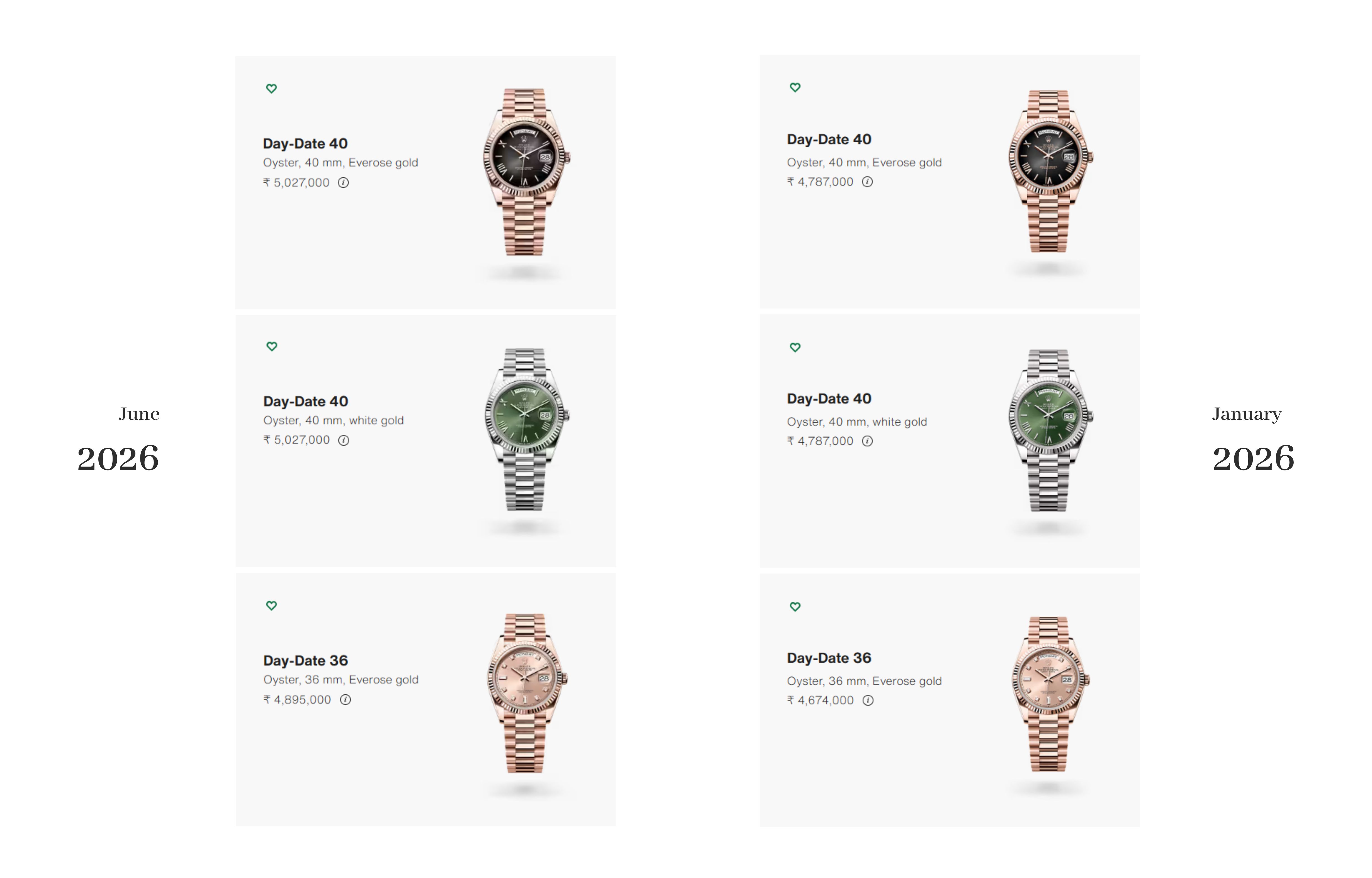
The Day-Date 36, Rolex’s original presidential-size configuration, has seen broad increases across all metal types. The yellow gold Day-Date 36 moves from ₹40,52,000 to ₹42,56,000 - an increase of approximately ₹2,04,000 or 5.03%. The Everose gold version moves from ₹46,74,000 to ₹48,95,000, also approximately 4.73%. Diamond-set versions command even steeper increases in absolute rupee terms, given their higher base prices.
The Day-Date 40, the larger presidential reference, moves similarly. Yellow gold Day-Date 40 models - the flagship of the collection - step up from ₹44,50,000 to approximately ₹46,75,000 across various configurations. The most expensive gold Day-Date 40 configurations in India - full yellow gold with diamond-set dials and bezels approaches ₹1,26,41,000 in June 2026 pricing.
A Maturity in Market Strategy
The June 1, 2026 adjustments are not reflective of a panicked reaction to market downturns - rather, they signal a maturity in Rolex’s financial governance. By selectively inflating the retail cost of precious metal references while holding steel steady, the brand effectively manages its status as an aspirational good.
For the collector, this serves as a reminder of the shifting valuation of precious metals. As we look toward the remainder of 2026, the delta between the “accessible” professional models and the “exclusive” precious metal models continues to widen, signaling a trend that will undoubtedly influence both the primary retail market and the secondary pre-owned market for the time to come.


