
 9 min read


The name OMEGA doesn’t always resonate with vintage. It is however a known fact that in 1913, OMEGA released its first wrist-chronograph (perhaps the world's first). It was a ground-breaking design that epitomised the brand's pioneering spirit and contributed to forever altering the watchmaking industry.
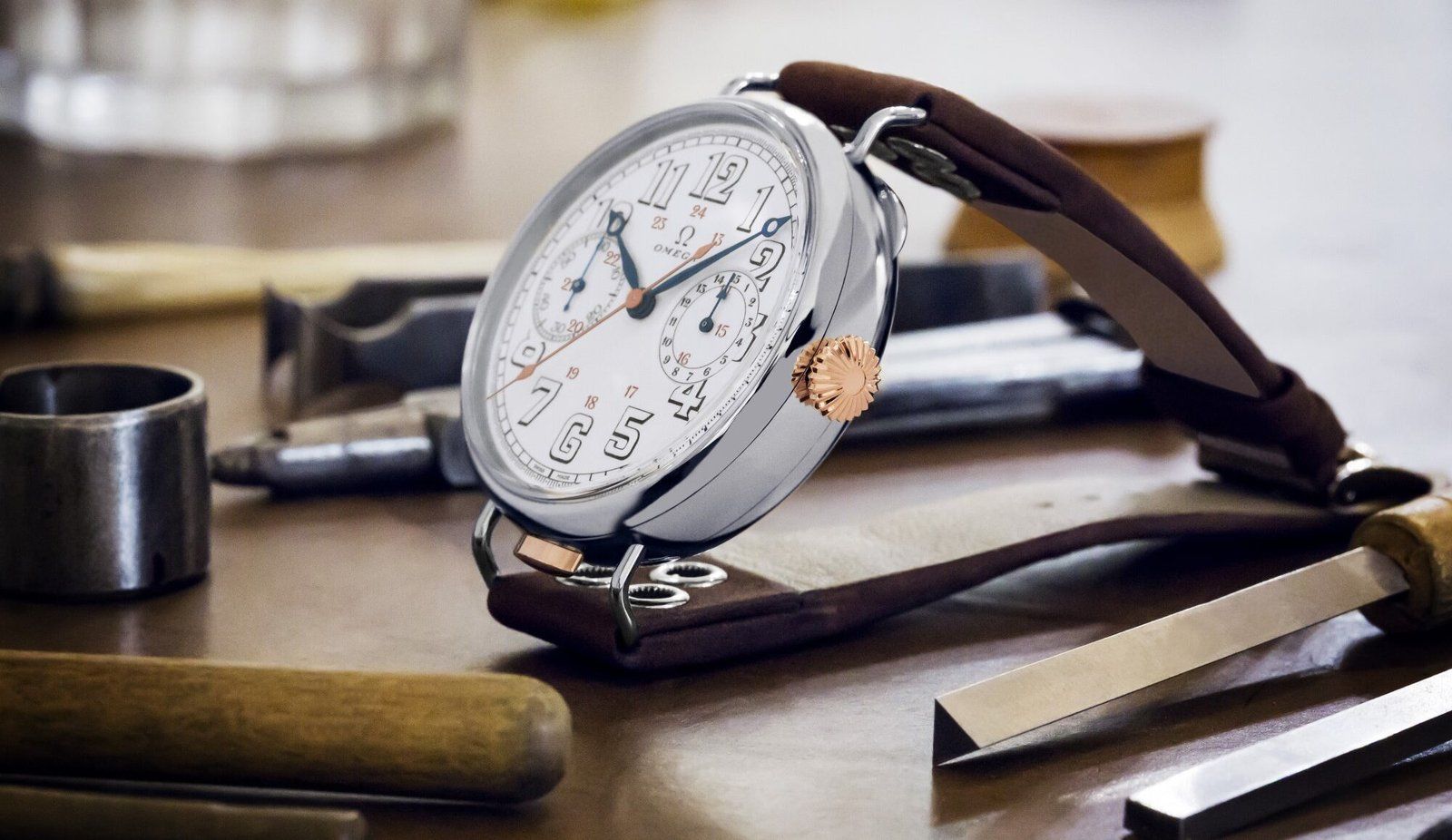
First OMEGA Wrist-Chronograph Limited Edition
The brand returned to that pivotal period, renovating 18 original movements from the era for a truly unique collection and dubbed the "First OMEGA Wrist-Chronograph Limited Edition."
The treasured calibres have been tastefully reconditioned by the professionals at OMEGA's Atelier Tourbillon.
The treasured calibres have been tastefully reconditioned by the professionals at OMEGA's Atelier Tourbillon and given a brand new lease on life after being retrieved from original timepieces within the vaults at the OMEGA museum.
Riveted leather band and the white enamel dial with blued "Empire" hands and hollow Arabic numerals.
During the First World War, this particular design was popular among military men. The easy-to-read dial design and 15-minute counters drew aviators in particular, making it suited for the most difficult missions.
A hatched caseback, which can be flipped open to reveal the movement hidden behind sapphire crystal, completes the classic design.
The restoration of the movement
Each of the 18 movements was distinct in its own right. Because each of the little parts had their own specific characteristics, the watchmakers had to start with different calculations and analyses for each movement's refurbishing.
Blueprints for the movement’s restoration
For each movement, new components and blueprints were created. The watchmakers calculated which replacement pieces were needed and made them according to their calculations.
As part of the quality control procedure, the new parts were thoroughly inspected. The cutting-edge camera system was able to take precise measurements to guarantee that each part was up to grade.
The cutting-edge camera system was able to take precise measurements to guarantee that each part was up to grade.
They were able to use a topping tool to round off the teeth of the wheels and establish perfect engagements between the gears after completing a precise inspection. The 3/4 bridge was then built to double-check the depth of the gears once this phase was completed and the wheels were now precisely aligned. The original OMEGA logo can easily be seen in the photos. The original serial number was also kept and can be seen on the mainplate, however, it was re-engraved for enhanced legibility.
The topping tool
OMEGA had to make sure the new gems fit perfectly because they were used in the movement. A Jig-Borer was used to bore or re-bore all of the holes on the mainplate and bridges in order to accomplish this. The new jewels had to work in tandem with the existing pivots. As a result, the pivots were burnished with a Jacot tool.
A Jig-Borer was used to bore or re-bore all of the holes on the mainplate and bridges.
The Grand Feu technique
The engravings were filled in with black enamel, which was smoothed over the plate.
A silicon stamp reached down at this point and picked up the black enamel display from the plate, transferring it to the white enamel dial. The dial was then baked again to blend the colours. The red enamel on the dial was created using the same procedure.
The Petit Feu technique
Restoration of the subdials
The Presentation Box
OMEGA is known for its classic chronographs, which have been trusted in settings as diverse as the ocean and space throughout history. They not only have a rich history, but they also represent the finest levels of quality, functionality, and craftsmanship in the watchmaking industry. Today, an OMEGA chronograph is unquestionably a jewel that every watch collector should possess.


