
Why Tissot’s India Story Reflects a Structural Shift in Global Watchmaking?
 6 min read

Part-I of a Four-Part Research Series
India has become one of the few genuine outliers in a slowing global Swiss watch industry, and Tissot is one of the cleanest, data-backed ways to see that shift.
India’s outlier status in a slowing Swiss watch world:
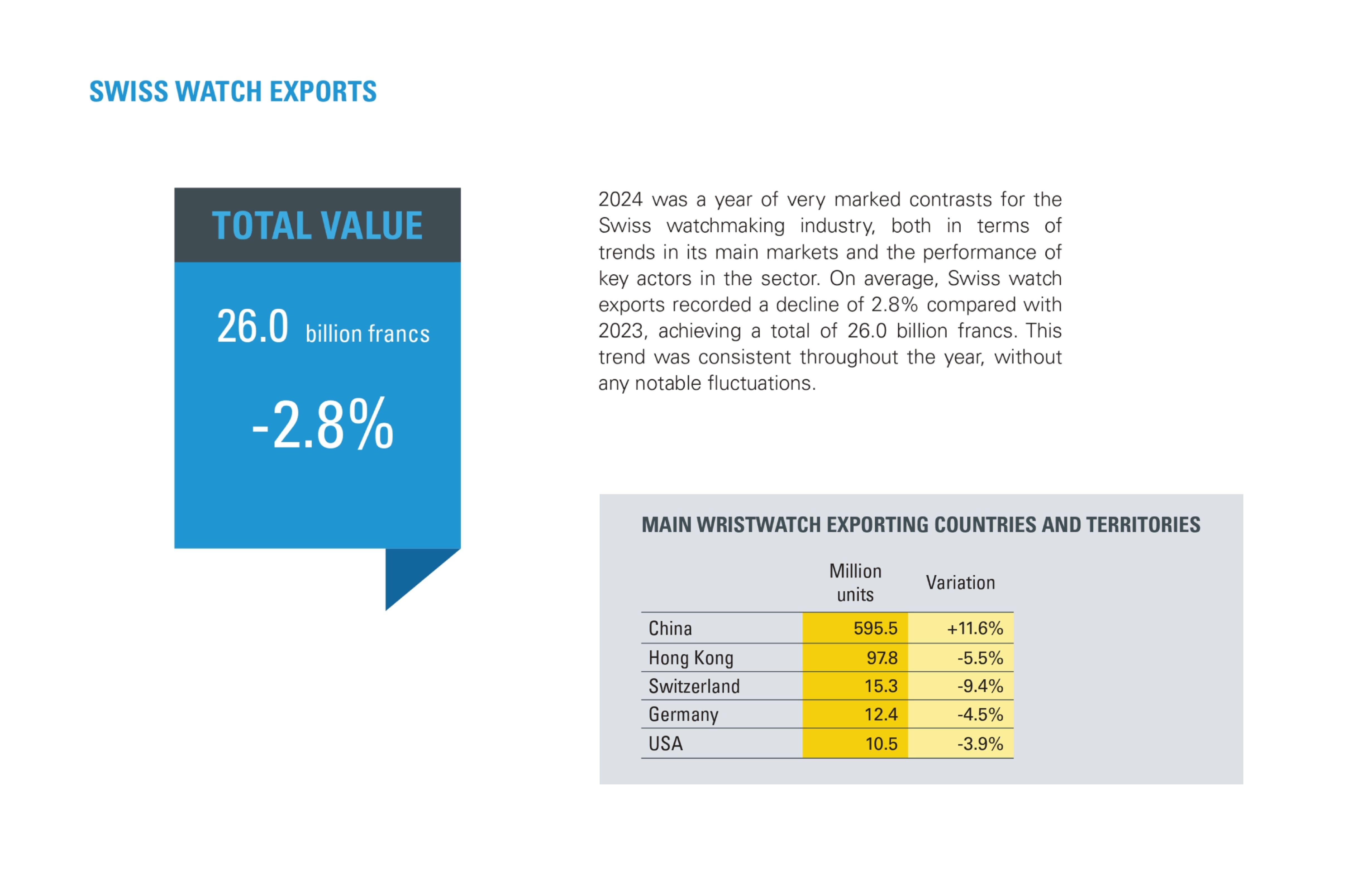
Swiss watch exports as a whole entered a cooling phase in 2024. According to the Federation of the Swiss Watch Industry (FH), total exports fell by about 2.8% in value that year, to roughly 26 billion Swiss francs, after three years of steady growth.
The Federation of the Swiss Watch Industry FH data shows that this slowdown was driven largely by Asia, with exports to China shrinking by around 25.8% and Hong Kong also posting a sharp double-digit decline, while Europe remained broadly flat and the United States grew modestly.
Within that picture, India stands out as a statistical anomaly.
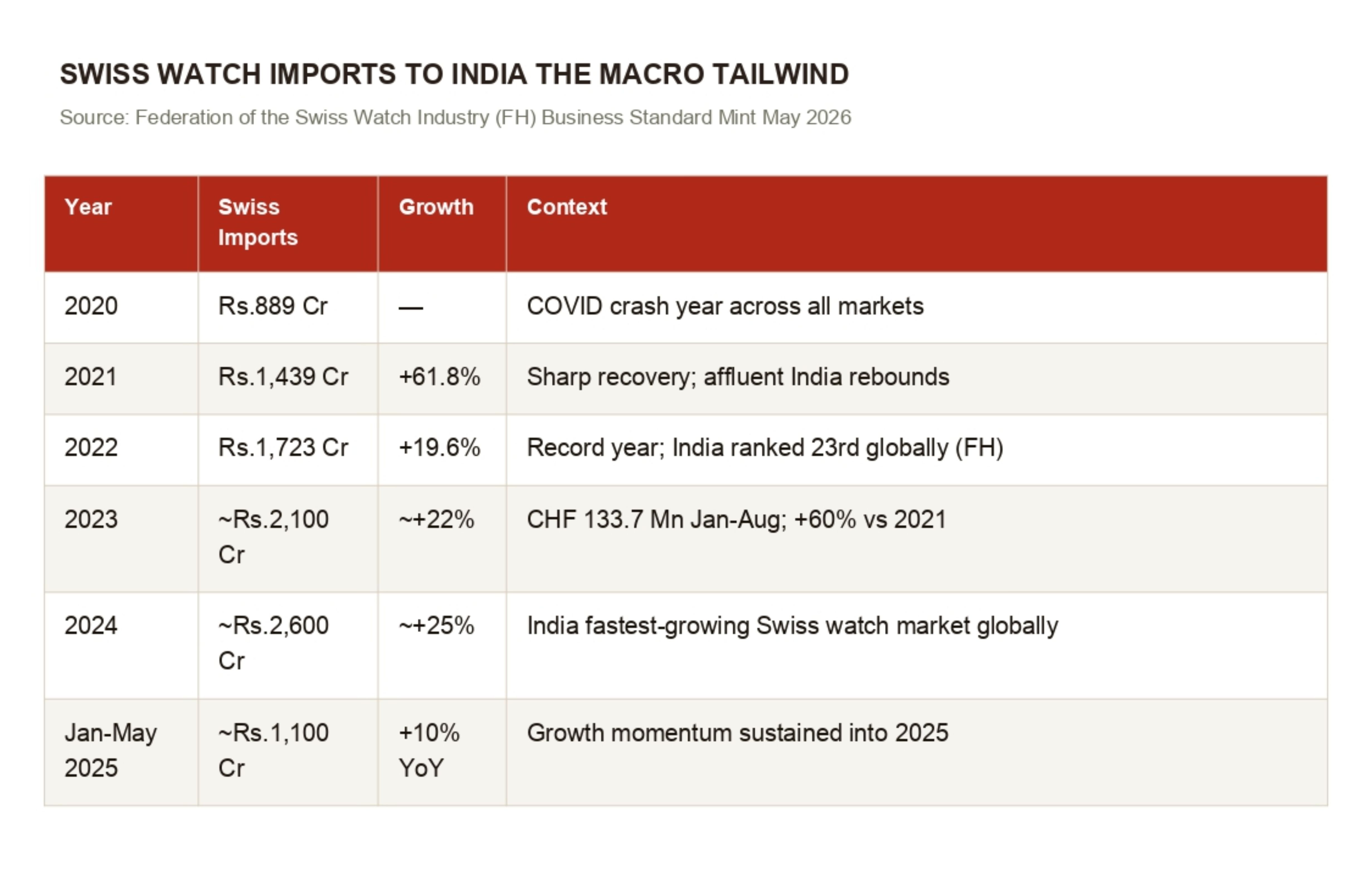
According to the data published by FH, Swiss watch imports into India rose from about Rs.889 crore in 2020 to around Rs.1,439 crore in 2021, Rs.1,723 crore in 2022, roughly Rs.2,100 crore in 2023 and approximately Rs.2,600 crore in 2024, implying annual growth of about 25% in 2024 alone.
The same data points out that while China and Hong Kong were shrinking, India was the fastest‑growing market for Swiss watch exports globally, and is on course to move from 23rd in the global ranking in 2022 into the top ten within a decade. For an in-depth insight into India's ascent, click here.
Deloitte’s “Swiss Watch Industry Insights 2024: Spotlight on India” reinforces this picture of asymmetry. The study flags India as the “next major growth market” for Swiss watch brands, driven by rapid expansion of the middle and upper-middle classes, rising urban incomes, and growing awareness of Swiss brands among younger consumers.
Deloitte notes that India is still a relatively small market in absolute value compared to the US or China, but is one of the very few large economies where structural demand for Swiss watches is growing off a low base even as some legacy markets stagnate or contract.

Swiss Watch Exports – Global Cooling, India Acceleration
Metric (2025) | Value / Change |
Global Swiss watch exports | −1.7% vs 2024, CHF 25.6 bn |
Exports to US | −0.5 % |
Exports to China | −12.1% |
Swiss watch imports to India (value) | ~Rs.3,500 crore (approx.) |
India Swiss-import growth (2025) | ~+21% year‑on‑year |
India’s projected global rank (FH) | From 23rd (2022) toward top 10 in 10 yrs |
In other words, at a time when the global Swiss watch engine is losing momentum, India is one of the only large markets where demand is not just resilient but accelerating. For the metrics highlighting Swiss watch exports to India, click here.
Tissot’s India Numbers: A Compounding Curve, Not A One-Off Spike
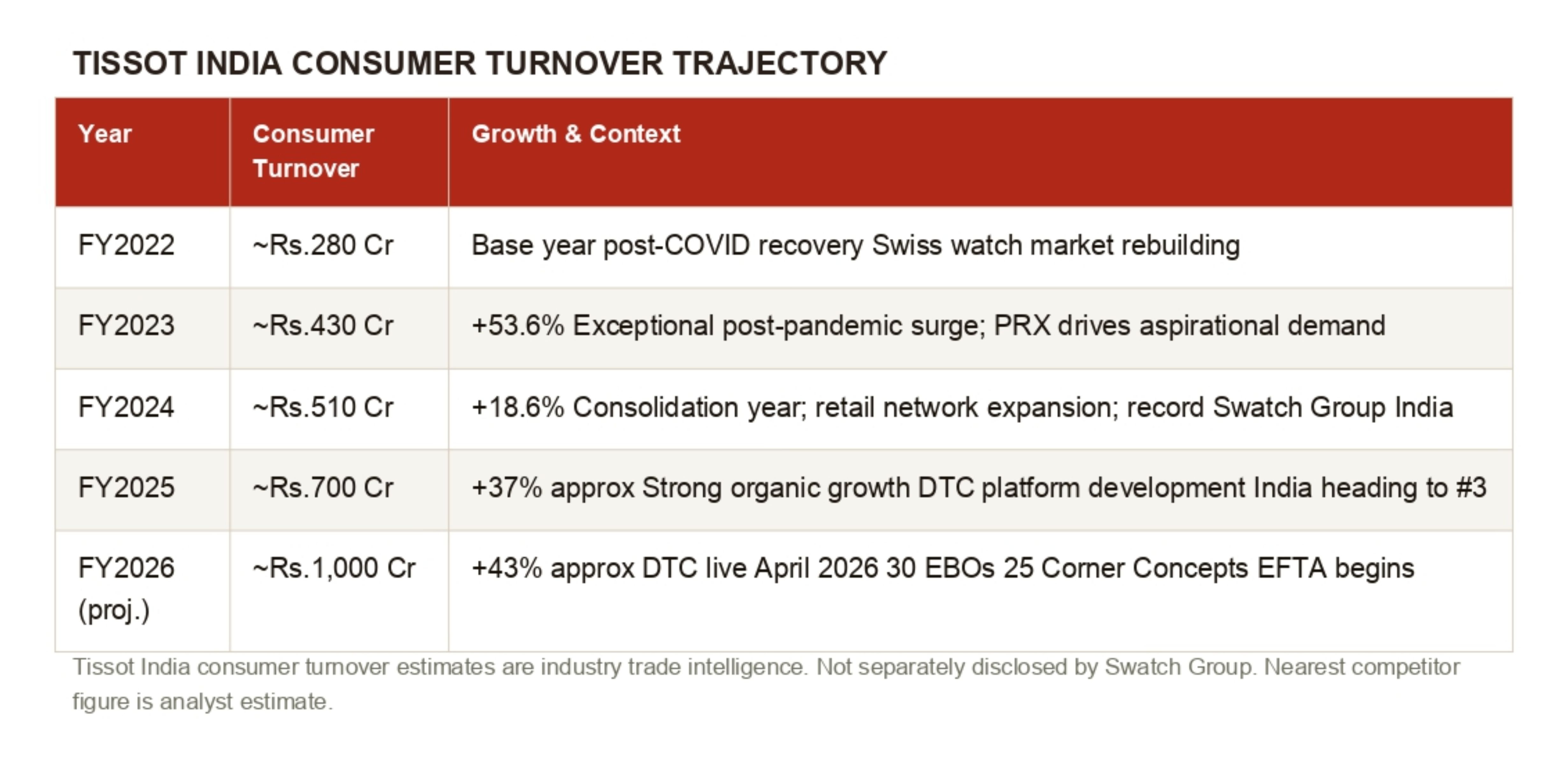
Tissot’s India numbers give a rare, quasi‑P&L view of a single Swiss brand’s performance in this environment. The data estimates Tissot India’s consumer turnover at about Rs.280 crore in FY2022, Rs.430 crore in FY2023, roughly Rs.510 crore in FY2024 and approximately Rs.700 crore in FY2025, with an estimated Rs.1,000 crore in FY2026.
That path translates into a three‑year CAGR of roughly 35.7% between FY2022 and FY2025, and a four‑year CAGR of about 37.5% between FY2022 and FY2026 (estimated) - numbers that would be impressive for an insurgent, let alone an incumbent market leader.
What makes this particularly notable is the pattern of growth.
- FY2023 is described as a post‑pandemic surge year, with turnover jumping to about Rs.430 crore on the back of PRX‑led aspirational demand. Read an interesting detail about the Tissot PRX here.
- FY2024, at around Rs.510 crore, is framed as a “consolidation year,” where growth moderates as the brand invests in retail network expansion.
- FY2025 then marks a renewed acceleration to roughly Rs.700 crore, driven by strong organic demand and the build‑out of a direct‑to‑consumer e‑commerce platform ahead of its April 2026 launch.
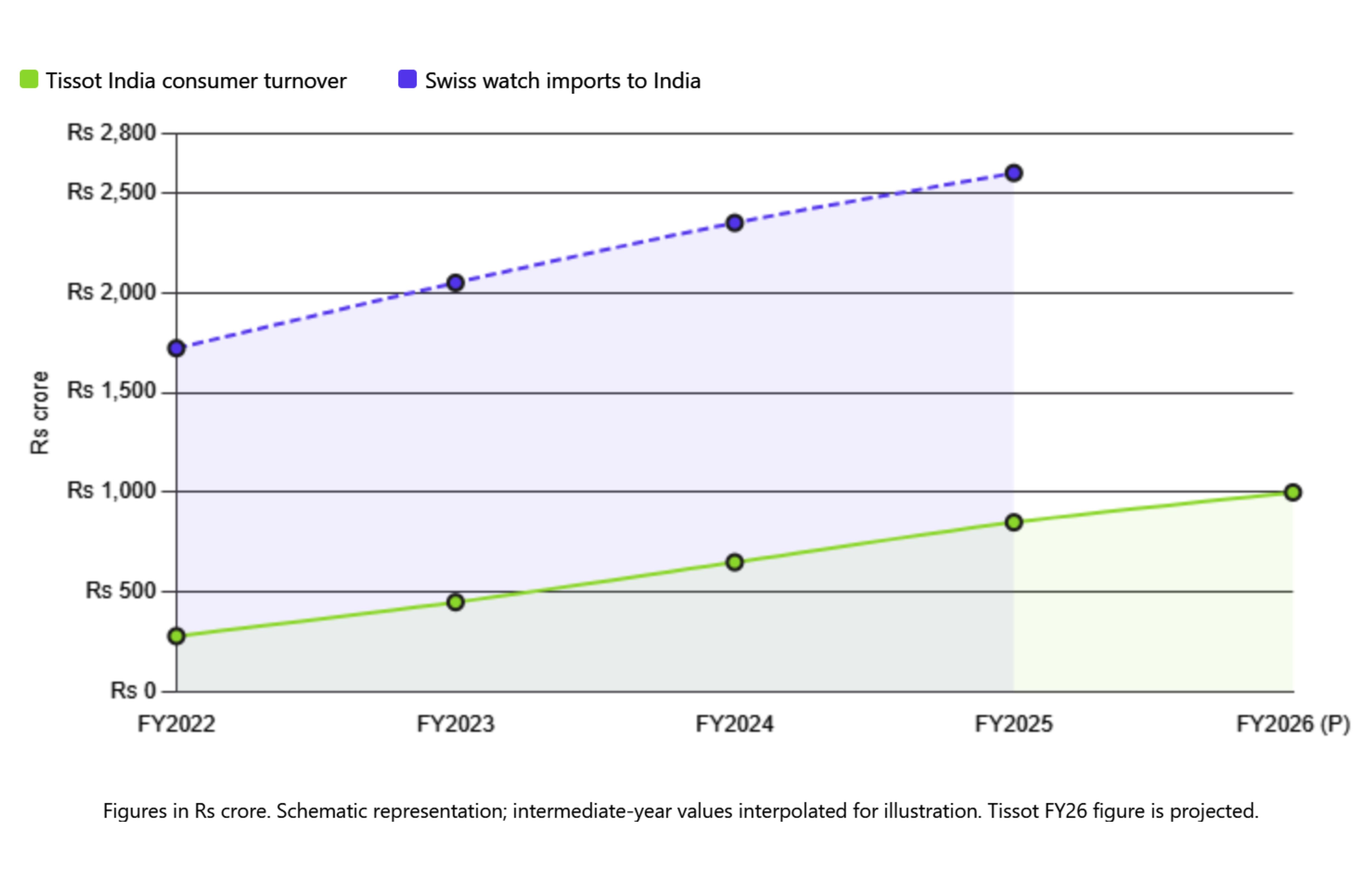
Visually, both curves slope upwards, but Tissot’s line is steeper: its India business is compounding faster than the overall Swiss inflow into the country.
The numbers further highlight that:
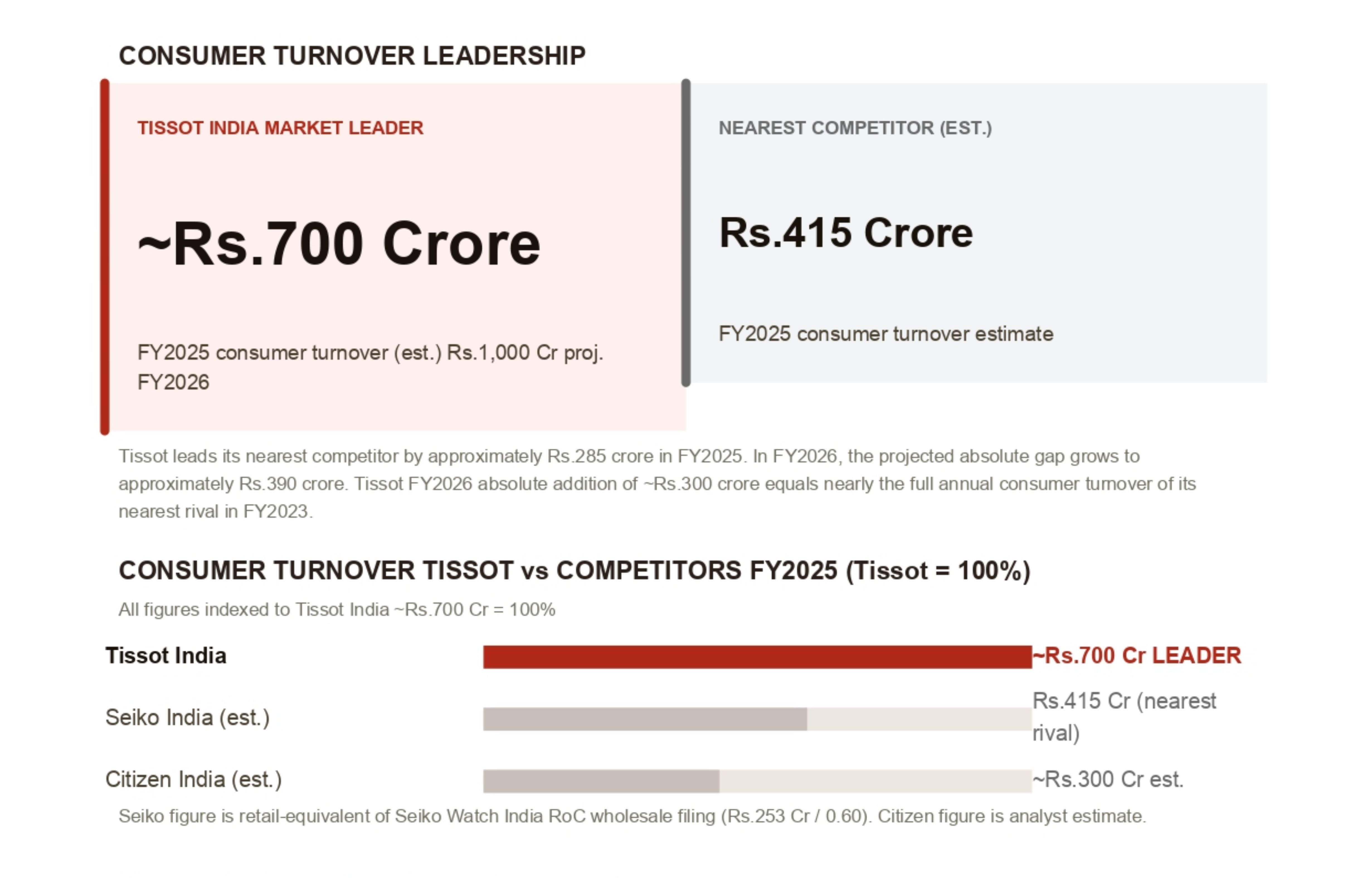
- Tissot is the market leader in its tier with an estimated FY2025 turnover of around Rs.700 crore, compared to an estimated Rs.415 crore for the nearest competitor and roughly Rs.300 crore for another key rival, implying a lead of about Rs.285 crore in FY2025.
- If Tissot reaches roughly Rs.1,000 crore in FY2026, the gap with the nearest competitor would widen to around Rs.390 crore, and that the brand’s single‑year addition of about Rs.300 crore would be almost equivalent to that rival’s entire 2023 turnover.
In the context of FH and Deloitte’s findings - that global exports are cooling, Asia is mixed, and India is still a mid‑tier market by absolute value - Tissot’s India numbers look less like a rising tide and more like a leveraged bet on one of the few rising rivers.

What Tissot’s India Trajectory Signals For The Future?
Taken together, the data suggests a clear pattern:
- Globally, the Swiss watch industry is entering a more mature, possibly flatter phase, with pockets of contraction in once‑hyper‑growth markets like China.
- India, by contrast, is one of the few large economies where both Swiss imports and the wider luxury watch market are expanding and where growth is driven not just by the ultra‑rich but by a widening base of upper‑middle‑class consumers.
- Within that environment, Tissot’s India business is compounding at rates that far exceed both the global market and the domestic category, making it a case study in how a brand can turn an emerging market into a core growth pillar.
For the broader Indian watch industry, Tissot’s curve poses both a challenge and a template. Domestic players that have historically dominated volume at lower price points will face a more competitive landscape at the mid‑premium tier, as brands like Tissot blend Swiss values with Indian‑specific distribution and digital strategies.

Other Swiss brands, particularly those without the backing of a large group or a differentiated technology story, will need to decide whether to invest in infrastructure and price architectures that match Tissot’s level of localization, or remain content with opportunistic participation in India’s growth.
For Tissot itself, the implication is that India is no longer a “future market” or a “potential,” but already a functional growth engine whose performance can materially influence global results. The numbers reported are more than local success metrics. They are hard evidence that when global demand splinters, the center of gravity shifts to where brands have the courage and discipline to build early.
In that sense, India’s outlier status in Swiss watch exports is not an abstract macro story. It is written, very concretely, in the curve of one brand and in the wrists of the millions of people Tissot now equips with Swiss watches that carry the values of precision, innovation and tradition from Le Locle to India.