Watches And Wonders 2026: Chopard Alpine Eagle 41 XPS And L.U.C 1860 Review
 9 min read

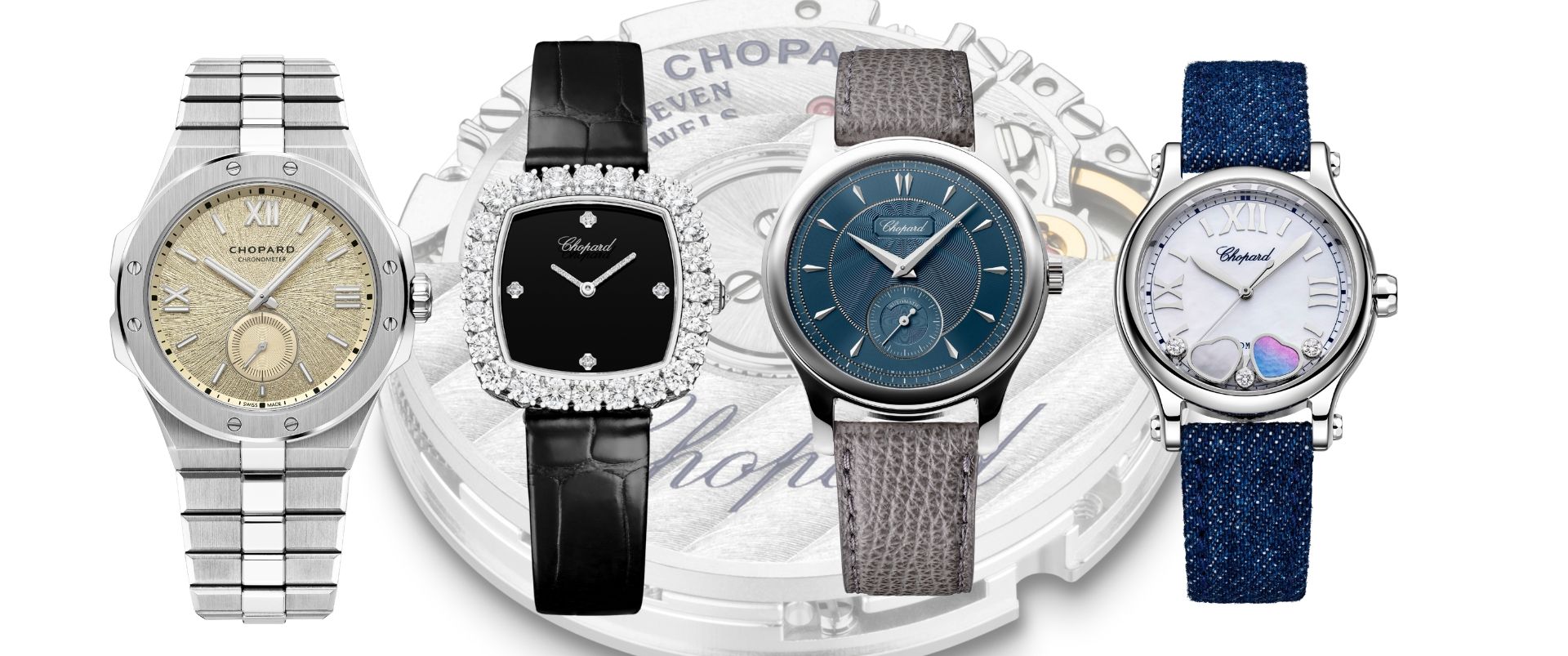
There's a version of Chopard that casual observers know: Happy Sport, red carpet, Cannes. It's not wrong, exactly, but it misses the other half of the house - a genuine manufacture in Fleurier that has been producing movements entirely in-house since 1996, holds both COSC chronometer certification and the Poinçon de Genève across its L.U.C line, and this year is celebrating thirty years of that operation with four watches that span hand-guilloché dress horology, an ultra-thin sports chronometer, a jewellery piece with floating diamonds, and a denim-strapped Happy Sport. That's a wide brief. The unifying argument across all of it is that Chopard has consistently done things the expensive, inconvenient way - building the movement, building the steel, building the bracelet - and 2026 is the year they're asking you to notice.
Chopard L.U.C 1860 Chronometer: Blue Dial, Same Blueprint, Still the Point
Pull up the 1997 L.U.C 1860 and the new one side by side. The 36.5mm case is unchanged. The proportions are unchanged. The small seconds at six, the clean symmetry, the absence of a date window - all intact. What Chopard has added is a dial colour called "Areuse Blue," named for the river that cuts through the Val-de-Travers gorge near the Fleurier manufacture. It's a specific, considered shade of deep blue, and it lands correctly on an 18-carat white gold dial that's been hand-guilloché with a sunburst pattern.
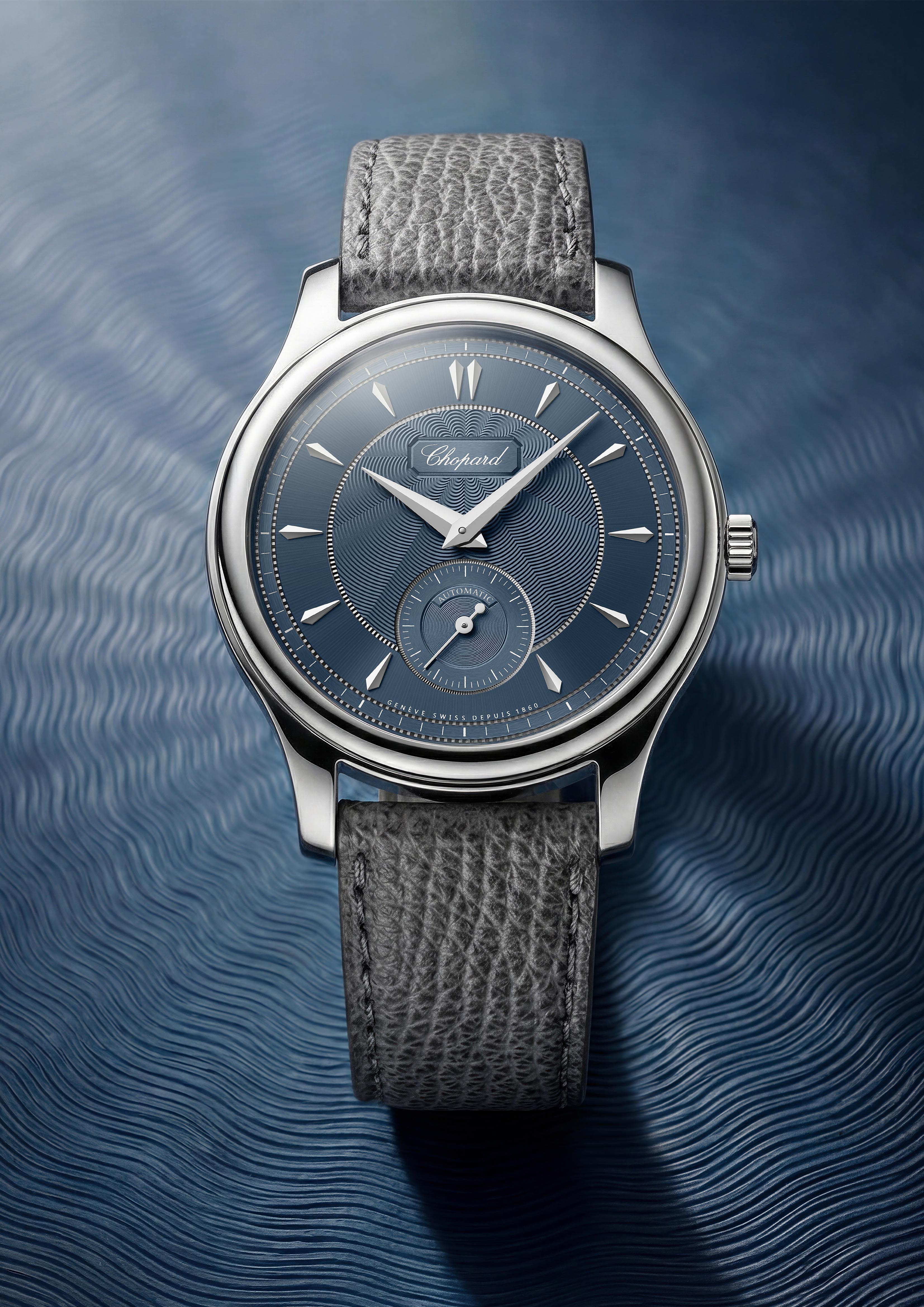
That guilloché matters more than the colour. Chopard's Metalem workshops, part of the group - run traditional lathes, some over a century old, operated entirely by hand. No digital guidance. The artisan controls the depth, speed and regularity of each pass manually, which produces a texture that a CNC machine technically cannot replicate because the slight human variation is the point. It adds light-interaction and three-dimensionality to the dial surface that a printed or applied finish simply doesn't achieve. Chopard has been doing this since the first L.U.C 1860, which makes them genuinely rare company. Around the guilloché centre: concentric guilloché rings, a satin-brushed chapter ring, polished white gold chevron markers, Dauphine hands. The composition has the kind of resolved quality that comes from not changing things that work. No date, deliberately, the layout is clean enough that adding one would have been a concession. The watch wears on an anthracite grey grained calfskin.
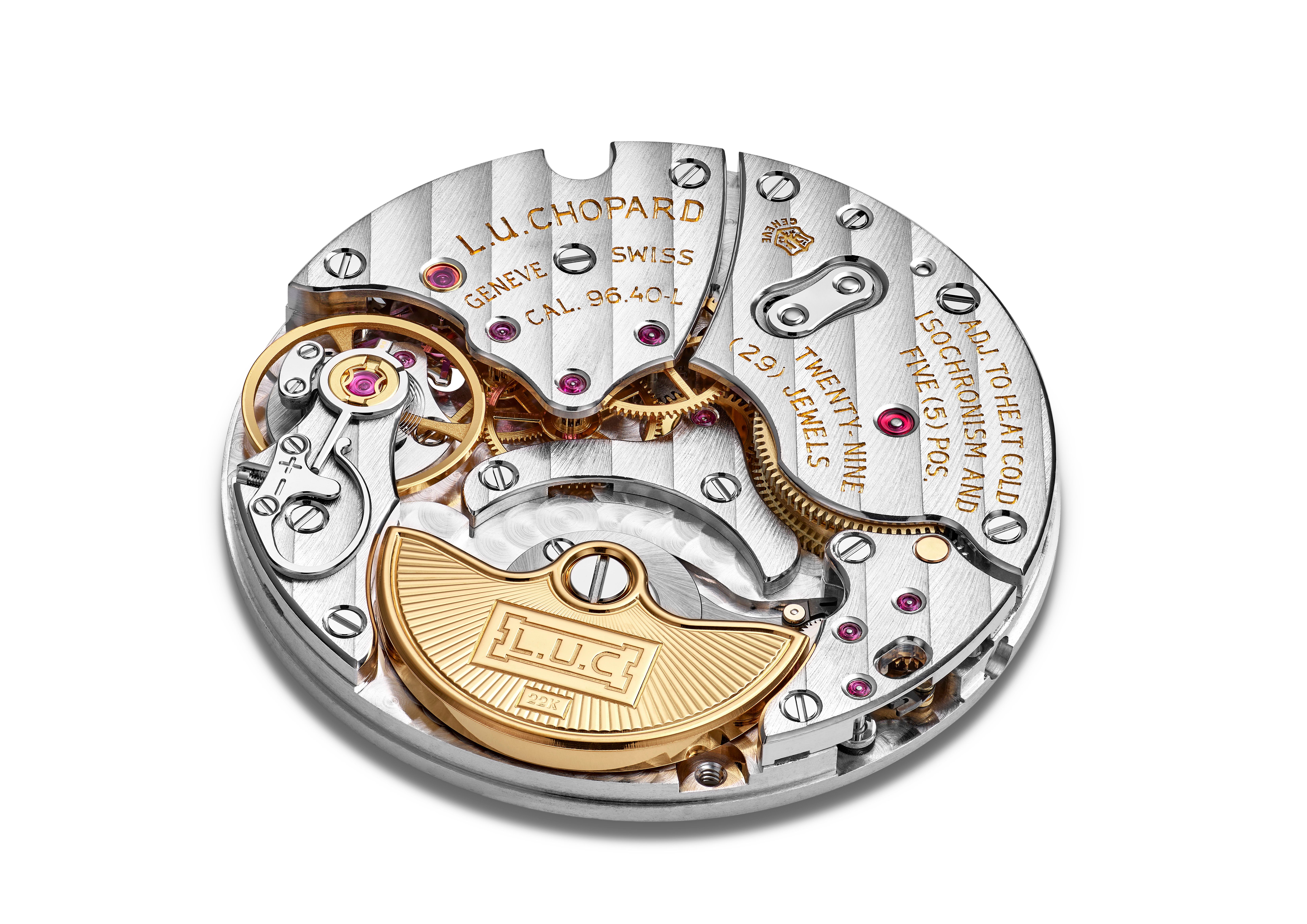
The movement is the L.U.C 96.40-L, a direct evolution of the calibre that launched this whole project in 1996. It is 3.30mm thick. The micro-rotor is 22-carat gold. Two stacked barrels run in parallel via Chopard Twin Technology, providing consistent energy output across a 65-hour power reserve without adding movement thickness. The balance carries a swan's neck regulator and Phillips terminal curve spring. COSC certification means 15 days of independent testing across five positions and three temperatures. Poinçon de Genève means the finishing meets one of watchmaking's oldest and most demanding third-party standards and doing that in Lucent Steel rather than gold is harder, because the material is less forgiving under finishing tools.
This is the watch Karl-Friedrich Scheufele said he imagined becoming a classic thirty years ago. It has.
Chopard Alpine Eagle 41 XPS "Mountain Glow": The Sports Watch With a Manufacture Pedigree
The Alpine Eagle origin story is worth knowing. In 1980, a young Karl-Friedrich Scheufele pitched his father on a steel sports watch, the St. Moritz, Chopard's first. Forty years later, his own son Karl-Fritz quietly encouraged him to revisit it. What came back was the Alpine Eagle, launched in 2019 with Lucent Steel, a proprietary alloy made with 80% recycled material, hypoallergenic, harder than standard steel, and visually closer to gold in the way it takes a polish. It was developed specifically for this collection and has since become the house standard for every steel Chopard produces. The XPS is the ultra-thin version. At 8mm thick and 41mm wide, it's a proper sports bracelet watch that wears like a dress watch. The new "Mountain Glow" dial is a champagne shade from galvanic treatment on brass stamped with the radiating eagle's-iris pattern, active in sunlight, calm indoors, and warmer in tone than the Monte Rosa Pink that launched this reference. The ethical white gold markers and Dauphine hands are Grade X1 SuperLumiNova-filled. The small seconds lives at six, the stop-seconds function is there for precision setting.
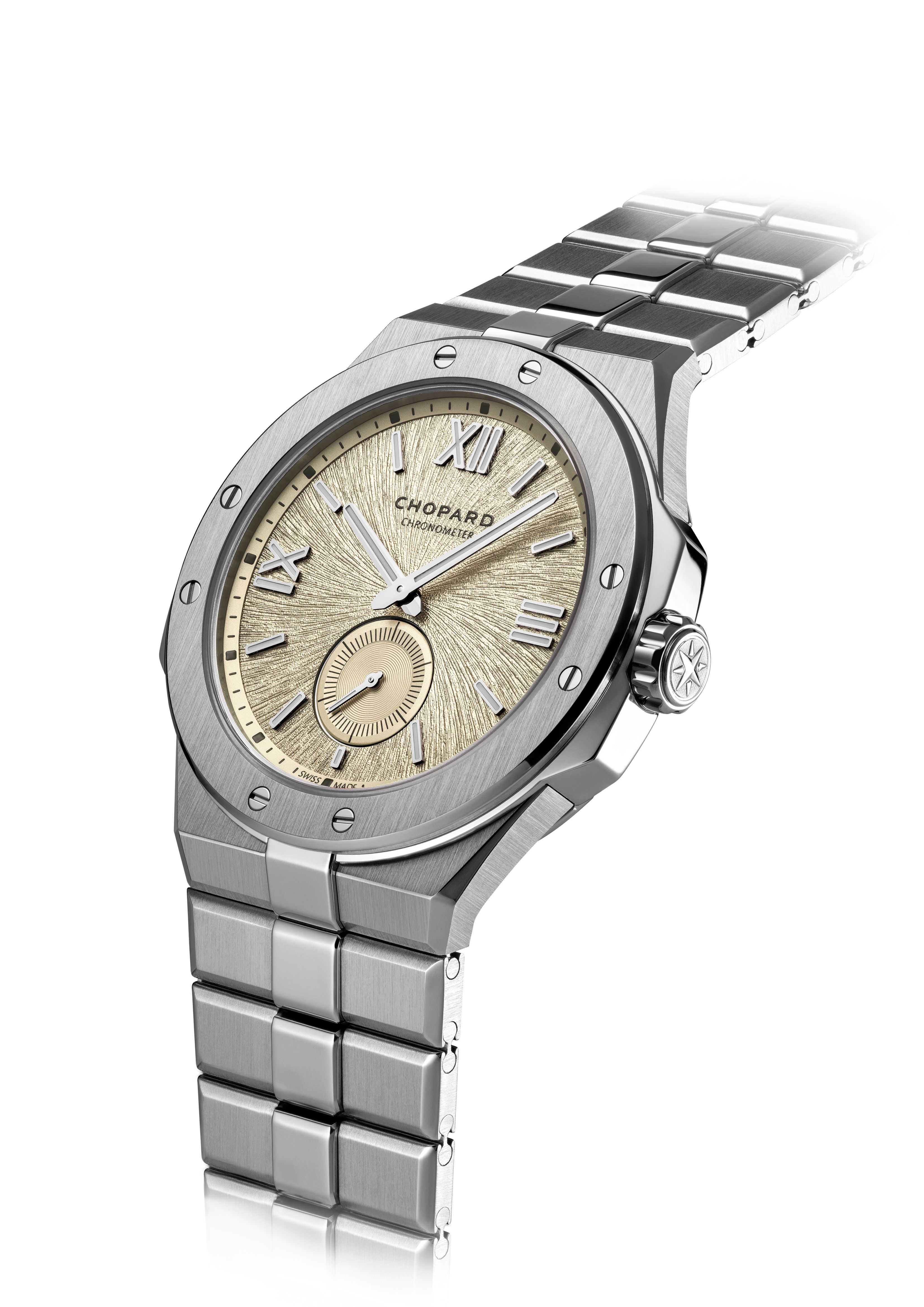
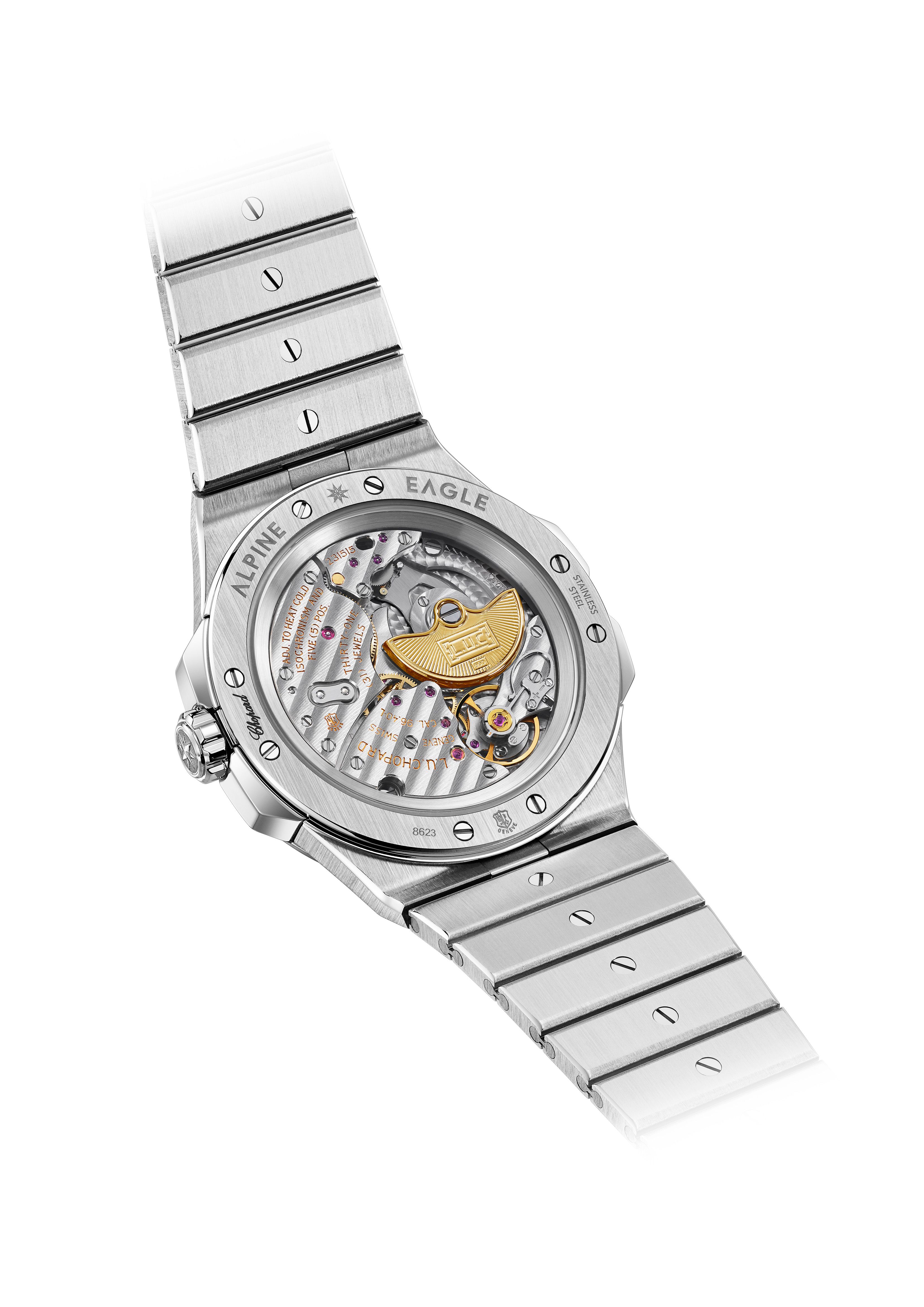
Inside: the same L.U.C 96.40-L as the 1860. COSC-certified. Poinçon de Genève. Twin Technology. 65-hour power reserve. 3.30mm movement thickness. This is the part that separates the Alpine Eagle from most of its integrated-bracelet sports watch contemporaries, the movement is genuinely serious, not adequate. That the caseback Poinçon de Genève emblem happens to show Geneva's coat of arms featuring an eagle is either a coincidence or very good planning. The bracelet has been redesigned. The first five links taper more sharply toward the case, visually reinforcing the thinness. Links narrow further approaching the clasp. The triple-fold clasp now incorporates a comfort-fit extension: a push-pull mechanism that adds up to 5mm of length for temperature changes or wrist movement during the day. It's small, it works, and it's invisible when not in use.
Chopard L'Heure du Diamant: Onyx, 4.40 Carats, and the Crown Setting
The L'Heure du Diamant began as a watch Karl Scheufele I made for his wife in 1970. It has appeared in round, oval, cushion, octagonal and heart-shaped cases since. This year's version is cushion-shaped in 18-carat ethical white gold at 30.50 x 30.50mm, with a deep black onyx dial.
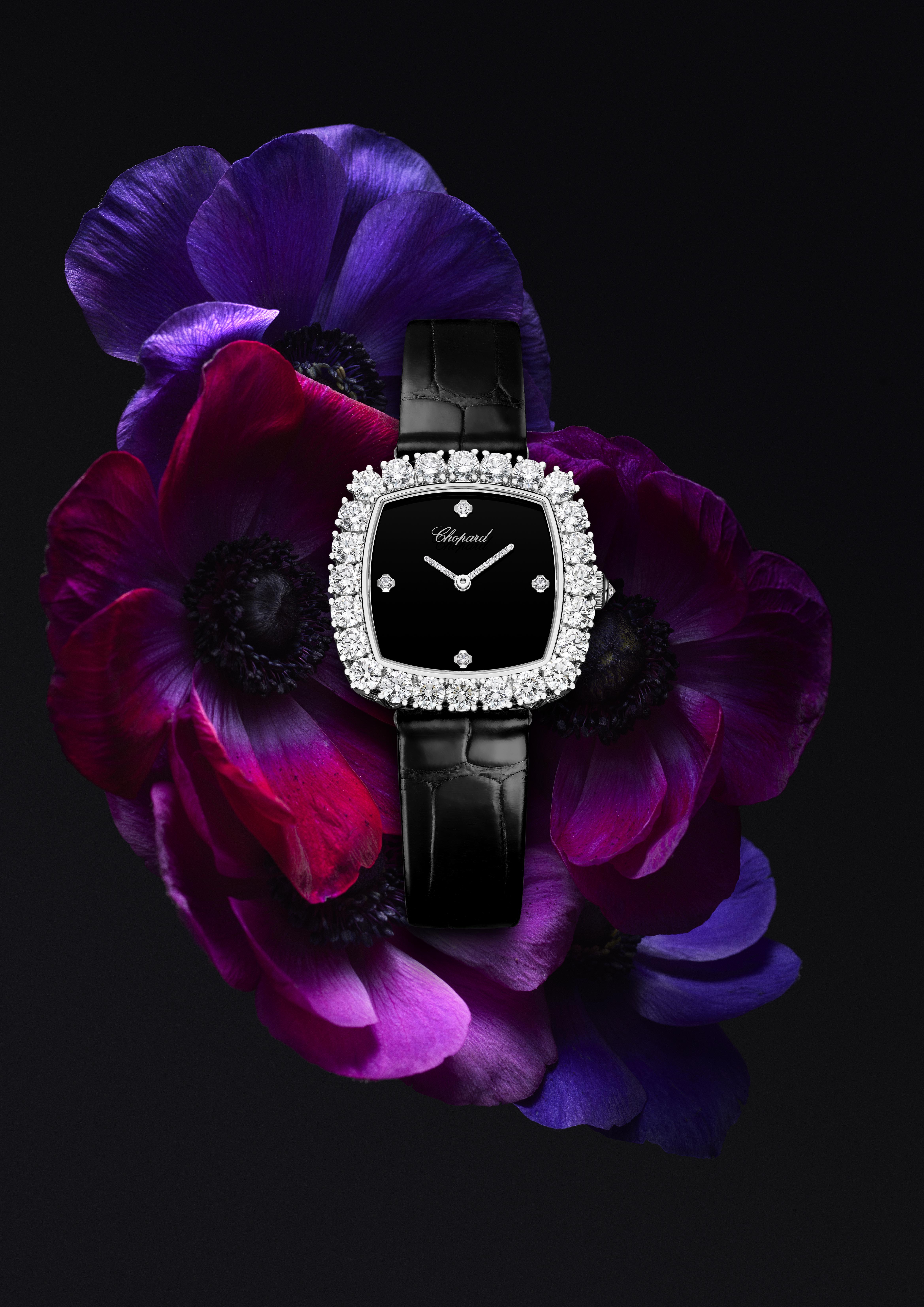
Onyx is a chalcedony,slow-formed, coloured by iron and carbon, cut flat at a thickness where fracture is a real concern. Every dial is unique because the stone is natural. The blackness of a well-cut onyx dial has a particular quality: it absorbs light rather than reflects it, which gives the diamond-set elements something genuinely dark to work against. No lacquer gets there. The bezel is set with 4.40 carats of diamonds in Chopard's crown setting, a technique developed by Karl Scheufele III using V-shaped prongs that support each stone from below and maximise the angle of light entry. The stones sit slightly proud of the bezel surface, creating a dimensional halo effect. Four brilliant-cut diamonds mark the cardinal positions. The hands are 18-carat ethical white gold set with diamonds, a detail specific to this reference, and one that earns its keep against the onyx rather than competing with it. Inside: the Chopard 09.01-C, a 148-component in-house automatic at 3.65mm, 25,200vph, 42-hour power reserve. Designed, developed and assembled in-house. Black alligator strap, white gold diamond-set buckle.
Chopard Happy Sport Happy Hearts: Two Hearts, Three Diamonds, One Denim Strap
The Happy Sport is thirty-two years old and it still makes sense as a watch. The loose diamonds between two sapphire crystals, free to move with the wearer were genuinely unusual when the concept launched in 1993, and the idea has held up because it's based on something real: the physical pleasure of watching small brilliant-cut stones move unpredictably inside a closed case. It's a complication of joy rather than function, and there's nothing wrong with that.
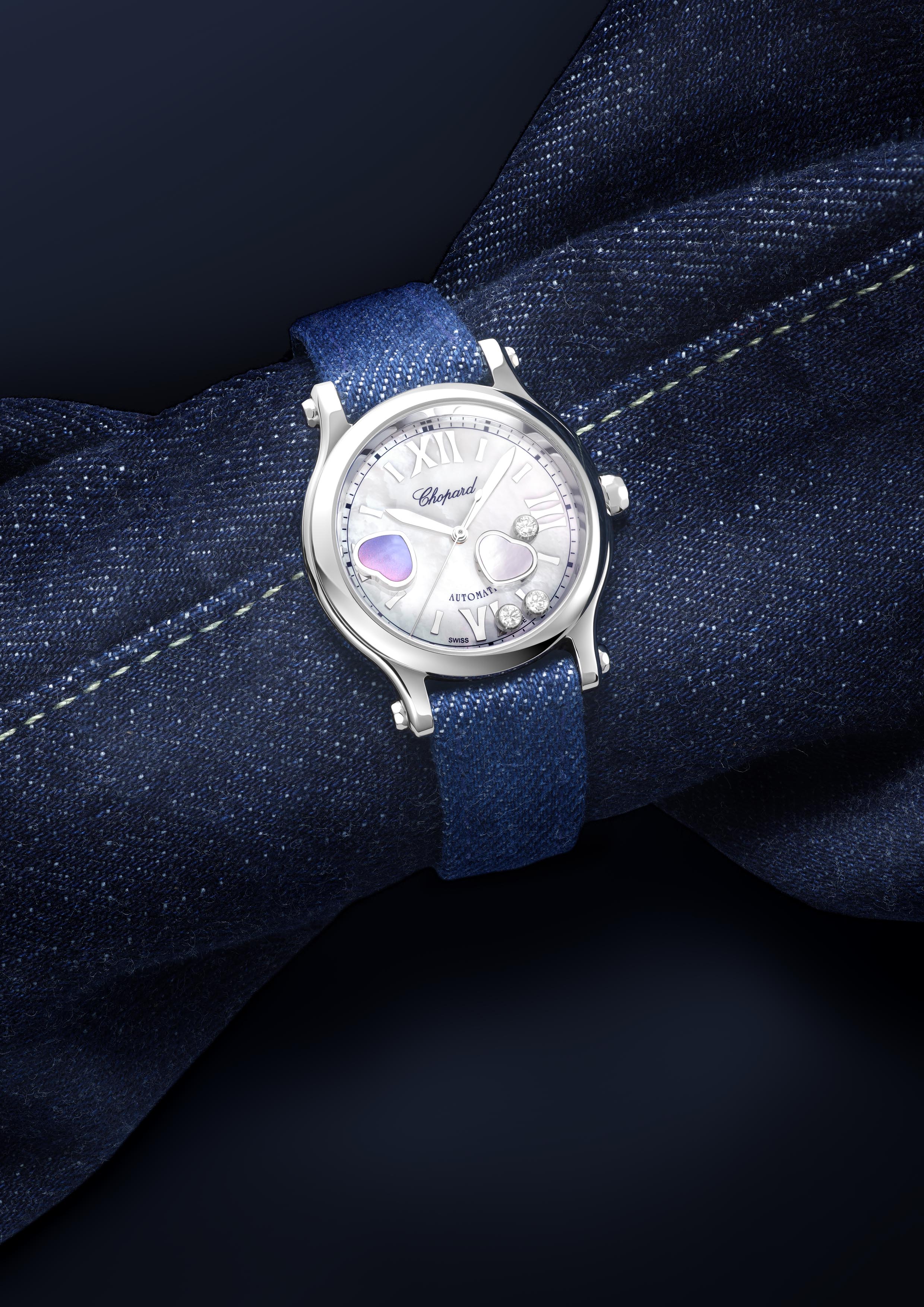
This year's Happy Hearts version puts two floating hearts into the equation alongside the three dancing diamonds. One is white mother-of-pearl. The other shifts through a pink-purple gradient, soft pink to vivid rose to mauve, driven by the iridescent properties of the mother-of-pearl as light hits it at different angles. It changes constantly on the wrist, which is the point. The dial beneath them is white mother-of-pearl, the case is 33mm Lucent Steel, and the strap is denim. The denim works against the mother-of-pearl in the same way the original Happy Sport worked steel against diamonds, materials that don't conventionally belong together, placed together deliberately. The exhibition caseback carries the Happy Sport logo in the sapphire. The 09.01-C inside is the same calibre as the L'Heure du Diamant. 148 components, 42 hours, 25,200vph. The case size is dictated by the movement dimensions, which is how it should be done.
The Manufacture, Thirty Years On
What Chopard has built in Fleurier since 1996 is not complicated to describe: a manufacture that makes its own movements, decorates them to the highest certification standards available in Swiss watchmaking, and has progressively applied those standards to the case and material level as well. The four watches at this year's fair sit across very different price points and very different audiences. The L.U.C 1860 and Alpine Eagle XPS are for the collector who reads movement specs before dial colours. The L'Heure du Diamant is for someone who wants a jewellery piece with a serious movement inside it rather than a quartz module. The Happy Sport is for the person who doesn't need a reason beyond the fact that it makes them smile when they look at it.
All four are made by the same people, in the same group, with the same commitment to not cutting corners on the parts nobody can see. That's the thirty-year argument, and it holds.
Technical Specifications
Chopard L.U.C 1860 Chronometer (Ref. 168860-3005) Calibre: L.U.C 96.40-L | Self-winding, 22-carat gold micro-rotor | 28,800 vph (4Hz) | 65 hours power reserve | 176 components | 29 jewels | 27.40mm diameter | 3.30mm thickness | Chopard Twin Technology dual barrels | Swan's neck regulator | Phillips terminal curve | Certifications: COSC chronometer, Poinçon de Genève. Case: Lucent Steel, 36.50mm diameter, 8.20mm thickness, 30m water resistance. Dial: Hand-guilloché "Areuse Blue" 18-carat white gold, sunburst pattern, satin-brushed chapter ring, snailed small seconds counter, white gold chevron hour markers and Dauphine hands. Strap: Anthracite grey grained calfskin, Lucent Steel pin buckle with L.U.C engraving.
Chopard Alpine Eagle 41 XPS "Mountain Glow" (Ref. 298623-3003) Calibre: L.U.C 96.40-L | Self-winding, 22-carat ethical yellow gold micro-rotor | 28,800 vph (4Hz) | 65 hours power reserve | 176 components | 29 jewels | 3.30mm thickness | Chopard Twin Technology | Swan's neck regulator | Stop-seconds function | Certifications: COSC chronometer, Poinçon de Genève. Case: Lucent Steel, 41mm diameter, 8mm thickness, 100m water resistance, eight-screw bezel, compass rose crown. Dial: "Mountain Glow" champagne galvanic treatment on brass, eagle's-iris radial stamp, ethical white gold markers and Dauphine hands with Grade X1 SuperLumiNova, small seconds at 6 o'clock. Bracelet: Lucent Steel tapering integrated bracelet, triple-fold clasp with comfort-fit 5mm extension system.
Chopard L'Heure du Diamant with Onyx Dial (Ref. 13A386-1109) Calibre: Chopard 09.01-C | Self-winding | 25,200 vph (3.5Hz) | 42 hours power reserve | 148 components | 27 jewels | 20.40mm diameter | 3.65mm thickness. Case: 18-carat ethical white gold, 30.50 x 30.50mm cushion, 9.30mm thickness, 30m water resistance, bezel set with brilliant-cut diamonds (4.40ct), crown set with briolette-cut diamond. Dial: Onyx, brilliant-cut diamond indexes at 12/3/6/9, 18-carat ethical white gold hands set with brilliant-cut diamonds. Strap: Black alligator leather, 18-carat white gold diamond-set buckle.
Chopard Happy Sport Happy Hearts (Ref. 278608-3012) Calibre: Chopard 09.01-C | Self-winding | 25,200 vph (3.5Hz) | 42 hours power reserve | 148 components | 27 jewels | 20.40mm diameter | 3.65mm thickness. Case: Lucent Steel, 33mm diameter, 10.84mm thickness, 30m water resistance, facetted crown, exhibition caseback. Dial: White mother-of-pearl, three dancing diamonds, two dancing hearts in 18-carat ethical white gold (one white mother-of-pearl, one pink-purple gradient mother-of-pearl), rhodium-plated markers and conical hands. Strap: Blue denim, Lucent Steel pin buckle.


