Watches And Wonders 2026: Grönefeld Unveils Their Most Personal And Most Feminine Watch Yet
 9 min read

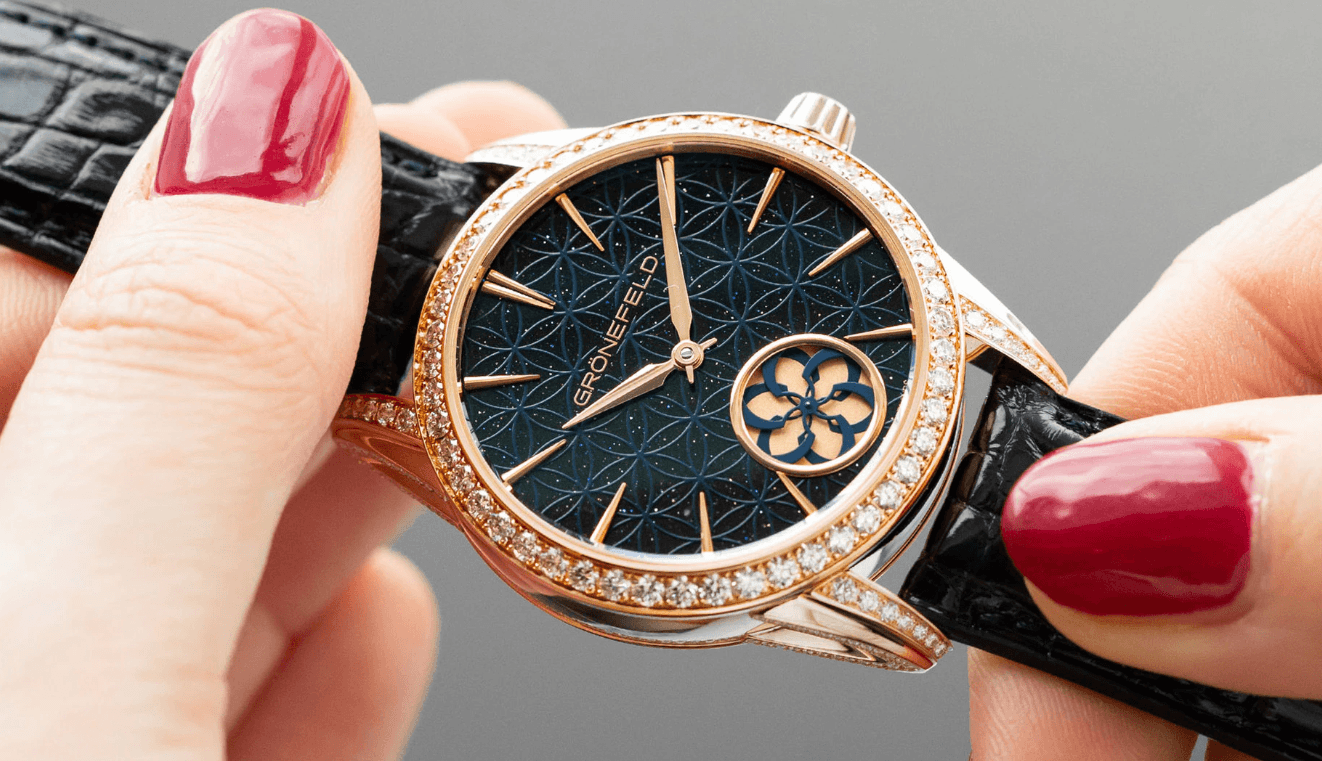
There are watches made to impress, and there are watches made to mean something. The Grönefeld 1944 Tanfana, unveiled today at Watches & Wonders 2026, belongs unmistakably to the second category. From its name, drawn from the mythology of a small Dutch city, to its reference number, a quiet tribute to the woman who shaped two watchmakers, every element of this timepiece has been chosen with intention. The result is a watch that carries the weight of history, devotion and craft in equal measure and wears it with extraordinary grace. Tim and Bart Grönefeld have built their reputation on the kind of mechanical watchmaking that demands respect: double tourbillons, precision constant-force mechanisms, peerless hand-finishing. Their collectors are, by and large, connoisseurs who prize technical achievement above all else. The 1944 Tanfana does not abandon that tradition. But it expands it in ways that feel genuinely new and deeply personal.
A Name Rooted in Myth and Memory
Oldenzaal, the Grönefeld brothers' hometown in the east of the Netherlands, is not a city that announces itself loudly. But its history runs deep. It was here, according to ancient Germanic tradition, that Tanfana stood — a goddess revered as a guardian of peace and harmony, her name surviving the centuries as a fragment of myth embedded in the local landscape. The brothers have walked the streets of Oldenzaal their entire lives. They know its gables, its churches, its rhythms. And in Tanfana, they found a spirit worthy of a watch. The reference number, 1944, carries its own quiet charge. It is the birth year of Netty, their mother, a woman who, one imagines, watched her sons build something remarkable with pride, patience, and the particular quiet confidence of a parent who always knew. To name a watch after a goddess and number it after your mother is not a marketing decision. It is a love letter. "To name a watch after a goddess and number it after your mother is not a marketing decision. It is a love letter."
New Design Codes, Unchanged Standards
Grönefeld has never made a ladies' watch before. The 1944 Tanfana is a first, and with it comes a deliberate rethinking of the brand's design language. The silhouette is new, the materials are new, and the decorative vocabulary is new. Yet the standards, as the brothers are at pains to emphasise, remain absolutely unchanged.
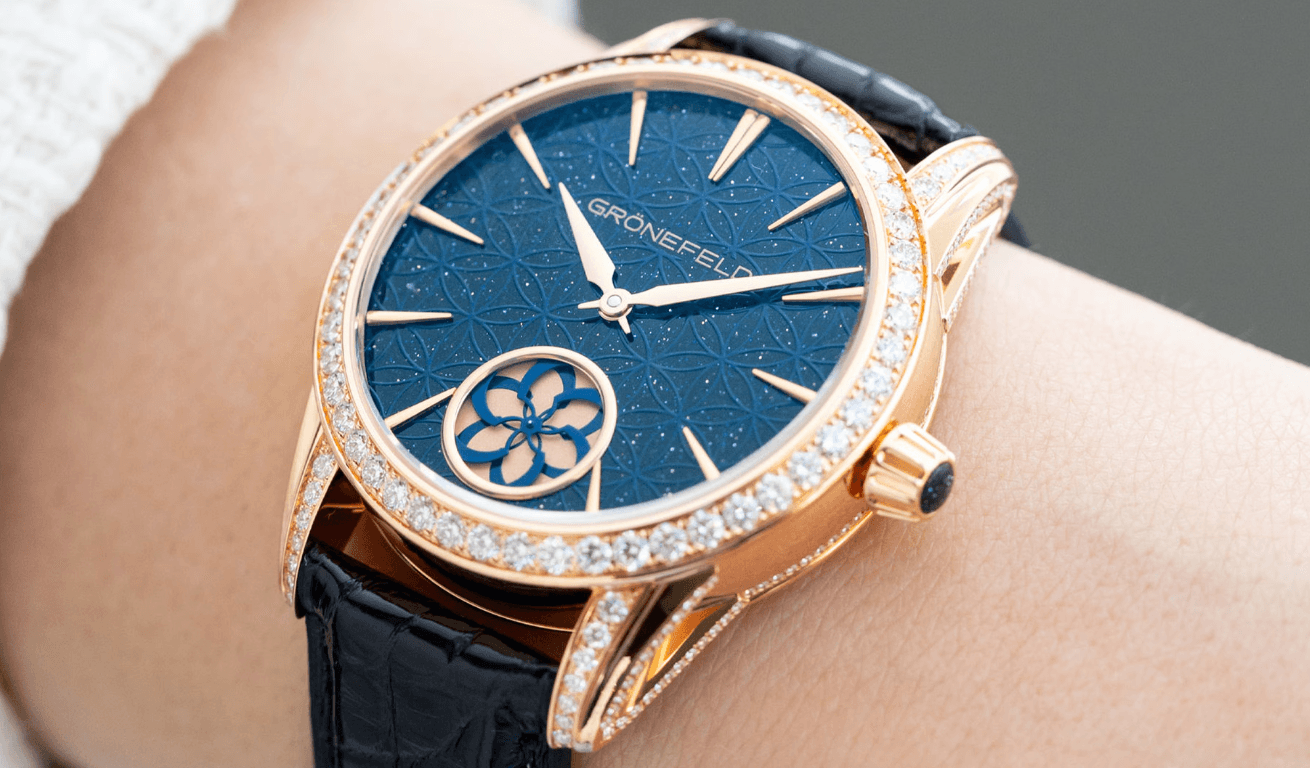
At 37.5mm in diameter, the case sits at a size that reads decisively as a ladies' watch without ever feeling slight. Its construction is a tour de force of case-making: a form that rises and falls across multiple levels, blending rectilinear lines with flowing curves to produce shifting contrasts of brilliance and shadow. This is not simply a round case. It is a sculptural object, one that rewards close examination from every angle. The material is red gold, specifically Au750 5N, the warm-toned alloy that Grönefeld uses across their collection, and its gleaming surfaces interact with the case architecture to produce an almost jewellery-like sense of light. The crown reinforces this atmosphere with an aventurine cabochon that mirrors the dial, creating a sense of material continuity around the entire watch.
The Dial: Midnight Blue and the Flower of Life
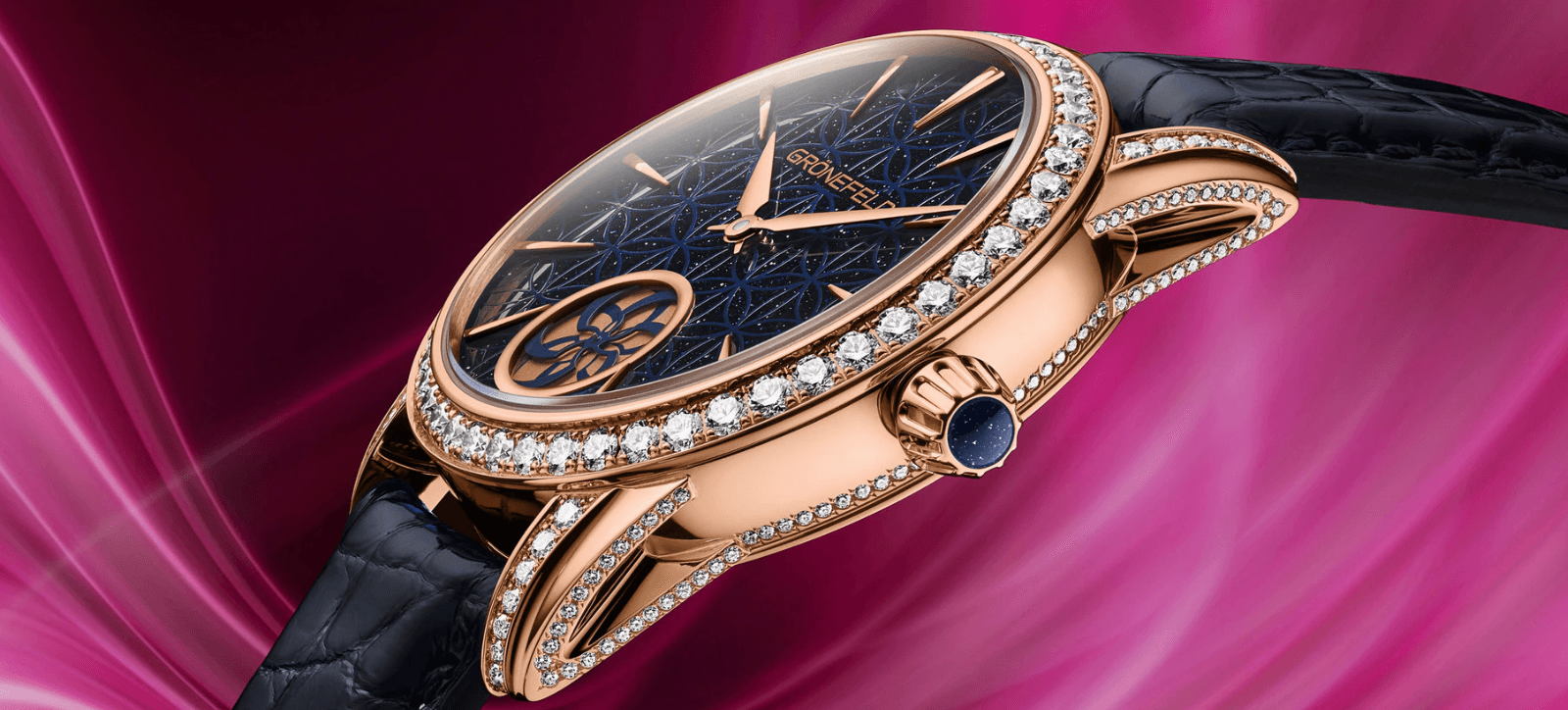
If the case of the 1944 Tanfana is architecture, its dial is astronomy. Formed entirely from aventurine — a glossy, midnight-blue material threaded through with glinting metallic inclusions, it gives the impression of staring into a clear night sky, a surface alive with light that shifts and moves with the slightest tilt of the wrist.
Across this stellar ground, Grönefeld has engraved the Flower of Life: a geometric motif of overlapping circles that has appeared across cultures and centuries, from ancient Egypt to the Renaissance, from Islamic architecture to the notebooks of Leonardo da Vinci. It belongs to the tradition of Sacred Geometry, the exploration of spiritual meaning in mathematical form and its presence on the dial of the 1944 Tanfana is entirely fitting. Tanfana, the goddess, stood for harmony. The Flower of Life has always been understood as a symbol of harmony in its purest, most universal expression. The motif also enhances the dial's visual texture, adding depth to a surface that already seems to have infinite layers. Time is read through extended lancette hands, a signature of the Grönefeld collection, long and elegant, formed in red gold to match the applied trapezoidal indexes. The pairing is confident and legible, the hands sweeping across the aventurine with authority while never overwhelming its beauty.
At the base of the dial, the seconds display represents perhaps the most poetic decision in the entire design. Rather than a conventional counter with a hand and a track, Grönefeld has installed a small animated floral motif that rotates as the movement runs. As it turns, it produces a mesmerising moiré effect, a visual illusion born from the interaction of the rotating form and the pattern of the dial beneath it. It resembles nothing so much as a flower endlessly, perpetually blooming. It is the kind of touch that requires genuine creative confidence to execute, and extraordinary technical skill to realise. "The rotating floral seconds display produces a mesmerising moiré effect, a flower in a state of endless, perpetual bloom."
The Gem-Set Case: 233 Diamonds and a Study in Restraint
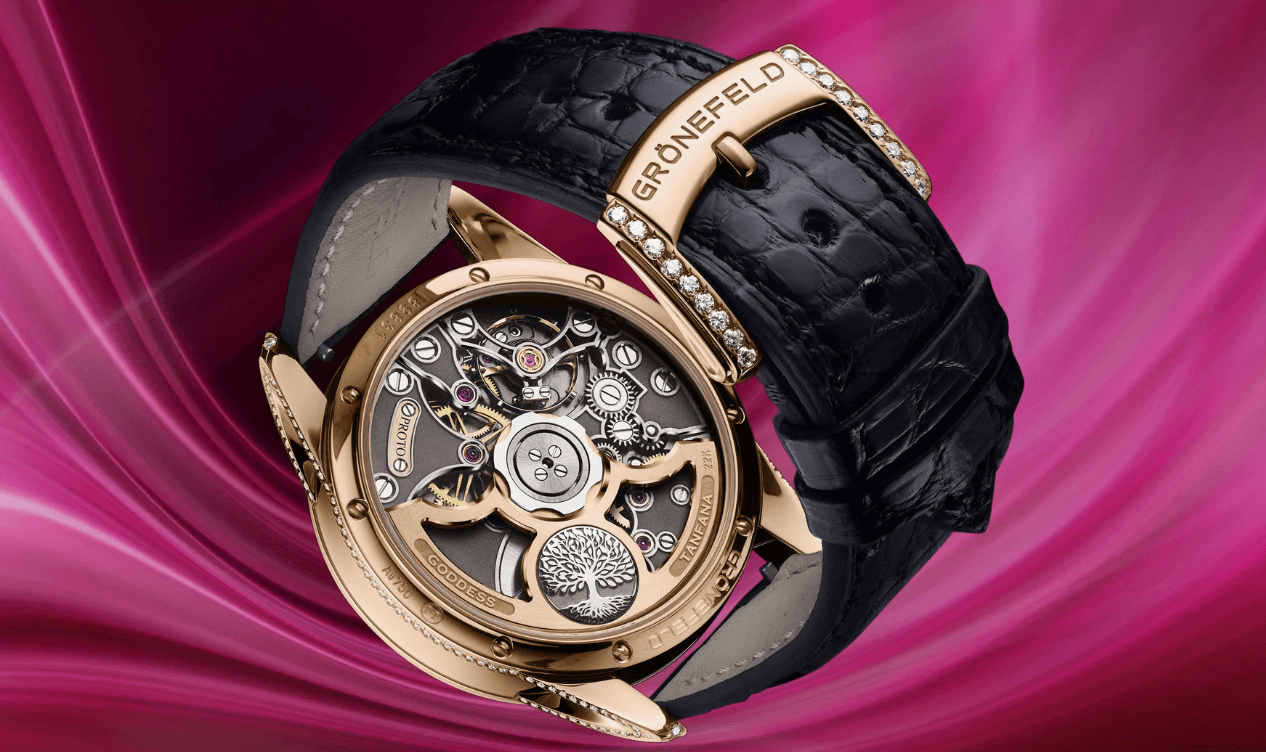
For those who want their 1944 Tanfana to announce itself with maximum brilliance, Grönefeld offers a gem-set configuration that places 233 brilliant-cut diamonds, weighing approximately 2.73 carats in total, across the bezel, case, and pin buckle. It is a significant quotient of sparkle, but it is deployed with characteristic Grönefeld restraint: the stones follow and reinforce the forms of the case rather than overwhelming them, their placement a function of the watch's architecture rather than an addition to it.
The effect, particularly in natural light, is considerable. Light catches the facets from multiple angles simultaneously, producing a shifting, flickering brilliance that is, in its own way, as alive as the aventurine dial itself. The watch is offered with a wide selection of straps, each chosen to complement the palette of the dial and case, providing an additional dimension of personalisation for the wearer.
The Calibre G-06: An Inner Beauty to Match the Outer
Open the caseback of the 1944 Tanfana and you encounter something that has become one of the great pleasures in modern watchmaking: a Grönefeld movement in full decoration. The Calibre G-06 is an automatic movement — a practical and pragmatic choice for a watch intended for daily wear, eliminating the need for manual winding without sacrificing any of the mechanical excellence the brand demands and it has been finished to the highest standard the brothers know, which is to say, to one of the highest standards in independent watchmaking.
The oscillating weight is a statement piece in its own right: 22-karat red gold, openworked to reduce mass and reveal the mechanics beneath, running on ceramic ball bearings for smoothness and longevity. Engraved into its surface are the words 'Goddess' and 'Tanfana', alongside the Tree of Life symbol rendered in white gold. The Tree of Life, roots representing family and foundation, branches signifying aspiration and self-discovery, is an emblem of considerable resonance in the context of a watch made by two brothers, in honour of their mother, in a city steeped in mythological tradition. Technically, the movement is distinguished by a free-sprung variable inertia balance, a more precise means of rate regulation than the conventional index-adjusted balance, and one that renders the movement less susceptible to the positional variations that can affect accuracy in daily wear. This is not a detail that many wearers will consciously notice, but it is the kind of decision that defines the Grönefeld philosophy: if something can be done better, it must be done better, regardless of whether the improvement is visible.
The Art of Finishing: Bell Gables and Bevelled Edges
The movement finishing of the 1944 Tanfana is, in the finest Grönefeld tradition, a complete exercise in itself. The stainless steel bridges have been shaped to echo the distinctive 'bell gables', the stepped, curvilinear rooftops that characterise the historic architecture of Oldenzaal's town centre. It is a connection to place that most wearers will never consciously make, but which gives the movement a narrative coherence that goes far beyond mere decoration.
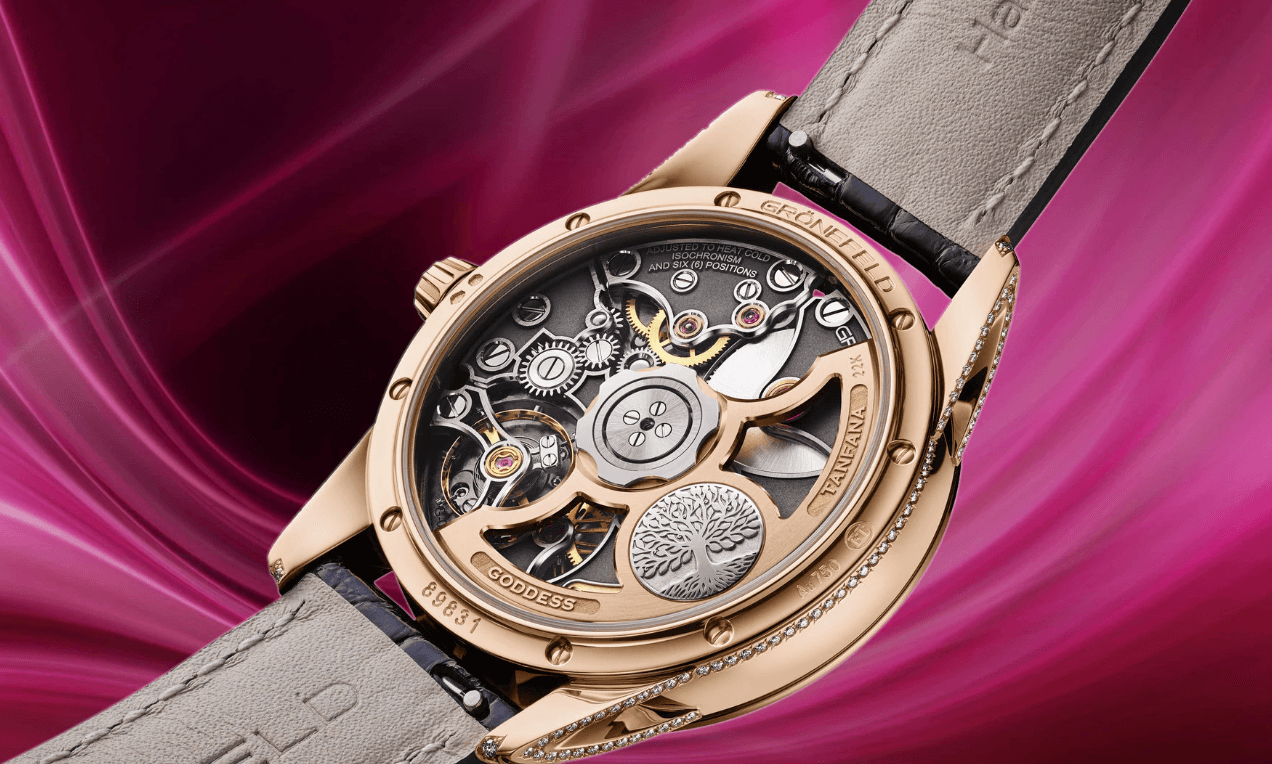
Each bridge features micro-blasted centres, a fine, matte texture that absorbs light evenly, surrounded by relief engravings and framed by gleaming hand-bevelled edges that catch the light with crystalline precision. The contrast between the two textures, matte and mirror, is a hallmark of high watchmaking, and Grönefeld executes it with characteristic thoroughness. The five-arm double-spoke gear train wheels transmit power efficiently while providing visual interest to the movement's architecture. The mainplate is decorated with spotting, a circular pattern applied by hand that gives the surface a jewel-like texture. Screws are mirror-polished with chamfered rims and slots. Gold chatons, those small golden settings used to hold jewels in place, are present throughout — a tribute to the traditions of haute horlogerie that predates even the Grönefeld brothers' considerable heritage. Together, these details constitute a movement that rewards prolonged, close examination. This is finishing not as performance but as practice, the expression of a belief that every surface, seen or unseen, deserves to be made as well as it possibly can be.
The 1944 Tanfana represents something genuinely significant in the Grönefeld story. Not because it introduces new complications or pushes the boundaries of mechanical horology in ways the brand has done before, but because it proves that Tim and Bart Grönefeld are capable of something arguably more difficult: genuine creative expansion. This watch could have been a simple feminine reworking of an existing model. Instead, it is a fully realised new aesthetic statement, one with its own mythology, its own symbolism, its own emotional weight. The aventurine dial is genuinely beautiful. The animated floral seconds display is genuinely inventive. The case construction is genuinely complex. And the story behind it, goddess, goddess, mother is genuinely moving. In a year already filled with important launches at Watches & Wonders 2026, the Grönefeld 1944 Tanfana stands apart not by being loudest, but by being most sincere. For Grönefeld, this is not merely the first ladies' watch. It is proof that the Horological Brothers still have new things to say.
GRÖNEFELD 1944 TANFANA — KEY SPECIFICATIONS
Reference: 1944
Case: Red Gold Au750 5N, 37.5mm diameter
Gem Setting: 233 brilliant-cut diamonds, approx. 2.73 carats (bezel, case and pin buckle)
Dial: Aventurine with engraved Flower of Life motif; red gold lancette hands; trapezoidal applied indexes; animated floral seconds display
Movement: Calibre G-06, automatic
Oscillating Weight: 22-karat red gold, openworked, ceramic ball bearings; engraved with Tree of Life, 'Goddess' and 'Tanfana' in white gold
Balance: Free-sprung variable inertia balance
Crystal: Sapphire (front and rear)
Crown: Set with aventurine cabochon
Straps: Wide selection available