Watches And Wonders 2026: Joia De Baume & Mercier Expresses What It Has Always Meant
 6 min read


There is a particular kind of object that earns its place not through spectacle but through timing. Not the timing of a movement, though that too. The timing of arrival: appearing at the right moment in a life, at the right moment in a culture, at the right moment in a brand's own story. The Joia de Baume & Mercier collection, launched in 2026, is that kind of object. To understand why it matters, you have to understand what the Maison has been building toward since the day it opened its doors. Baume & Mercier was founded in 1830 in the Swiss Jura. It has been, for virtually its entire existence, a house that understood watches as vessels for meaning rather than simply instruments for measurement. The tagline the brand carries today, "Celebrating meaningful moments since 1830," is not marketing language retrofitted to a product. It is a description of what the Maison has been doing, in practice, across nearly two centuries of production. The watches have changed in form, in material, in complication. The underlying intent has not.
The relationship with women is where that intent has been most consistently expressed. In 1918, when aesthete Paul Mercier joined forces with the pragmatic William Baume, one of the first things they observed was the emancipation of women beginning to move through European society. These were women showing a clear and growing interest in watches, and they wanted more from their timepieces than the functional. The Maison responded with ladies' creations that were described in the 1920 Davoine General Indicator of Watchmaking as "haute Fantaisie pour Dames": watches conceived as jewels, as expressions of personality, as objects that could carry the weight of an occasion without announcing themselves too loudly.
That tradition continued across the decades. The 1950s saw Baume & Mercier portray the modern woman as a doctor in its advertising, a deliberate statement of what the brand's customer represented. The 1970s, 1980s, and 1990s produced spectacular gold jewelry pieces adorned with mother-of-pearl, onyx, lapis lazuli, and turquoise. Cuff watches. Bracelet watches. Objects that sat at the intersection of horology and jewellery with a confidence that most brands at the time were unwilling to commit to fully. The Joia de Baume & Mercier collection arrives in 2026 as the direct descendant of all of this. But it is not a heritage exercise. It is a forward statement.
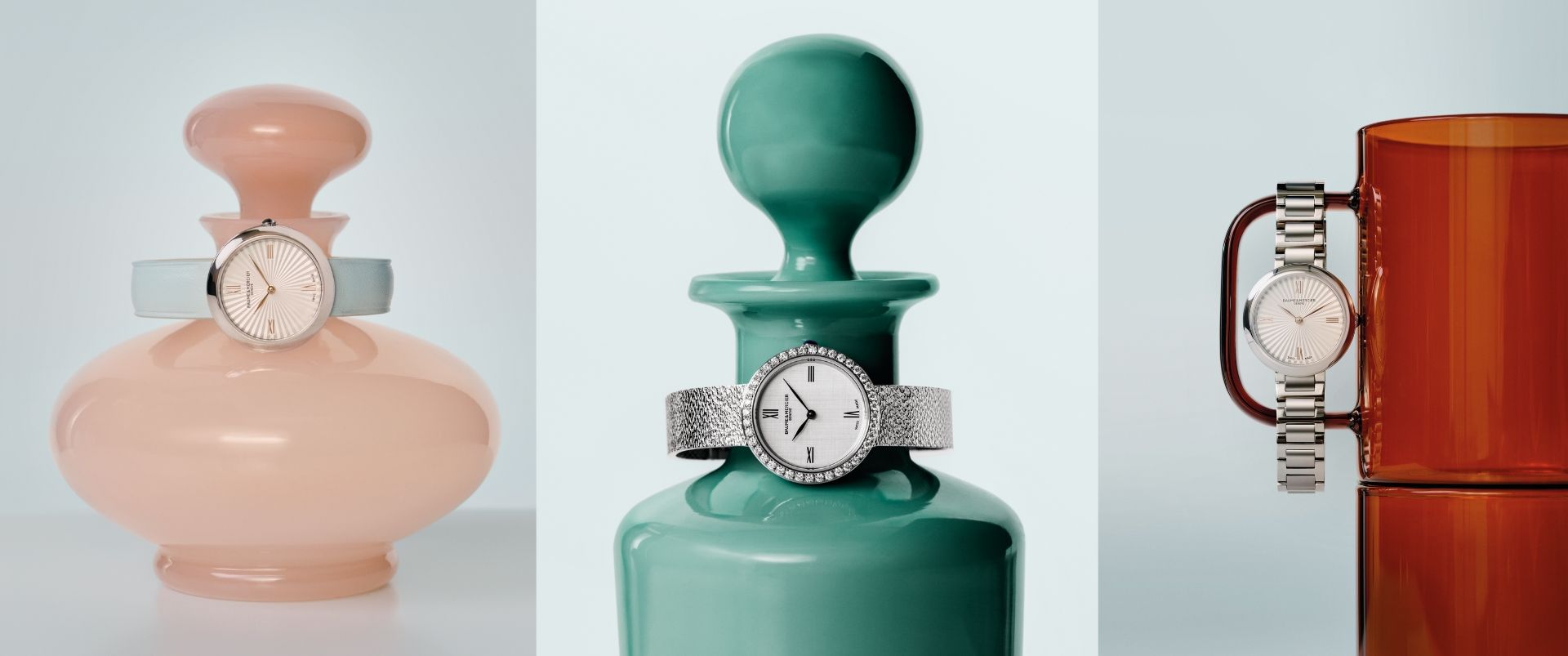
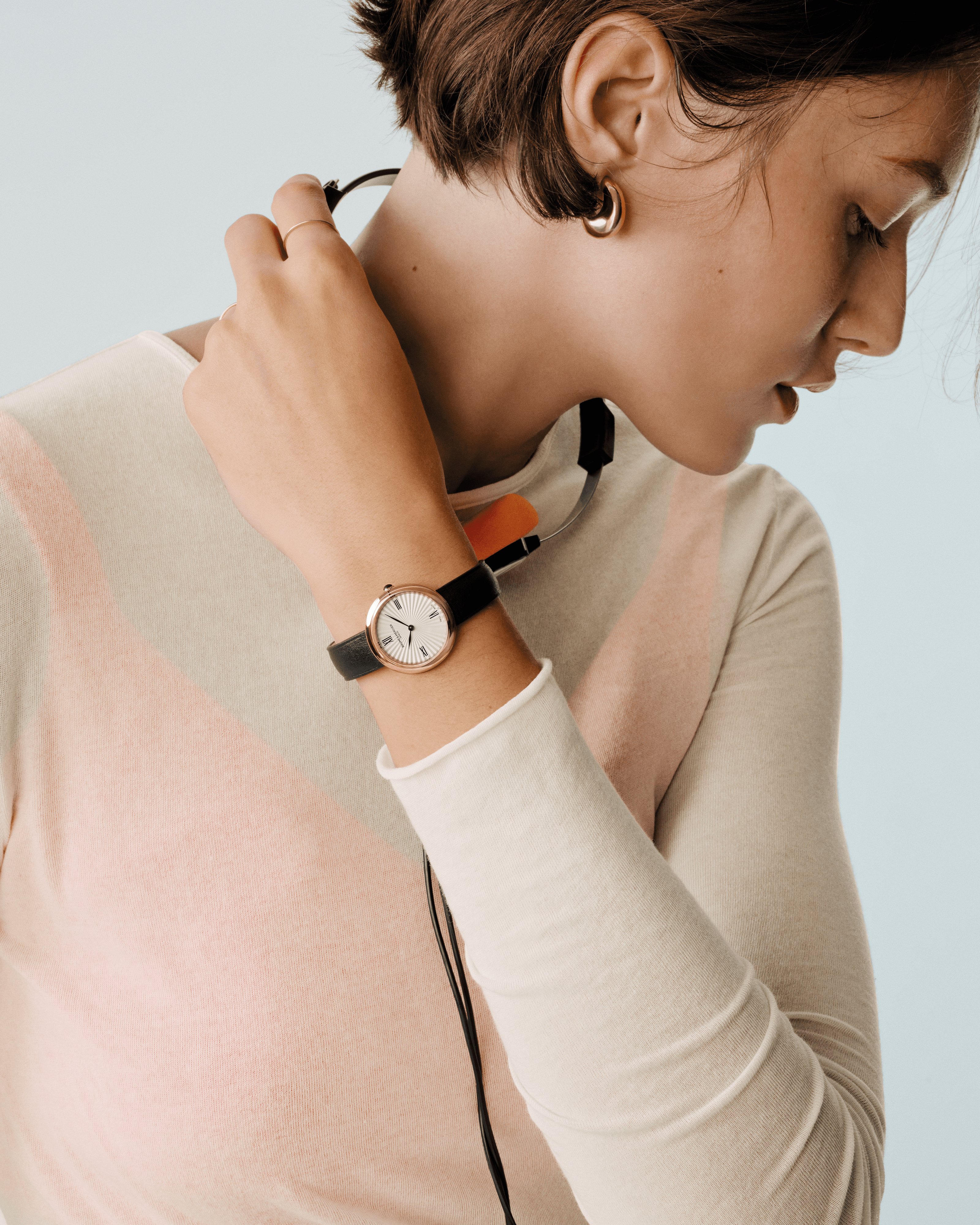
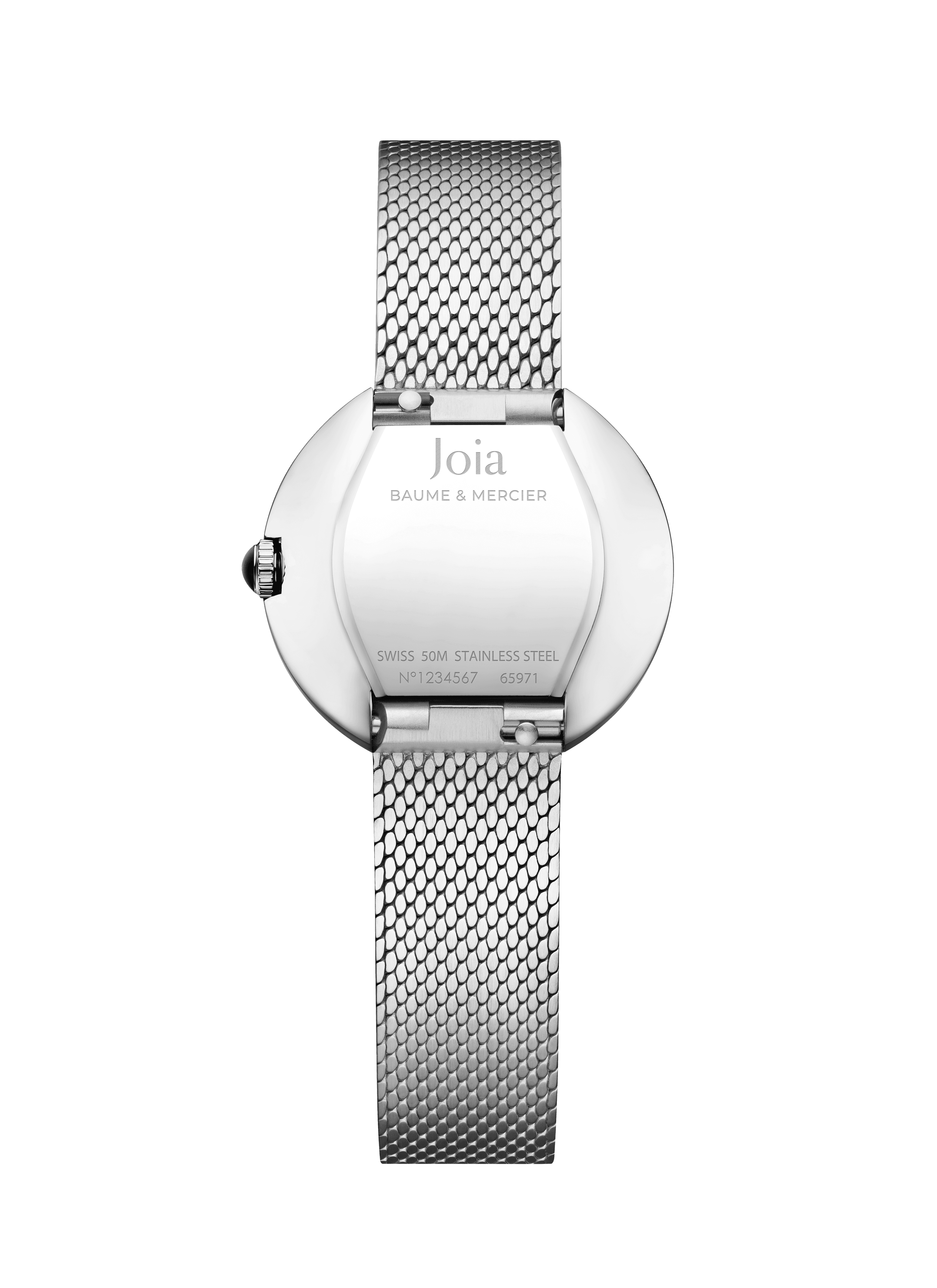
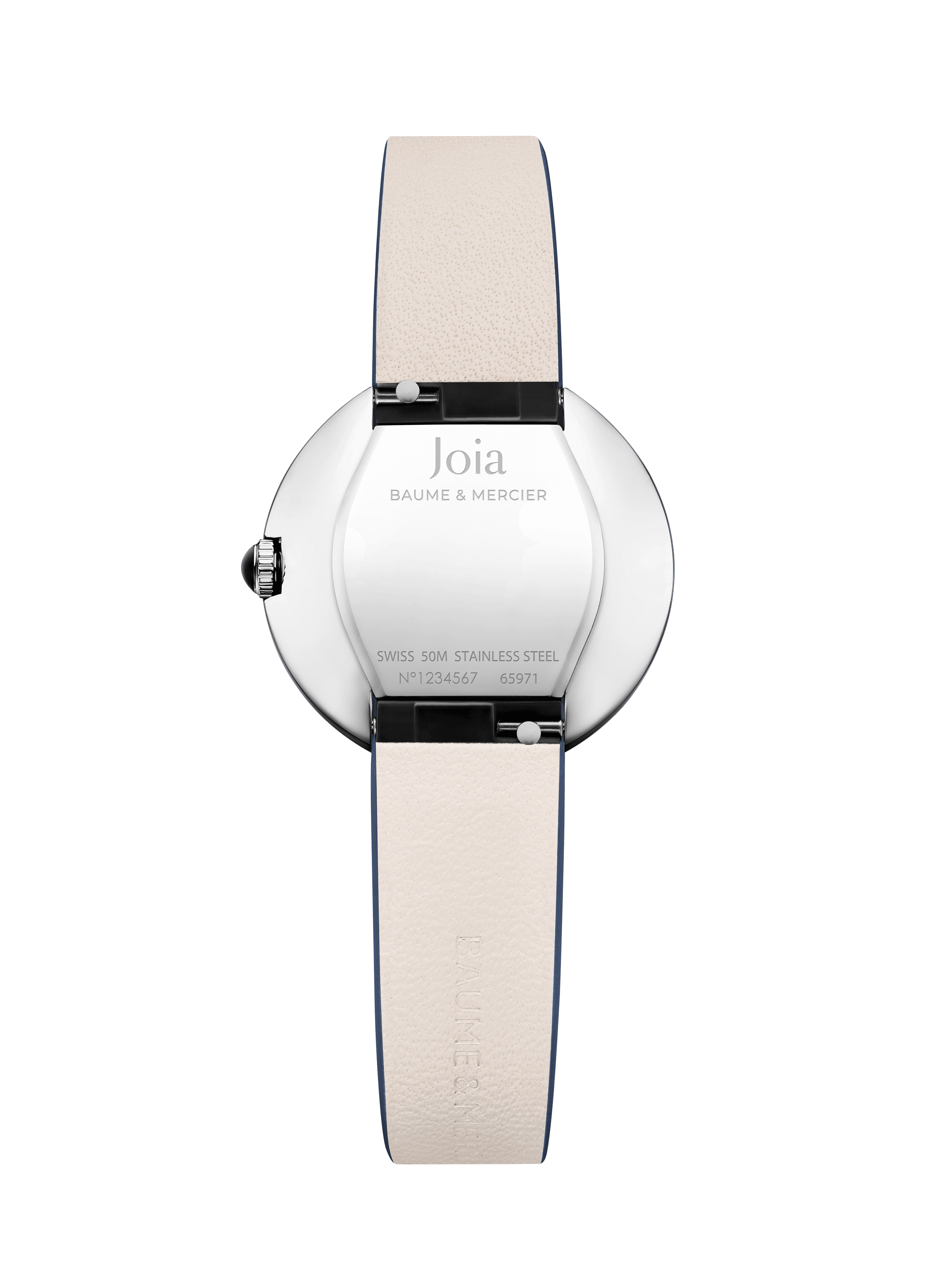
The collection comprises four references, three of which are introduced together. All share a 28mm case designed without lugs, a choice that is more consequential than it might initially appear. The absence of lugs removes the visual interruption between case and strap, creating a continuous, unbroken line that sits on the wrist as a jewel rather than a watch wearing a strap. The cases measure 7.2mm in thickness. The crowns are set with black agate. The sapphire crystals are scratch resistant and anti-glare treated. The solid casebacks can be engraved. Each one of these details points in the same direction: an object designed to be given, and to be kept.
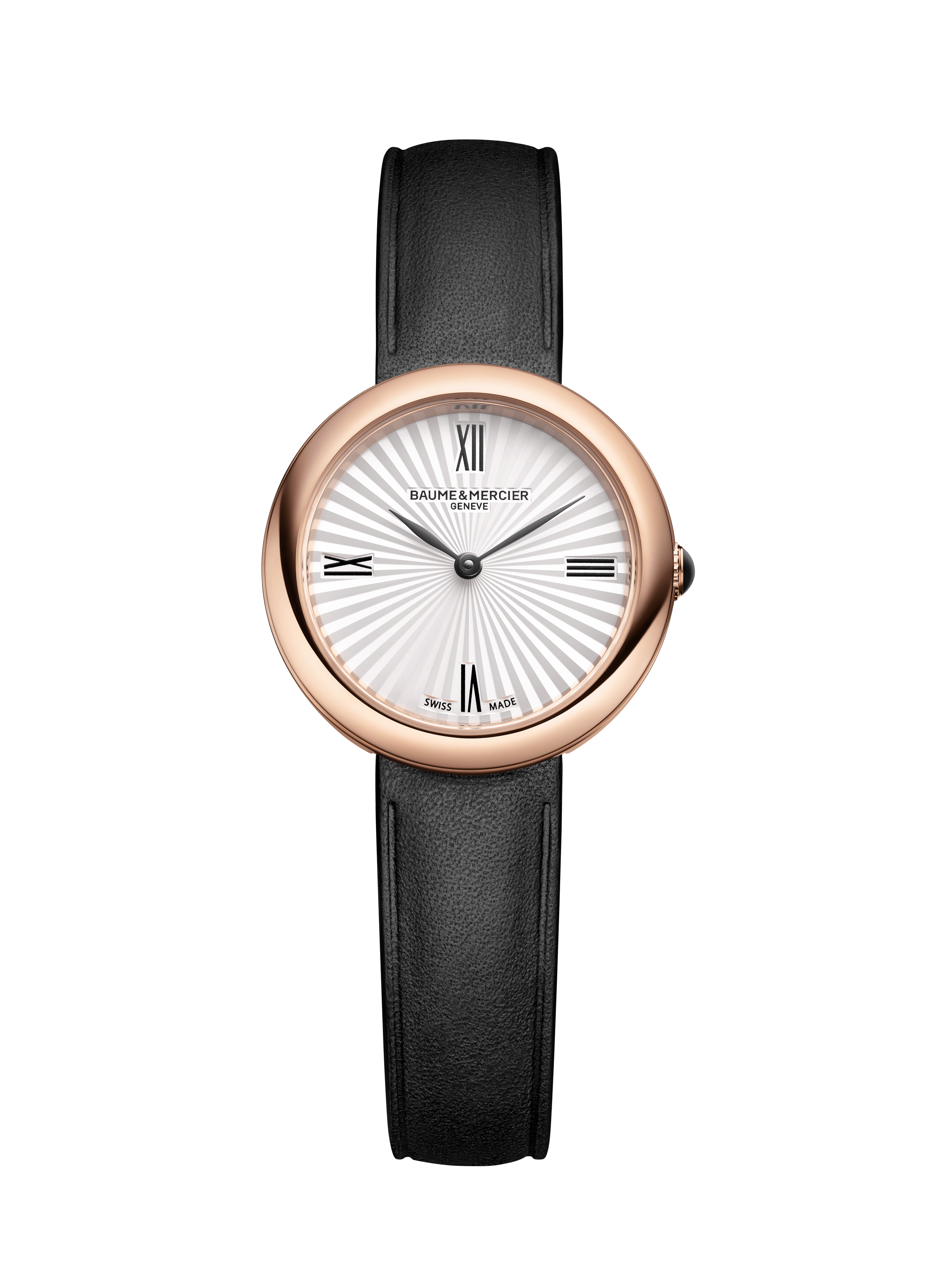
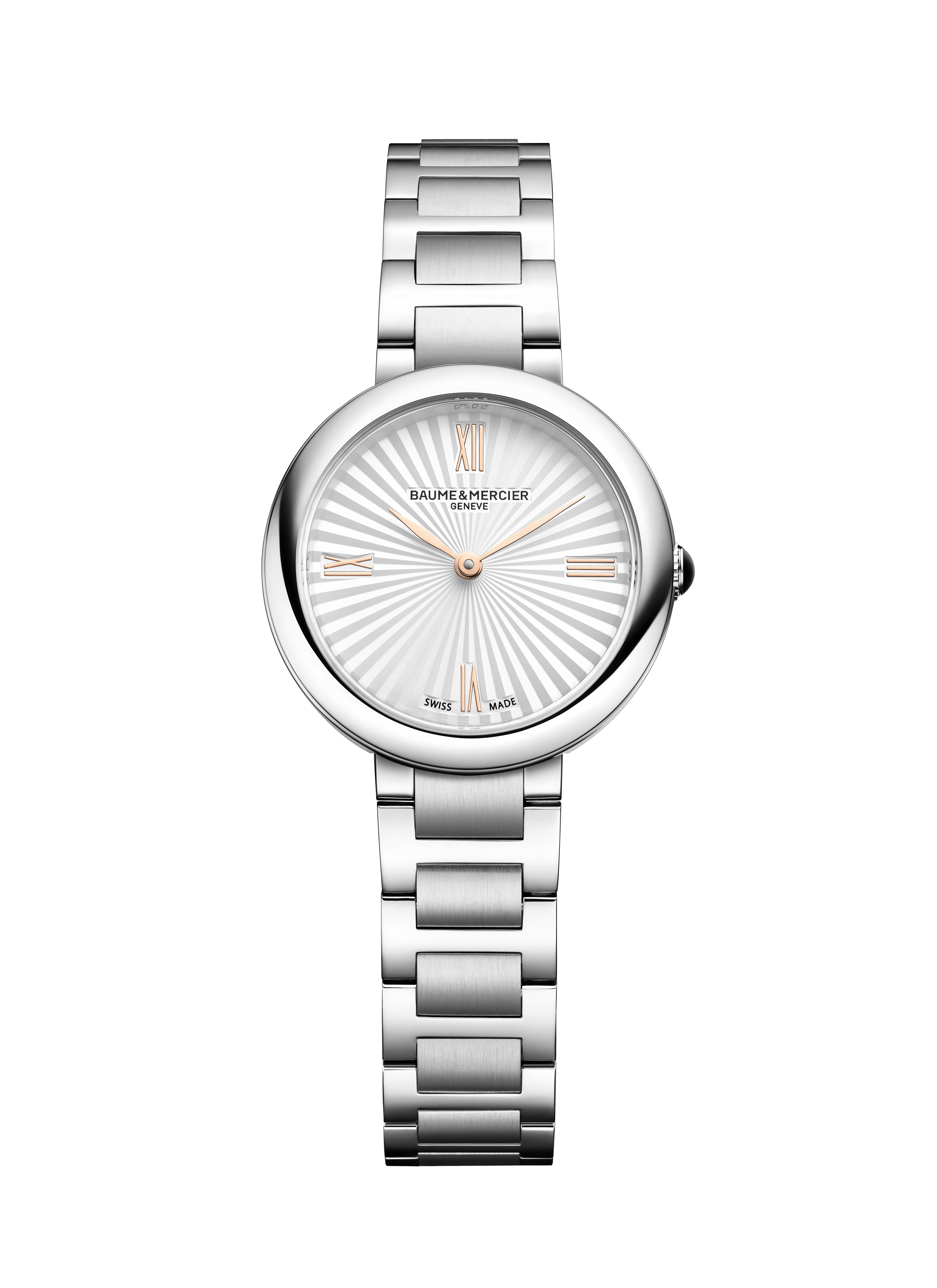
The three core references cover distinct moods within a coherent aesthetic. The M0A10847 pairs a silvery sun-satin dial with 4N gold-plated Roman numerals and leaf hands against a midnight blue calfskin strap, an alliance of warmth and cool that sits equally well at a ceremony and at a dinner. The M0A10848 replaces the strap with an integrated bracelet in polished and satin-finished stainless steel with three rows of H-shaped links, a design decision that elevates the watch into fully integrated jewellery territory while retaining the spring-bar interchangeable system that allows the wearer to swap straps without tools. The M0A10849 introduces chromatic contrast, placing a silvery sun-satin dial against black Roman numeral transfers and ruthenium leaf hands within a 4N PVD gold case, the gold warmth against the dark details creating a graphic tension that reads as confidence rather than convention.
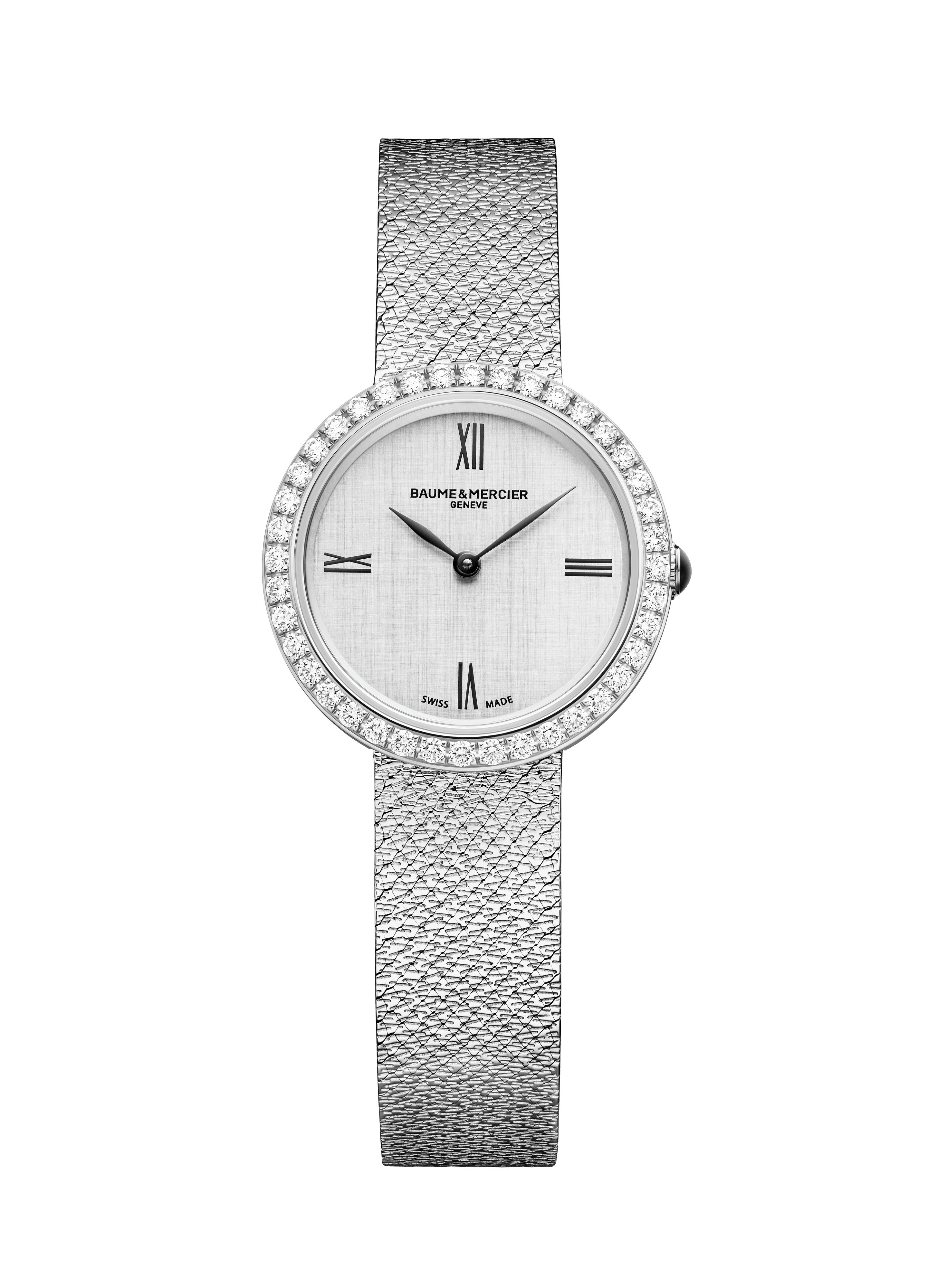
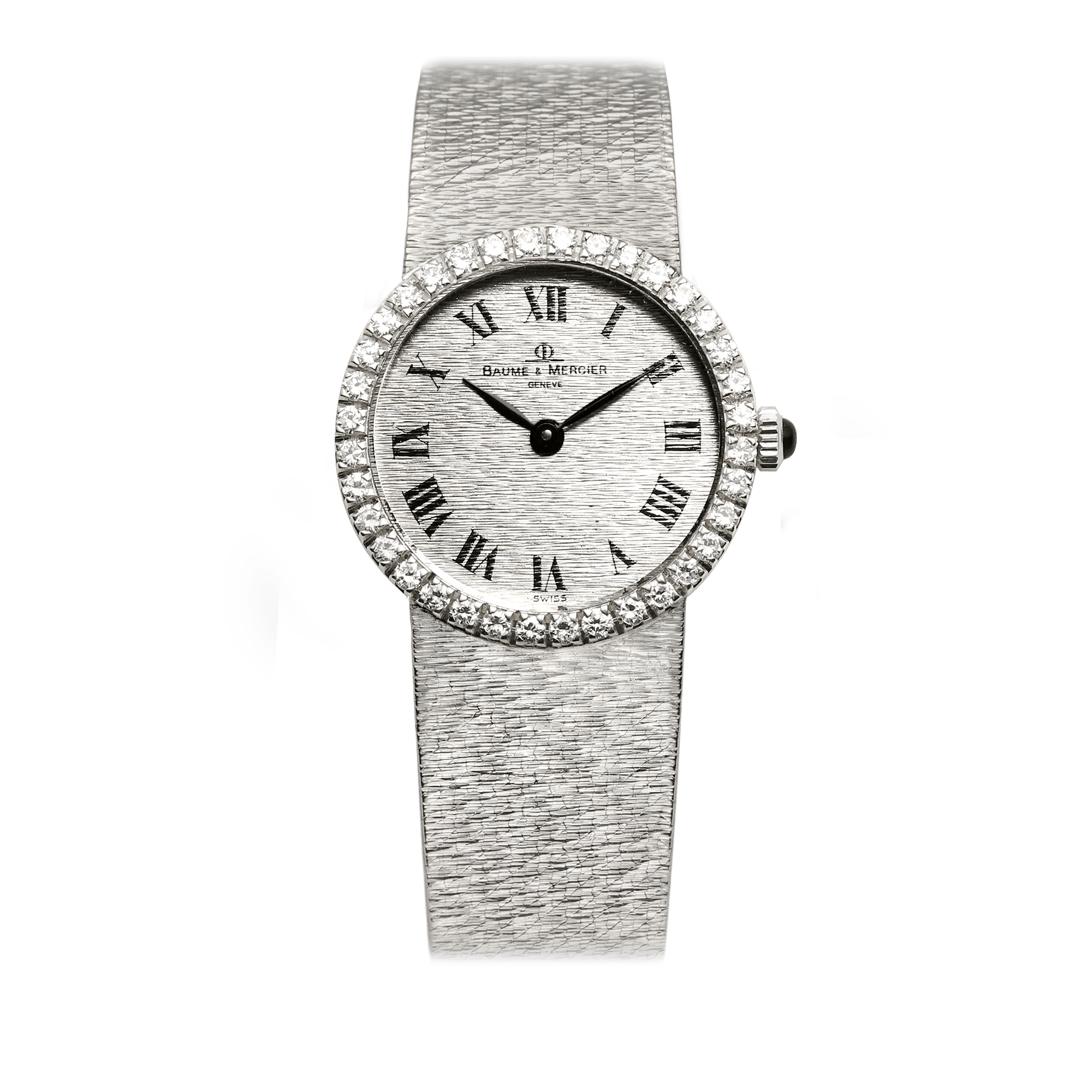
All three run on the Ronda 751 quartz calibre with a five-year battery autonomy, a choice that is entirely correct for what these watches are built to do. A watch given to mark a milestone should keep running reliably for years without requiring service intervention. The Ronda 751 delivers that reliability within dimensions that allow the 7.2mm case profile to remain achievable. This is watchmaking logic applied to a jewellery proposition, and it is the right logic. The fourth reference, the Joia de Baume & Mercier M0A10850, stands apart. It is the piece that carries the full weight of the collection's heritage argument. Inspired directly by a historical model from the 1980s, it presents within a 28mm case set with 40 brilliant-cut diamonds, Top Wesselton quality, VS clarity, totalling 0.81 carats across the bezel. The dial carries a silvery finish with criss-crossed satin-brushed textures that echo the flattened link decoration of the integrated steel bracelet. The ruthenium leaf hands move across a surface of restrained complexity. This reference is in limited production. It is the piece you point to when someone asks what the collection stands for at its most resolved.
What holds all four references together is something the campaign built around the collection articulates clearly: "A moment for all of us. A moment together. A moment just for you." These are three distinct registers of meaningful occasion, and they map directly onto what the collection is equipped to mark. The communal celebration, the shared milestone between two people, the private acknowledgment of something achieved or claimed. Baume & Mercier does not prescribe which moment a watch is for. It builds watches that are ready for whichever one arrives.
In the context of this magazine's broader inquiry into what makes a watch iconic, the collection poses an interesting question. Iconic status is typically associated with technical complexity, with radical design departures, with the kind of public drama that produces decades of retrospective analysis. The Joia de Baume & Mercier is none of those things. It is 28mm of considered restraint, powered by quartz, priced accessibly, finished with the precision of a much more expensive object. And yet the conditions for iconhood are present in a quieter form: genuine continuity with a century-long design tradition, a clarity of purpose that requires no explanation, and an emotional register that connects directly to the moments human beings most want to remember.
The watches that endure are the ones built around something that does not change. Technology changes. Trends change. What people want to mark, to honor, to hold onto, does not. Baume & Mercier understood this in 1918 when Paul Mercier began designing for women who wanted a watch that felt like a choice rather than a concession. The Joia de Baume & Mercier collection, arriving 108 years later, is the same understanding expressed in a new hand. The moment is still the point. It always was.

No articles found