
Watches And Wonders 2026: The Yacht-Master II Is Back, Rebuilt From the Ground Up, And It Means Business
 7 min read

The original Yacht-Master II arrived in 2007 with a genuinely radical idea inside it. A mechanical countdown chronograph with a programmable memory, designed specifically for the starting sequences of sailing regattas, where the difference between crossing the start line at precisely the right moment and arriving a second too early can cost you an entire race. The Ring Command system that operated it, using the bezel to programme the countdown duration, was unlike anything else in the Rolex catalogue. It was complicated. It was large. It was unambiguously a tool watch for a specific, demanding purpose. It was also, if you spent time learning it, deeply satisfying to use.

The watch has been in the catalogue for nearly two decades since, largely unchanged in its fundamental architecture. Rolex does not move quickly when something is working. But the new generation Yacht-Master II, presented at Watches and Wonders 2026 alongside an entirely new movement and a completely redesigned case and dial, represents the kind of ground-up rethink the brand reserves for moments when it has genuinely found a better way to do something. This is one of those moments.
The Problem It Solves
To understand what has changed, you need to understand what a regatta starting sequence actually demands of a watch.
A typical race countdown runs between five and ten minutes, with preparatory signals marking specific intervals before the start. The critical challenge is synchronisation. Race officials sound a signal to begin the official countdown, but if you press your chronograph start a fraction of a second late, or if conditions force you to reset, you need to be able to resynchronise with the official time on the fly, without reprogramming from scratch, without taking your eyes off the water for longer than necessary. The original Yacht-Master II solved this with the Ring Command bezel, a clever mechanical linkage between the bezel and the movement that allowed the countdown duration to be programmed by rotating the bezel before starting. It worked. But it required a specific sequence of operations that sailors under race pressure found demanding, and the bezel had to come out of the operation of the countdown itself to do so, which created a potential for confusion. The new system is simpler. Elegant in the way that genuinely better engineering is always elegant.

How the New Countdown Works
The countdown scale has moved from the dial to a flange, positioned on the middle case with precision requiring a patent application. It runs from 10 to 0 minutes, with half-minute triangular markers providing intermediate reference points. Two pushers shaped like winches, which is both a design decision and a contextual one given that actual winches are what sailors use to control a yacht's rigging, handle everything. The lower pusher programmes the countdown one minute at a time. Press it five times, the minute hand moves to five minutes. Press it ten times, ten minutes. Simple, unambiguous, operable with gloves on. Once programmed, the mechanical memory retains the setting. A new countdown of the same duration can be launched without reprogramming, which matters across a multi-leg race where the start sequence repeats. Press the upper pusher to start. If the launch was slightly mistimed relative to the official signal, press the lower pusher to resynchronise: the seconds hand resets and restarts instantaneously, while the minute hand corrects automatically to the nearest minute. The whole synchronisation happens in a single press, while the watch is already running.
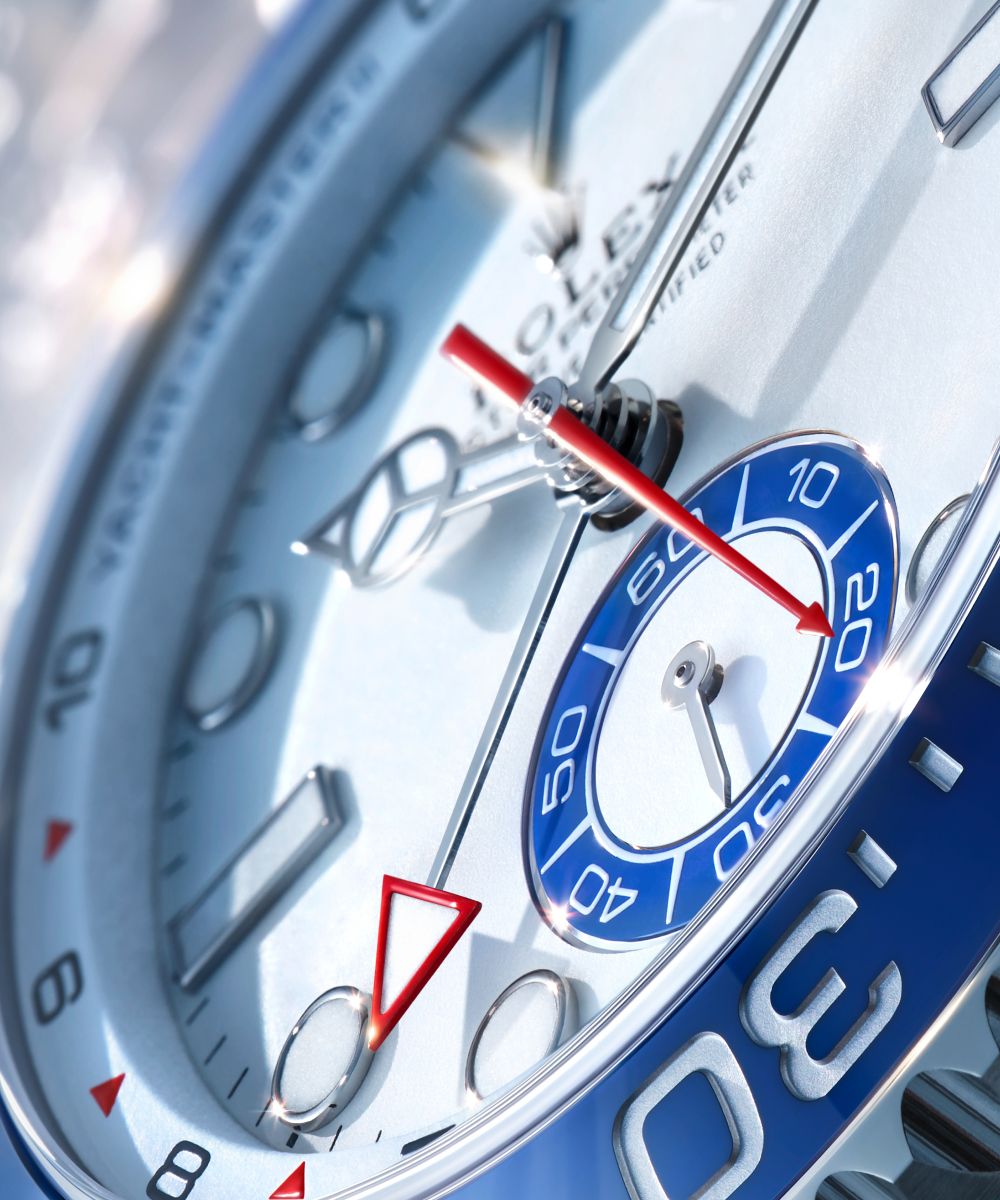

And then there is the detail that Rolex quietly notes is a first for the brand: the countdown hands turn counterclockwise. Not as a gimmick, but because a hand counting down toward zero should read as moving toward zero, and counterclockwise rotation achieves that with an intuitiveness that no clockwise countdown hand has ever quite managed. In the final minute, the seconds hand running counterclockwise can be read against the first half of the bezel's Cerachrom insert, which temporarily reads as seconds rather than minutes, giving the sailor precise second-by-second resolution at the most critical moment of the entire starting sequence. It is a detail that took genuine engineering to implement and communicates its purpose the moment you see it in use.
The Redesigned Case and Dial
The 44mm Oyster case has been entirely restyled with domed sides on the middle case that give it a more refined profile than its predecessor. The proportions feel considered in a way that the original, which wore its tool-watch brief quite visibly, did not quite achieve. The bracelet is slightly broader than before, which corrects a proportion that never quite resolved on the original model, and the Oysterlock clasp has been slimmed down for better visual continuity between case and bracelet.

The dial is white lacquer, matt rather than glossy, a decision made specifically to reduce reflections in conditions where direct sunlight is a constant and legibility under any angle matters. The applied hour markers are from the Professional collection vocabulary, robust and instantly readable. The red countdown hands and flange markers on the steel version create a clear visual hierarchy between timekeeping functions and countdown functions, so that at a glance, in the middle of a tack, you know precisely which hand is telling you what. The blue Cerachrom bezel insert in the 60-minute configuration remains, providing the time-interval measurement function that operates independently of the countdown. Between marks, leg timing, measuring elapsed time against a course plan: the bezel handles all of it while the countdown function handles the start. Two complementary tools in one object.

Calibre 4162: A New Movement Entirely
This is where the engineering commitment of this release becomes fully apparent. Rolex did not upgrade the existing calibre. They built a new one. Calibre 4162 is an evolution of the 4161 that powered the previous Yacht-Master II, but the countdown mechanism has been completely reengineered. The new programming system, for which a patent application has been filed, replaces the Ring Command architecture with the two-pusher logic described above. The column wheel and vertical clutch engagement mechanism delivers an instantaneous, precise start that is critical when synchronisation is measured in fractions of a second.
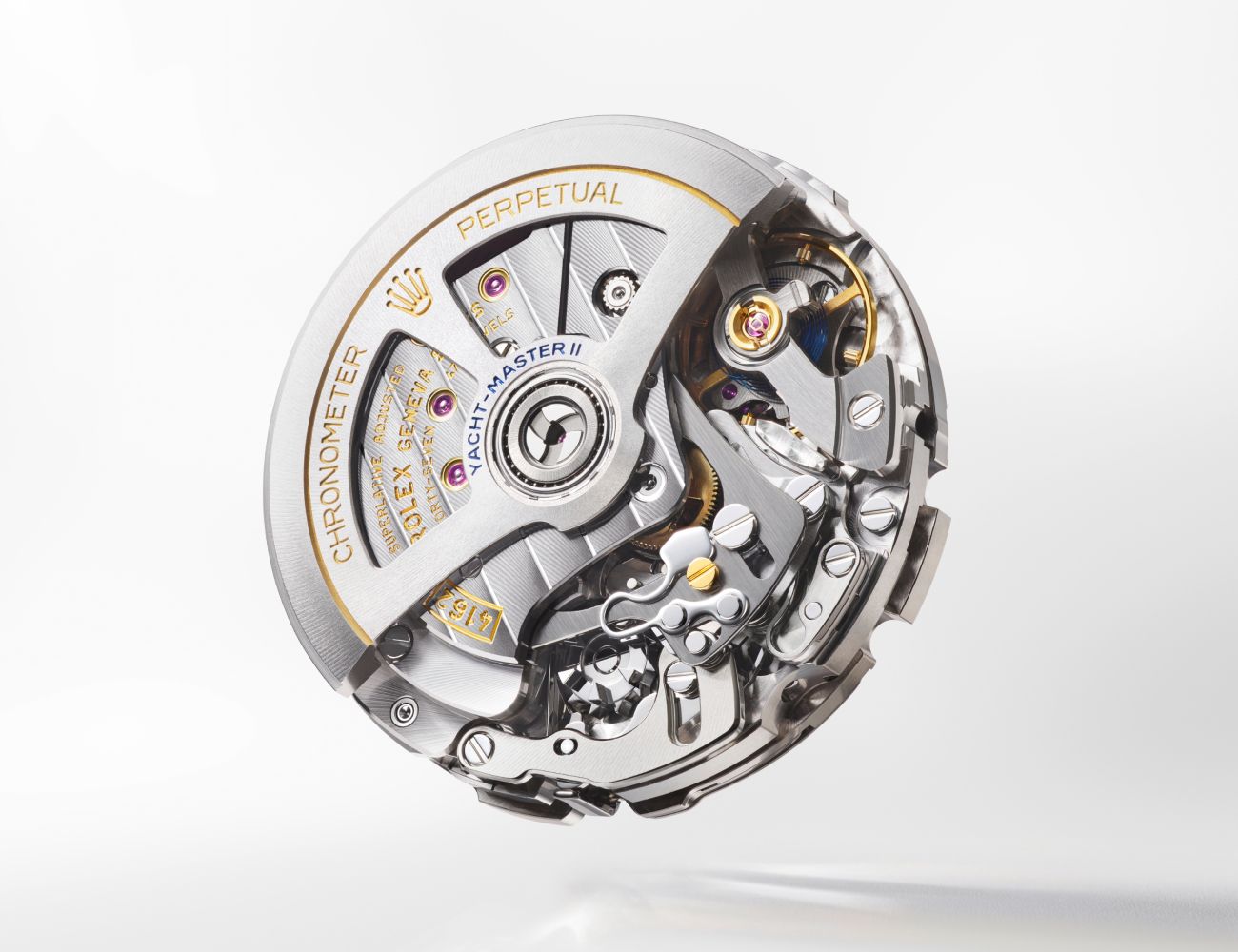
The movement incorporates the Chronergy escapement in nickel-phosphorous, the Parachrom hairspring in paramagnetic alloy, and the Paraflex shock absorbers, the same trio of technical components that appear across the current Rolex catalogue and that together produce a movement resistant to magnetic fields, temperature variation and physical shock. Power reserve extends to 72 hours, two hours more than the calibre 3235 in the Datejust, a consequence of the barrel architecture optimised alongside the new countdown mechanism.
The aesthetics of the movement have been reconsidered too. The bridges carry Rolex Côtes de Genève, the brand's own interpretation of the traditional decoration that adds a polished groove between each band to distinguish it from the standard version. The oscillating weight is cut out, revealing the movement beneath it rather than obscuring it. These are decisions that speak to a movement built for visibility as well as performance, which is appropriate for a watch whose reason for existing is to demonstrate what Rolex is capable of when it commits fully to a specific problem.
Who This Watch Is Actually For
The Yacht-Master II has always occupied a specific and slightly awkward position in the Rolex hierarchy. Too large and specialised for the collector who wants a clean sports watch. Too niche and functionally specific for someone who just wants a chronograph. And yet genuinely respected, perhaps even loved, by the people who understood what it was trying to do and appreciated how seriously Rolex had taken the brief.
The new generation resolves some of that awkwardness. The cleaner case design brings it closer to something you might consider wearing off the water. The simplified operation removes the barrier to entry that made the original feel almost intimidating to learn. And the counterclockwise countdown hands are such a confident, considered detail that they communicate something important about the attention that went into every aspect of this redesign.
For actual sailors, this is a better tool than its predecessor in every measurable way. The programming is faster, the synchronisation is simpler, and the legibility under pressure is improved. For collectors who have always found the Yacht-Master II compelling but never quite committed, this is the version that makes the strongest case. And for anyone who simply wants to understand what Rolex looks like when it approaches a mechanical problem with the full weight of its engineering capability, this is one of the most instructive watches the brand has released in years. The original Yacht-Master II was impressive. This one is resolved. There is a meaningful difference between those two things, and Rolex has spent nearly two decades learning exactly what that difference looks like.
Priced at INR 18,77,500 for the Oystersteel model and INR 53,59,000 for the Yellow gold model


