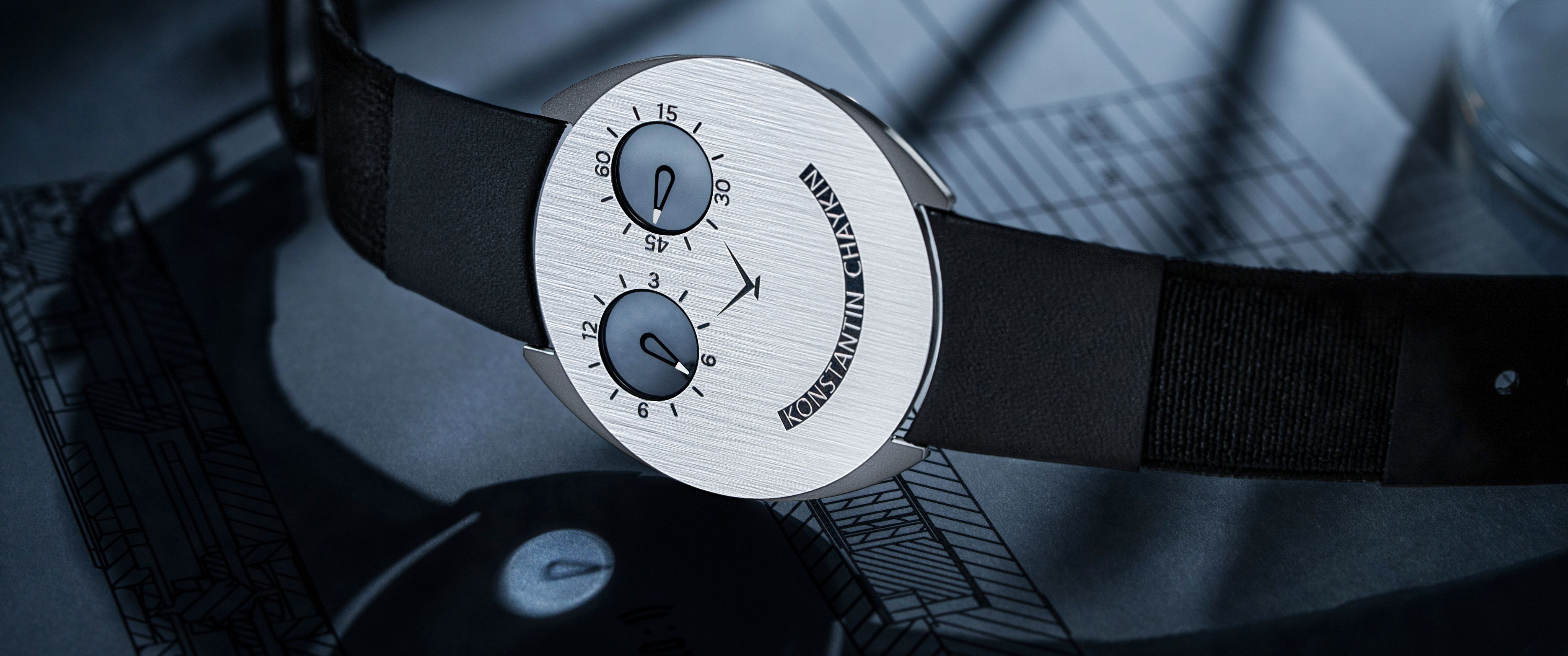
Konstantin Chaykin Unveils The 1.65mm-Thin ThinKing Mystery
 6 min read

I’d say that the most interesting thing that’s happened in watchmaking from a technical standpoint is not the arrival of Silicon or high frequency oscillators. Rather it’s something that has only cropped up very recently. The renewed interest in ultra-thin watchmaking is significant for a couple of reasons. Firstly, the record-breaking realizations of this redundancy exercise are genuinely impressive and secondly, to a certain extent, this proportional minimalism of the extreme nature is also renewing an interest and inception of slimmer watches in general.
It’s very interesting and in favor of the “tradition” of the craft to see thin watches becoming prestigious again. Building a thinner watch is a genuine mark of accomplishment and more than just “stunt watchmaking,” the very exacting examples of its extreme practice can only promote thinner watches across the board, particularly given the dominance of sports watches.
Particularly in this genre, I think there’s plenty of weight to shed and thickness to remove. As a late developing watchmaking trend, ultra-thin watchmaking is going to find its way into the mainstream and that’ll be a consequence of some impressive creations like the Konstantin Chaykin ThinKing Mystery.
First introduced as the ThinKing Prototype in 2024, with its follow-up final prototype released last year, Russian watchmaker and inventor Konstantin Chaykin has now introduced what’s at 1.65 mm, the world’s thinnest mechanical watch as a limited edition of 12 pieces.
From Record To Reproducible
When Konstantin Chaykin first introduced the ThinKing in 2024, it felt like a one-off record-setter, you might see once and never again. With the new ThinKing Mystery, that singular experiment becomes a limited production watch - just 12 pieces, built on an internal ecosystem of protocols, tooling, and quality control that would not look out of place in aerospace. What might once have been a “lucky” outlier is now a construction that Chaykin insists is robust, repeatable, and industrially controllable at 1.65 mm.
Joker DNA, Robert-Houdin Mystery
Visually, ThinKing Mystery sits at an unusual intersection of Chaykin’s own mythology. The basic concept still traces its lineage back to the Joker - the watch that made his name globally, with its animated, expressive “eyes” doing double duty as indicators. On the ThinKing Mystery, those eyes remain, but something critical has changed: they are now completely transparent sapphire, their previous crossbars gone, leaving the indications to float in space. ThinKing Mystery adopts the same sleight of hand as Jean‑Eugène Robert‑Houdin’s signature floating hand trick via its time indicated by sapphire discs that appear to hover.
A 1.65 Mm Load‑Bearing Case
At 41 mm in diameter and 1.65 mm in thickness, the case of the ThinKing Mystery is not a container, it is a structural component in the strictest engineering sense. It acts as a load‑bearing frame that must maintain geometry under stress, despite near-nothing dimensions. To make this viable, Chaykin’s Manufacture turned to a high‑precision, fully non‑magnetic alloy with increased rigidity and corrosion resistance, then subjected it to demanding heat treatment to raise hardness and resistance to plastic deformation.
Here, the in‑house calibre K.23‑3.1 is integrated into the caseback, which doubles as the movement’s mainplate. This tight coupling between case and caliber is one of the keys to achieving such a small profile without sacrificing stability. It also makes finishing dramatically more complex, which nonetheless, obeys the full canon of haute horlogerie. The bridges and mainplate are decorated with perlage and straight graining, the wheels with circular graining, and every bevel is hand‑cut and polished to a mirror shine - operations that must be executed while constantly measuring thickness and flatness so as not to compromise the overall architecture.
A Dual‑Balance Plane And An Ultra‑Thin Barrel
The mechanical layout of the caliber K.23‑3.1 is as radical as its silhouette. The balance assembly is arranged in a single plane as two interlocking wheels: one governs the frequency and isochronism of the oscillations, the other, equipped with a roller, acting as the impulse‑jewel plate engaging the pallet fork. This dual‑balance with toothed coupling is a patented solution, operating at 18,000 vibrations per hour and designed to preserve stable amplitude in a movement where vertical layering is practically forbidden.
The barrel is also an exercise in extremity. It is ultra‑thin, with no traditional upper cover, and has been re‑engineered for this new iteration. The bridge holding the barrel is strengthened with stiffening ribs to counteract flex, while the barrel arbor incorporates an overrunning clutch with tungsten carbide balls - a detail that would be overkill in a thicker caliber, but here becomes essential to managing torque in as controlled a way as possible. Despite the architectural constraints, power reserve has been increased from 32 to 38 hours, all from a single ultra‑thin barrel, itself the subject of a patent.
The watch achieves an accuracy of −15/+20 seconds per day and weighs just 12.1 g without the strap.
No Crown, But Tools
Given the extremity of the architecture, Chaykin made an early decision: there would be no crown. A conventional winding and setting organ not only risks adding to the thickness, it would visually drag down the watch’s clean, blade‑like silhouette. Instead, he chose to extend the concept of the watch into two dedicated tools, each with its own safety mechanisms and mechanical interest.
The first is a compact winding box made of carbon and stainless steel, measuring 47 × 43 × 9.2 mm and weighing 30 g, comprising 112 components including the winding and time‑setting mechanism and a safety reversing clutch.
The second device is an elongated stainless‑steel key, 94 mm long and 9.50 mm in diameter, made of 26 components and also equipped with a safety mechanism. It fits into a special slot in the caseback, winding or time‑setting is performed by turning it, with the internal clutch again stopping the user from going too far.
A Foundation, Not An Endpoint
Konstantin Chaykin has been explicit that, for all its drama, the ThinKing Mystery is not an endpoint but a foundation. His focus, at this stage, is on establishing the groundwork for the regular production of ultra‑thin watches, with the solutions developed for this piece set to evolve into future variations and complications. In that sense, ThinKing Mystery is less a standalone oddity and more a statement of technological intent: a demonstration that 1.65 mm can be not only reached, but industrialized, finished to haute horlogerie standards, and made wearable.
As an impressive participant in the race to realize the thinnest mechanical watch, the ThinKing Mystery proves that it doesn’t necessarily take a ton of thickness to make a watch tough and, it doesn’t take a lot of thickness to make a watch pretty. Right now is what could be the golden era of thin watches and creations like these do set a direction.
You can only make watches bigger or smaller so many times. Hence, thickness is what's next.


