
Omega Launches A Two-Hand Constellation Collection That Earned Master Chronometer Status Without A Seconds Hand
 5 min read

In a breakthrough that quietly rewrites the rules of high-precision watchmaking, OMEGA has unveiled the Constellation Observatory Collection the first two-hand watch in history to earn Master Chronometer certification. No seconds hand. No visual sweep to track. Just hours, minutes… and an entirely new way of listening to time.

At the heart of this achievement is a revolutionary acoustic testing method developed by OMEGA’s Laboratoire de Précision and certified by METAS. By combining sound analysis with optical hand tracking, the laboratory can now evaluate a watch’s performance without relying on the traditional seconds hand, long considered essential for precision testing. For the first time ever, a watch displaying only hours and minutes can pass both Chronometer and Master Chronometer standards as a complete timepiece.
A Legend Reinvented: The Constellation Observatory
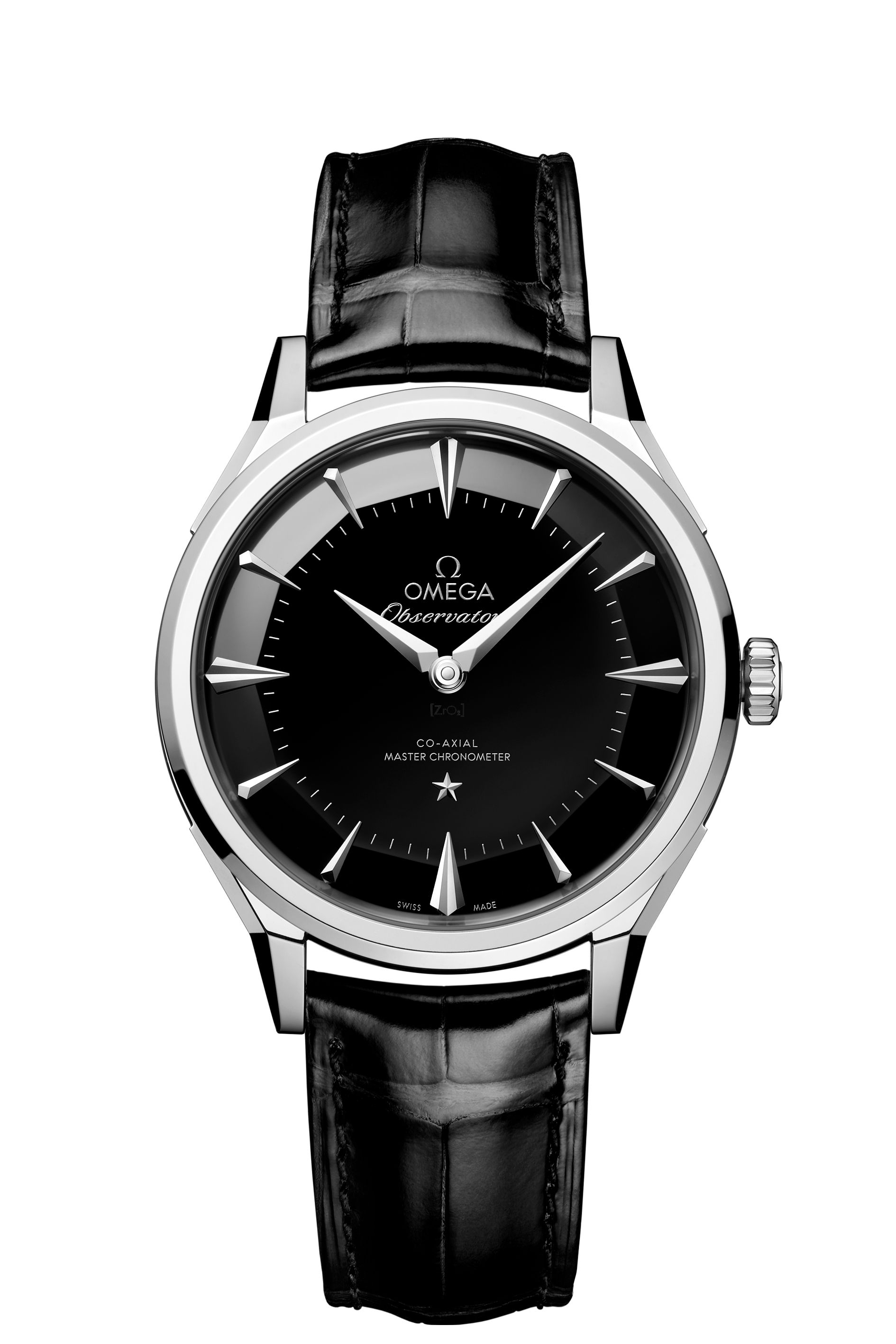
Since its debut in 1952, the Constellation line has symbolized OMEGA’s pursuit of certified accuracy. The new Constellation Observatory Collection represents the next evolutionary leap in that legacy. Housed in a refined 39.4 mm case, the collection introduces two entirely new movements across nine references. These watches fuse decades of Constellation design heritage with cutting-edge testing methods and exclusive materials, proving that innovation and tradition can coexist beautifully.

OMEGA President and CEO Raynald Aeschlimann sums up the significance: “Until now, precision certification has required a seconds hand. The development of a new acoustic testing methodology has made that requirement obsolete. It is this breakthrough that has enabled us to present the Constellation Observatory the first two-hand watch to achieve Master Chronometer certification.”
A Timeline of Precision
OMEGA’s journey to this milestone spans nearly eight decades:
1948 — The Centenary becomes OMEGA’s first chronometer-certified automatic wristwatch.
1952 — Constellation launches as the brand’s first serially produced chronometer collection. Every mechanical Constellation since has met chronometer standards.
1999–2013 — Introduction of the Co-Axial escapement, the first practical new escapement in 250 years, dramatically reducing friction and improving long-term accuracy. Fully anti-magnetic movements soon follow.
2015 — The Globemaster becomes the world’s first Master Chronometer certified by METAS, tested as a complete watch for precision, magnetic resistance, power reserve, and water resistance.
2023 — OMEGA establishes the Laboratoire de Précision, accredited under ISO/IEC 17025:2017.
2026 — The Constellation Observatory becomes the first two-hand collection tested using an acoustic method that eliminates the need for a seconds hand.

More than just a testing facility, the Laboratoire de Précision operates as an independent certification body. Its measurement technology, management structure, and procedures are all validated by METAS for Master Chronometer testing and accredited by SAS for Chronometer certification. The result is a system designed to guarantee impartial, confidential, and industry-reliable results.
Dual Metric Technology: Listening to Time
Traditional precision testing depended on photographing the position of a seconds hand effectively capturing a single data point per day. OMEGA’s new Dual Metric Technology changes everything. A wireless, self-contained testing unit continuously records the sound of each tick and tock while simultaneously monitoring environmental conditions such as temperature, position, magnetic exposure, and atmospheric pressure throughout the full 25-day testing period.

From the very first second, the system generates a constant stream of data. By analyzing the watch’s acoustic signature, technicians can detect frequency irregularities, positional sensitivity, pressure effects, amplitude fluctuations, and thermal responses. In other words, they can pinpoint not only that a deviation occurs but exactly when and why.
Heritage in Every Detail
While the technology is futuristic, the design speaks fluently in vintage Constellation codes. The aesthetic lineage traces back to the 1948 Centenary and early Constellation models, expressed through a series of signature elements:
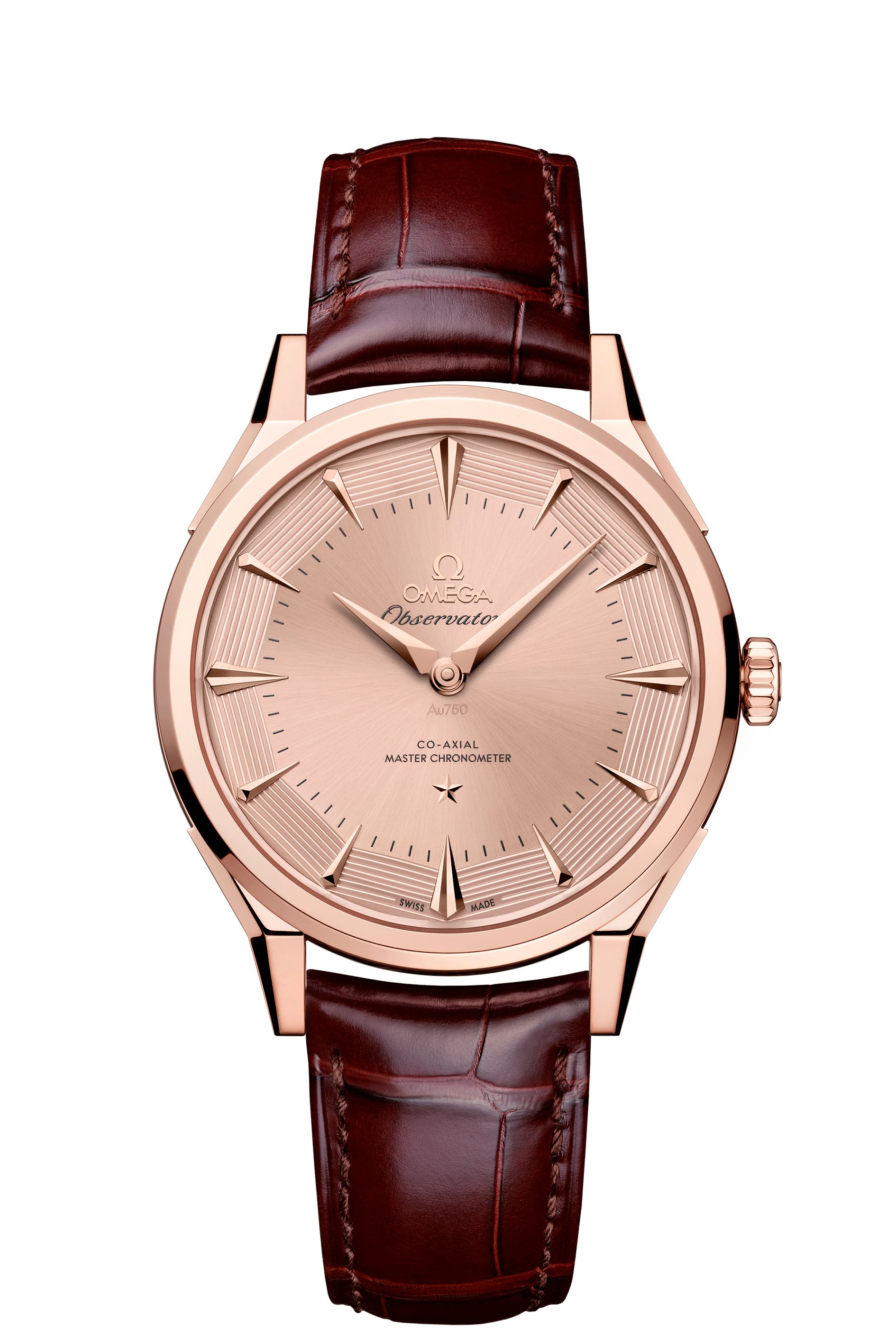

- The iconic dodecagonal “pie-pan” dial
- The Constellation star at 6 o’clock
- The Observatory medallion engraved on the caseback
- Guilloché finishing across the dial facets
- Faceted kite-shaped hour markers
- Classic dauphine hands
- Distinctive dog-leg lugs
- A nine-row brick-pattern mesh bracelet in 18K Moonshine™ Gold inspired by vintage designs
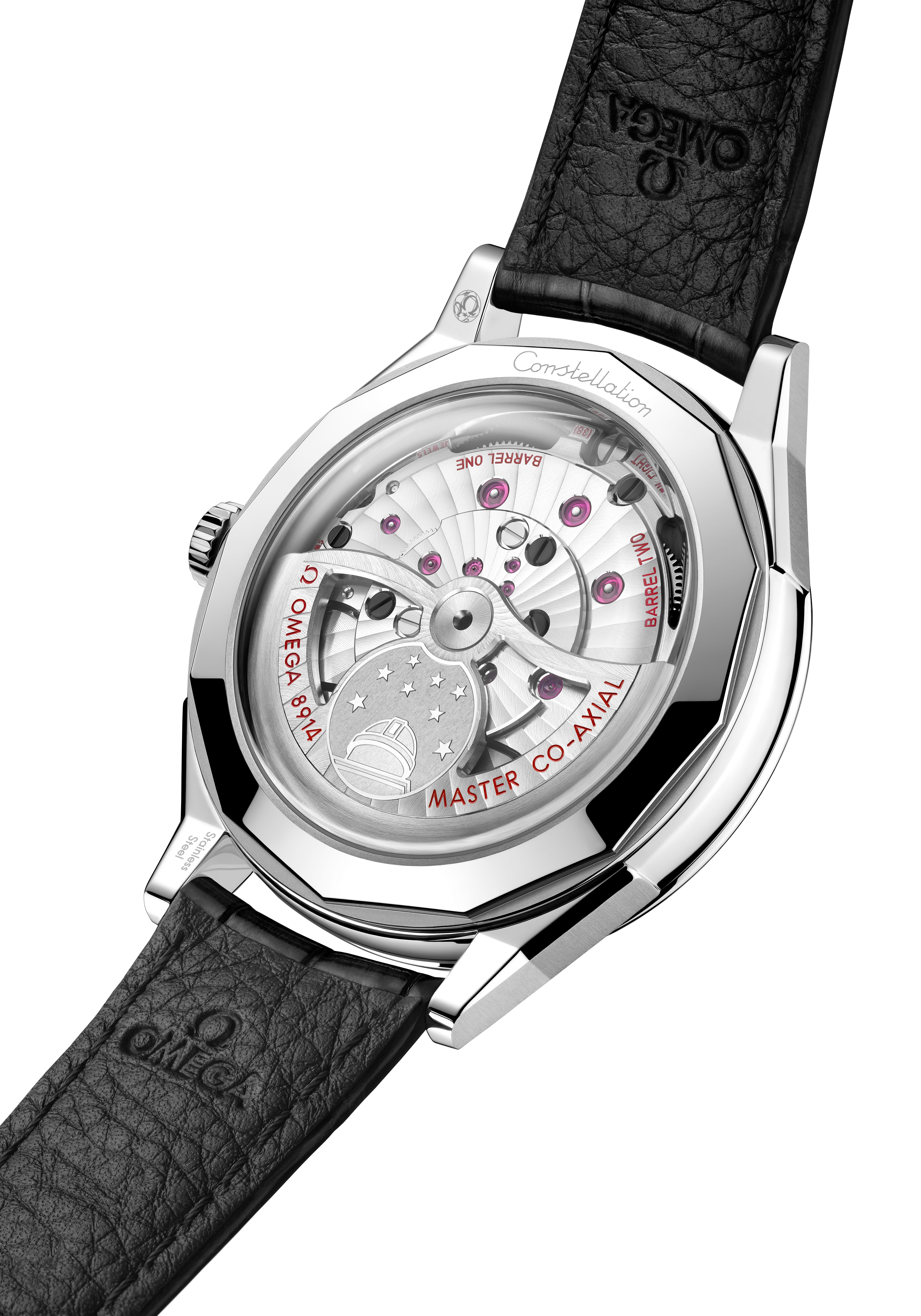
Together, these details create a watch that feels unmistakably Constellation refined, architectural, and quietly luxurious. Powering the collection are two newly developed calibres, both built on a skeletonised rotor architecture with polished bevels, a rounded rotor perimeter, and an applied Observatory medallion.
Calibre 8915 Grand Luxe & Luxe: The Grand Luxe version accompanies the Platinum-Gold model. Its rotor base is crafted from 18K Sedna™ Gold with a fine spiral finish and polished outer zone. The Observatory medallion in 18K white gold features laser-engraved details, a dark blue aventurine sky with eight stars, and a dome rendered in translucent white opal enamel.
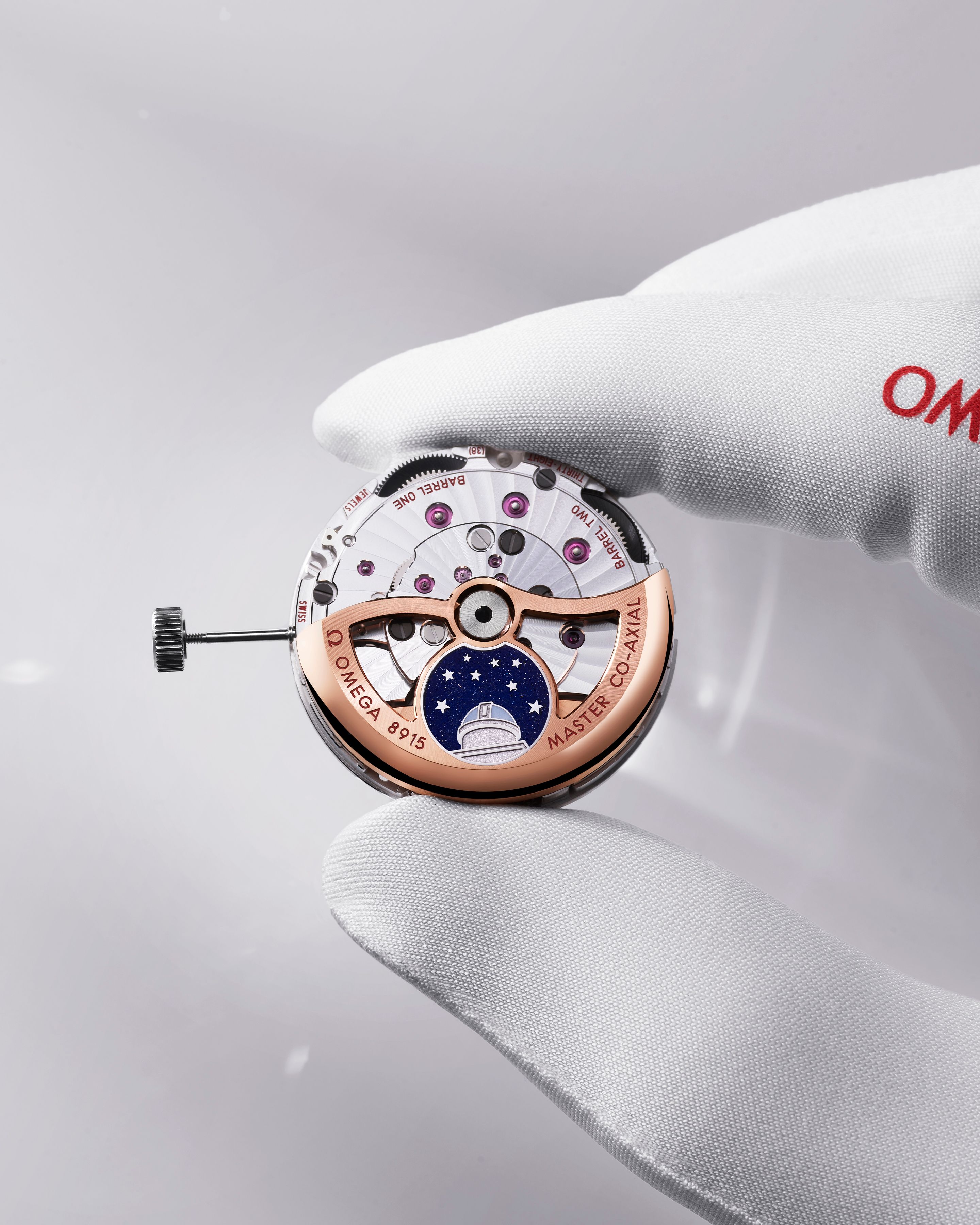
The Luxe variants serve the 18K gold models and introduce another first: the use of an 18K Moonshine™ Gold rotor and balance bridge, alongside Sedna™ Gold. Geneva waves in arabesque decorate the rotor base, contrasted by a brushed outer ring. The medallion is executed in matching gold with alternating matte and polished finishes.
Calibre 8914 Standard: Designed for the O-MEGASTEEL versions, Calibre 8914 mirrors the Luxe architecture but features a rhodium-plated finish, maintaining the same technical excellence in a more contemporary material context.
Materials: A Spectrum of Luxury
Precious Metal Editions (Calibre 8915)
Four expressions in OMEGA’s proprietary gold alloys create a seamless precious-metal identity, with case, hand-guilloché dial, and movement crafted in matching 18K Sedna™ or Moonshine™ Gold. These are offered on either leather straps or bracelets.
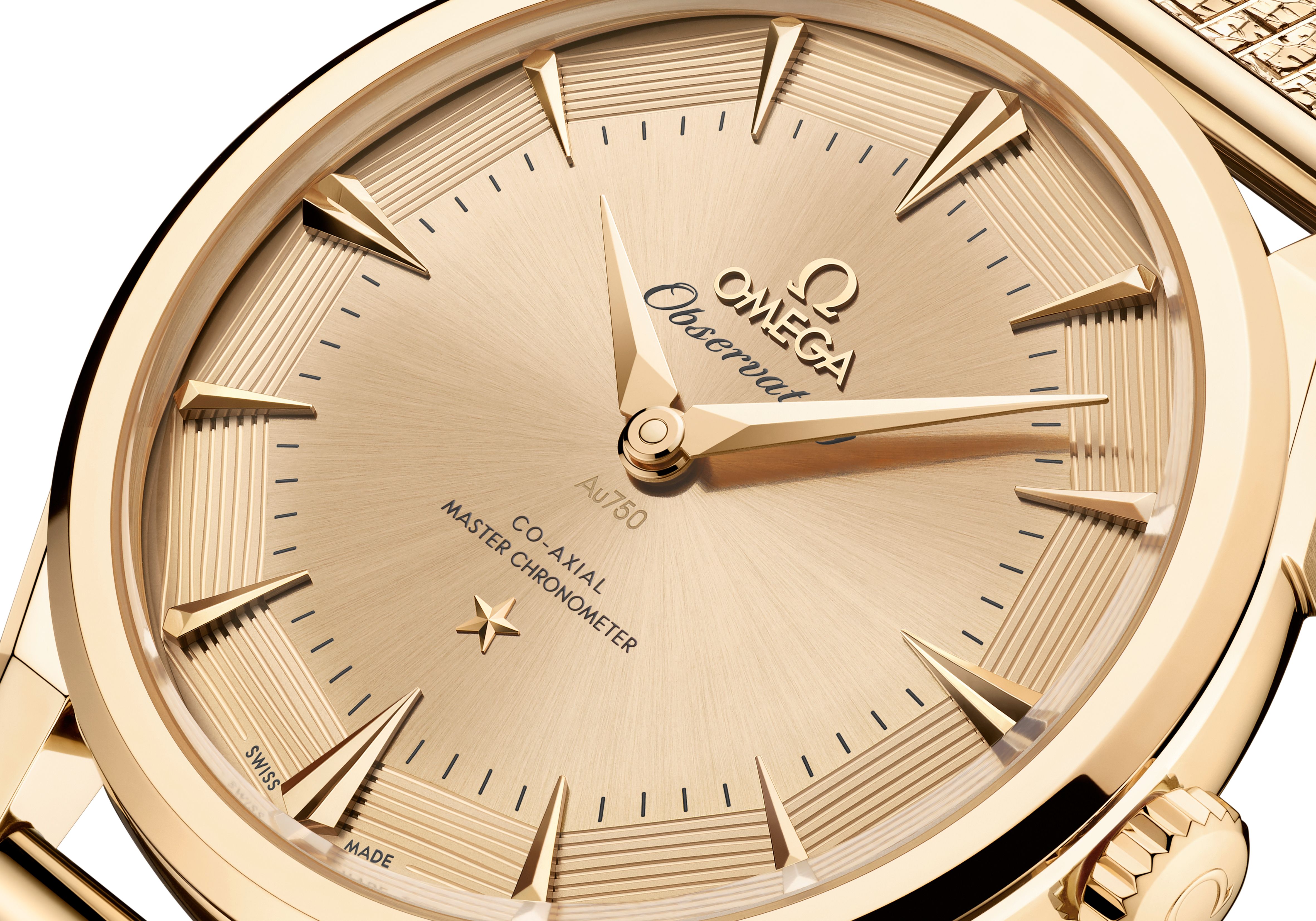
The Canopus Gold™ model stands apart with a striking contrast: a clean, monochromatic exterior paired with a Sedna™ Gold movement visible through the sapphire caseback.
A Platinum-Gold edition completes the quartet, bringing all four of OMEGA’s proprietary precious metals together in one collection for the first time.
O-MEGASTEEL Editions (Calibre 8914)
Four additional references showcase OMEGA’s exclusive steel alloy, chosen for its superior hardness and mechanical performance. Most notable is a black ceramic pie-pan dial a major technical achievement requiring extensive development to produce the precise dodecagonal geometry in ceramic. Three additional models feature colored dials with stamped groove facets, adding depth while maintaining the collection’s crisp architectural character.

The Constellation Observatory Collection does more than introduce new watches it challenges a fundamental assumption of horology: that precision must be visible to be measurable. By proving that accuracy can be heard rather than seen, OMEGA has opened the door to an entirely new category of certified timepieces. The absence of a seconds hand is no longer a limitation it is a statement. In an industry built on tradition yet driven by innovation, this may be one of the most subtle revolutions in decades.
Price:
O-Mega Steel- ₹10,43,200
Moonshine Gold- ₹56,45,200
Canopus Gold- ₹42,09,300