
Watches And Wonders 2026: How Roger Dubuis Turned Celestial Mechanics Into Four Of 2026's Most Compelling Watches
 7 min read

Roger Dubuis walked into Watches & Wonders 2026 with four watches and a clear thesis: that the sky above us - its rhythms, its vastness, its ancient relationship with human timekeeping - is not a mood board. It's an engineering brief. Every piece the Maison unveiled this year ties back to celestial mechanics in some concrete, horological way, not just in colour names and marketing copy. Whether that's a moonphase accurate to 122 years, four balance wheels fighting each other into submission, or a legendary sword-bearer rendered in diamonds and mother-of-pearl, Roger Dubuis came to Geneva with a point to make.
Three of the four releases are built around the Excalibur Biretrograde family - a lineage that traces directly to founder Mr. Roger Dubuis himself, who co-patented his biretrograde mechanism with Jean-Marc Wiederrecht back in 1989. That patent wasn't just a design flourish; it was a genuine engineering rethink. Out went strip springs, in came spiral springs positioned directly on the hand pinions. The cam was redesigned. Assembly got easier, precision improved, and the result - two hands sweeping elliptical arcs and snapping back to their origin - became the defining visual signature of everything that followed when the Maison opened its doors in 1995. Thirty years later, that mechanism remains the spine of the collection, and this year it received a meaningful upgrade.
The Headliner: Excalibur Biretrograde Perpetual Calendar (RDDBEX1178)
The perpetual calendar was Mr. Roger Dubuis' personal obsession. A complication that demands patience and methodical thinking, you're essentially programming a mechanical computer to understand that February is shorter than March, that every four years an extra day arrives, and that none of this repeats in a clean, simple cycle. Getting it wrong is obvious. Getting it right means a watch set correctly today displays the correct date through February 28, 2100, without ever needing a correction.
The new RD850 calibre powering this piece is an upgraded generation of the Maison's biretrograde perpetual calendar movement, and the most practically significant change is the addition of a month corrector. It sounds minor. It isn't. On previous perpetual calendar movements, adjusting the month indication required navigating a more complex process. Now, a single pusher handles it. That's the kind of quality-of-life improvement that owners actually feel, and it also protects the mechanism from over-correction damage, a real concern with any perpetual calendar.
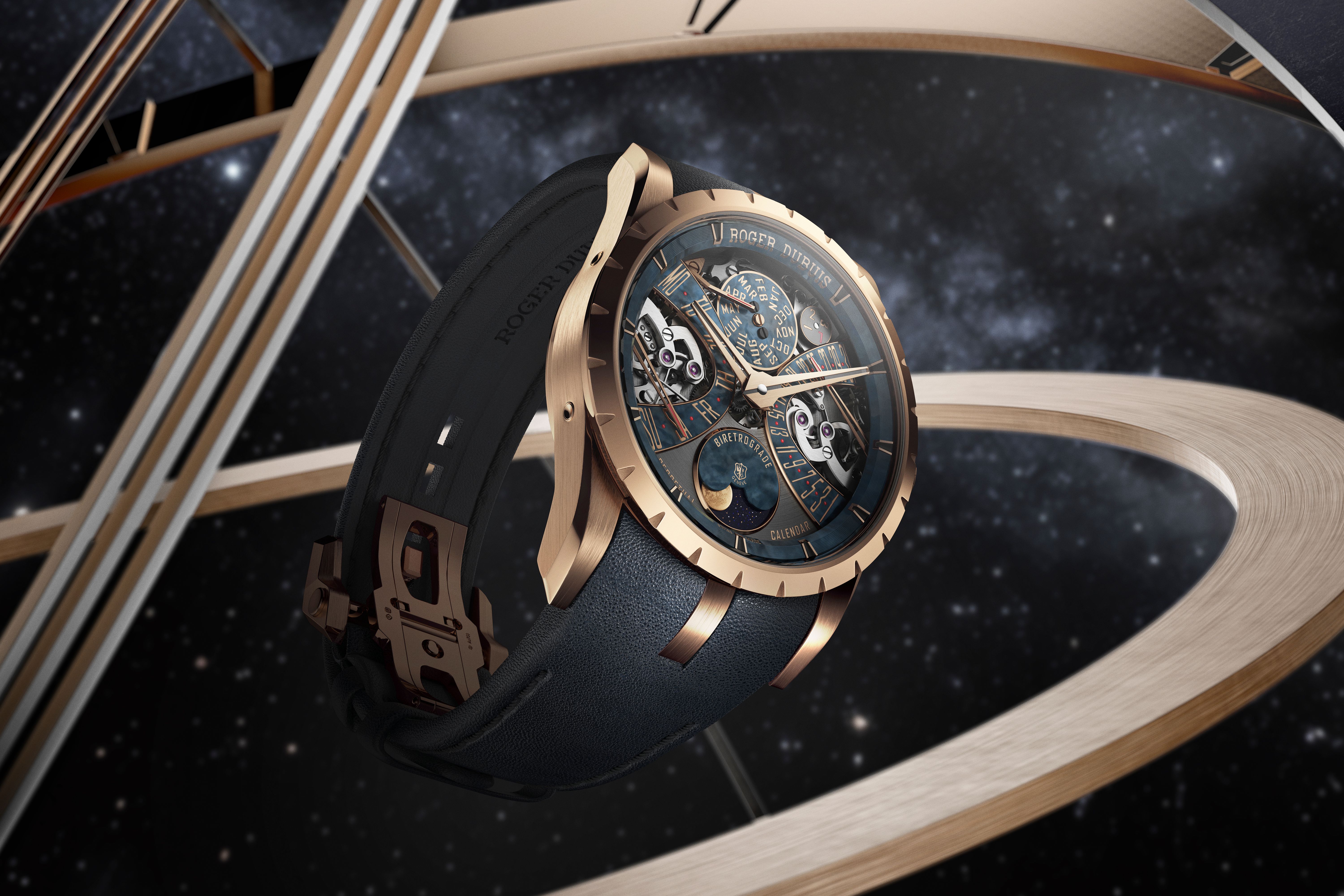
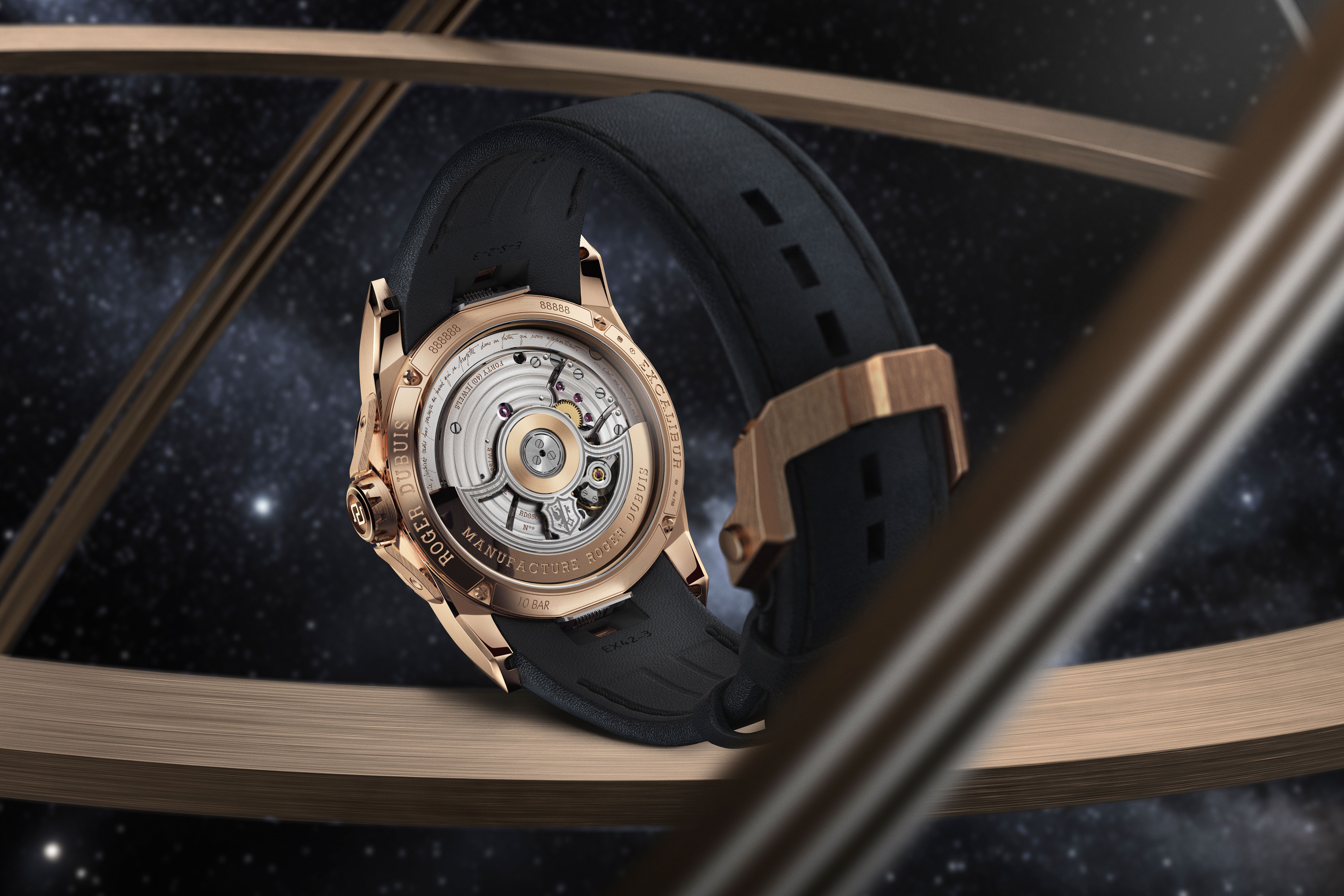
Beyond that functional improvement, the movement itself is a 435-component, 40-jewel in-house manufacture calibre beating at 4Hz, delivering 60 hours of power reserve. It carries the Poinçon de Genève certification — not a marketing badge at Roger Dubuis, but a genuine third-party audit of origin, construction, finishing, and performance. The calibre displays 19 different finishing techniques, and one of them deserves specific attention: inner angle finishing. This is exactly as labour-intensive as it sounds. Craftspeople press and work the material manually to achieve crisp, polished interior angles, the kind that are invisible from a metre away but represent hours of skilled hand-finishing. You'll find it on the W-shaped retrograde bridges at 3 and 9 o'clock, appearing 14 times across the movement.
The astronomical moonphase at 6 o'clock is the other headline. Roger Dubuis has calibrated it to 29 days, 12 hours, and 45 minutes, the actual synodic lunar cycle, rather than the approximated 29.5 days used by most standard moonphase mechanisms. That difference accumulates into a one-day error every two to three years on a standard display. Here, the first correction needed is roughly 122 years from now. A single click. This is not a decorative moonphase; it's a scientific instrument wearing a dress. The dial itself is layered nine deep, with an "Astral Blue" colourway centred on an aventurine moonphase disc and Astral Blue mother-of-pearl counters. The moon on that disc is an 18K pink gold dome, laser-engraved for texture. The case is 40mm in 18K pink gold, 12.25mm thick, with a leather strap in matching Astral Blue calfskin. This is a limited edition of 188 pieces.
The Accessible Entry: Excalibur Biretrograde Calendar in Cosmic Blue (Steel)
Not everything from Roger Dubuis needs to arrive in precious metal with a three-year waitlist. The Excalibur Biretrograde Calendar in steel is the Maison acknowledging that the biretrograde display — one of watchmaking's more entertaining mechanical spectacles — deserves to live in a case that more people can realistically consider.
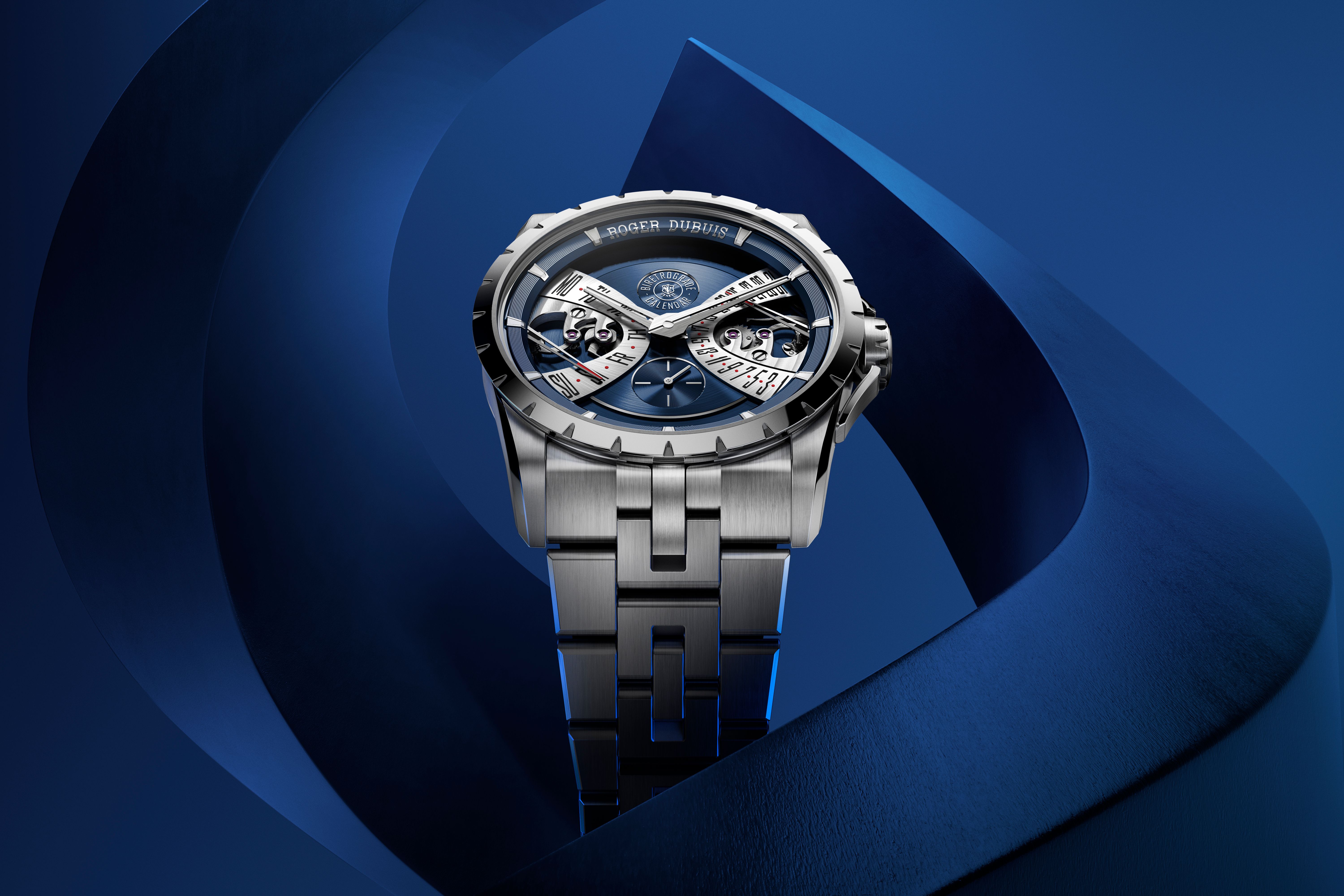
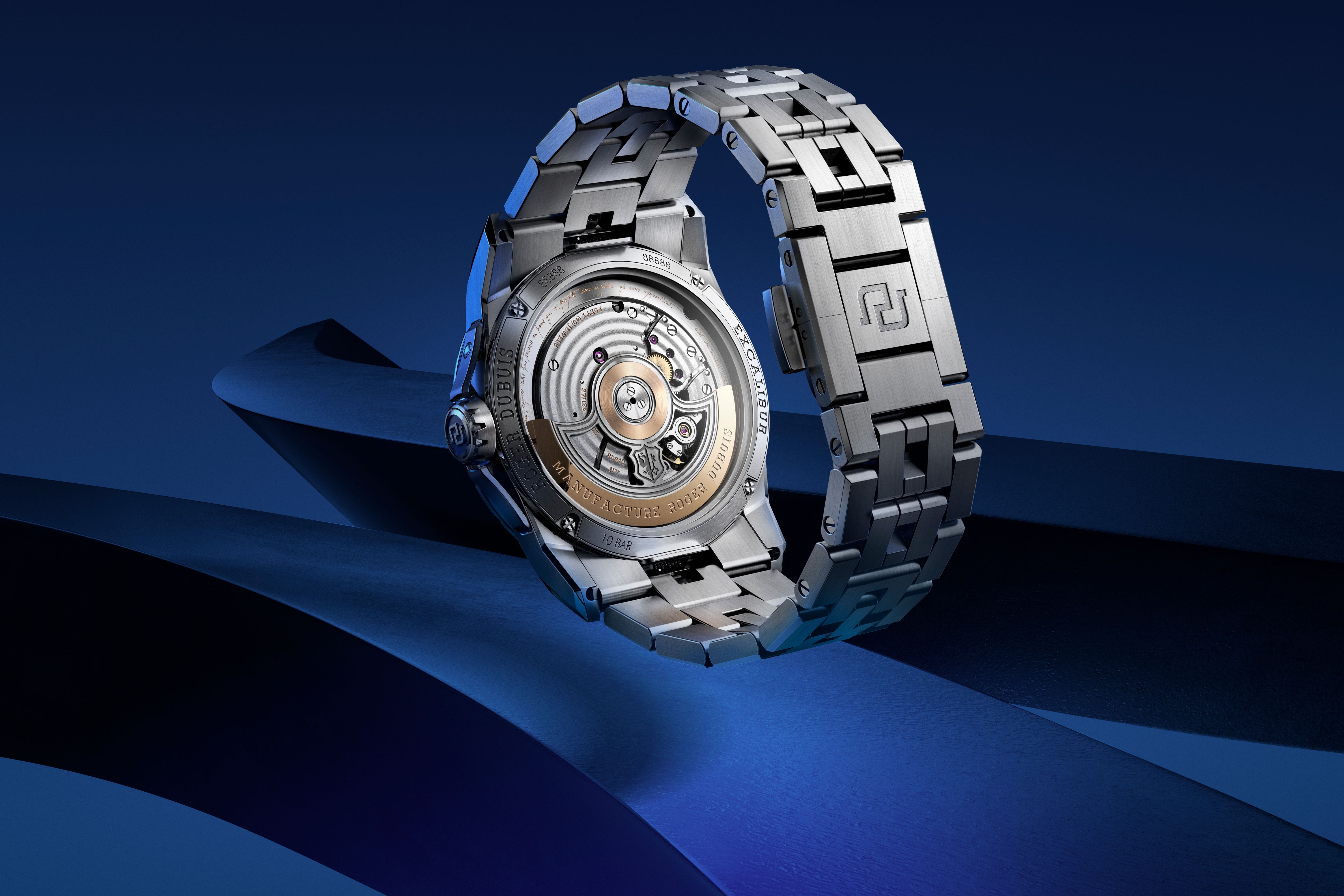
The case is 316L stainless steel with a thoughtful mix of polishing, shot-blasting, and satin-brushing across its surfaces. It's 40mm, a size that sits well on a wide range of wrists, and the "Cosmic Blue" dial - Roger Dubuis' description of the particular shade of sky between afternoon and night - gives the piece genuine personality without veering into costume territory. Inside is the RD840, an automatic calibre with 60 hours of power reserve and a sculpted oscillating weight that references the Maison's original 1996 rotor design. The movement carries 14 finishing techniques and the Poinçon de Genève. Through the sapphire caseback you get a real show - the retrograde bridges, the Côtes de Genève striping, the full choreography of the mechanism at work. The dial has seven layers. The ecliptic counters, where the retrograde day and date hands do their arcing sweep, are sun-brushed with rhodium coating. The package ships with a stainless steel multi-link bracelet and includes an additional blue rubber strap - a practical acknowledgment that a watch like this should be comfortable in more than one situation. This is the piece for someone who wants genuine biretrograde horology without the pink gold price tag.
The Conversation Stopper: Excalibur Perpetual Calendar Quatuor (RDDBEX1127)
Eight pieces. That's the entire edition. If you need context for what the Quatuor represents, consider this: most mechanical watches use a single balance wheel to regulate timekeeping. The Quatuor uses four, beating simultaneously at 4Hz each, arranged to cancel out the positional errors that gravity introduces into any single oscillator. It's a solution to a very old problem, the fact that a watch lying flat on a table keeps different time than one standing upright — and it requires two patents (both filed in 2013 by Roger Dubuis) to make it work in a wearable package. Combining that complication with a full perpetual calendar - day, date, month, leap year — in a single movement is the kind of project that most manufactures would not attempt. The RD116 calibre that results from this combination has 758 components and 86 jewels. It's manually wound, which given everything else it's doing is almost a mercy — one fewer system to engineer. Power reserve is 40 hours. Frequency is 4x 4Hz. The movement is 13.75mm thick.
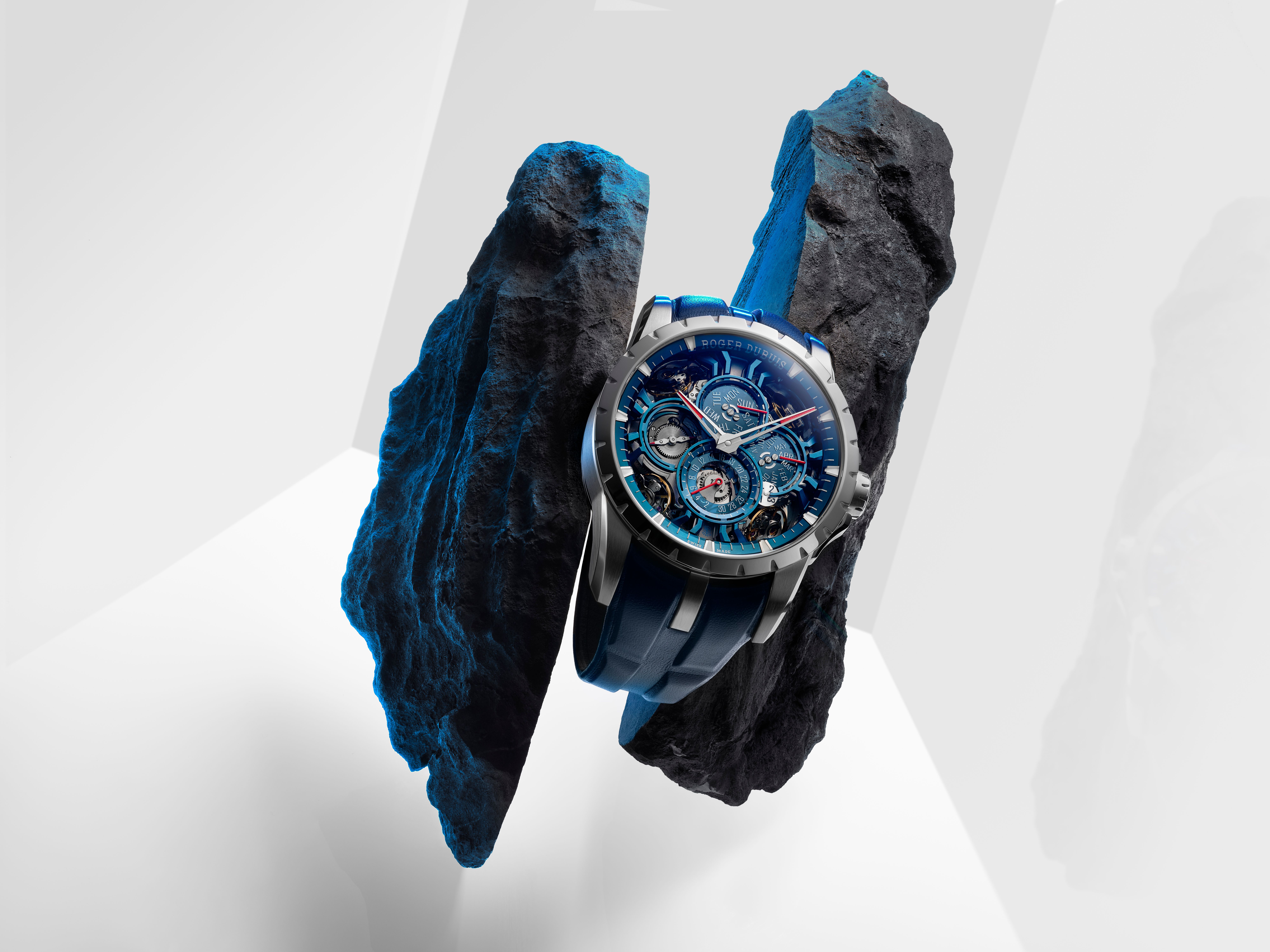
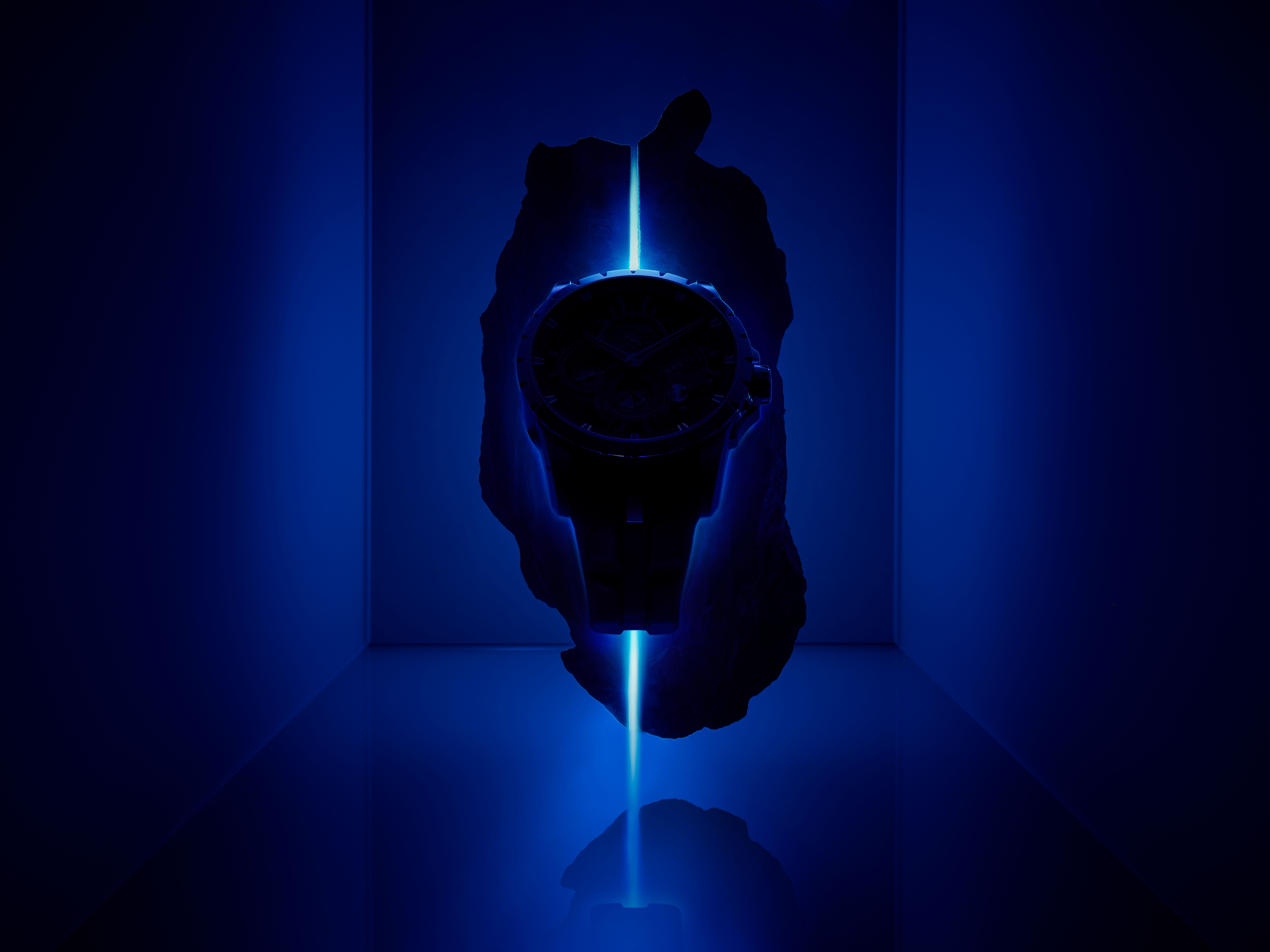
The case is 48mm Cobalt Chrome - Roger Dubuis' signature high-performance alloy, chosen for its hardness, its distinctive grey-blue appearance, and its lightweight character relative to steel. At 20.2mm thick, this is not a watch that pretends to be anything other than what it is: an extreme horological object. The calendar discs are in sapphire glass with metallization, which means you're looking through the display rather than at it. The dedicated box comes with an automatic crown-winding mechanism. Eight people in the world will own this. The rest of us get to understand what it means.
Roger Dubuis Excalibur Moonlight
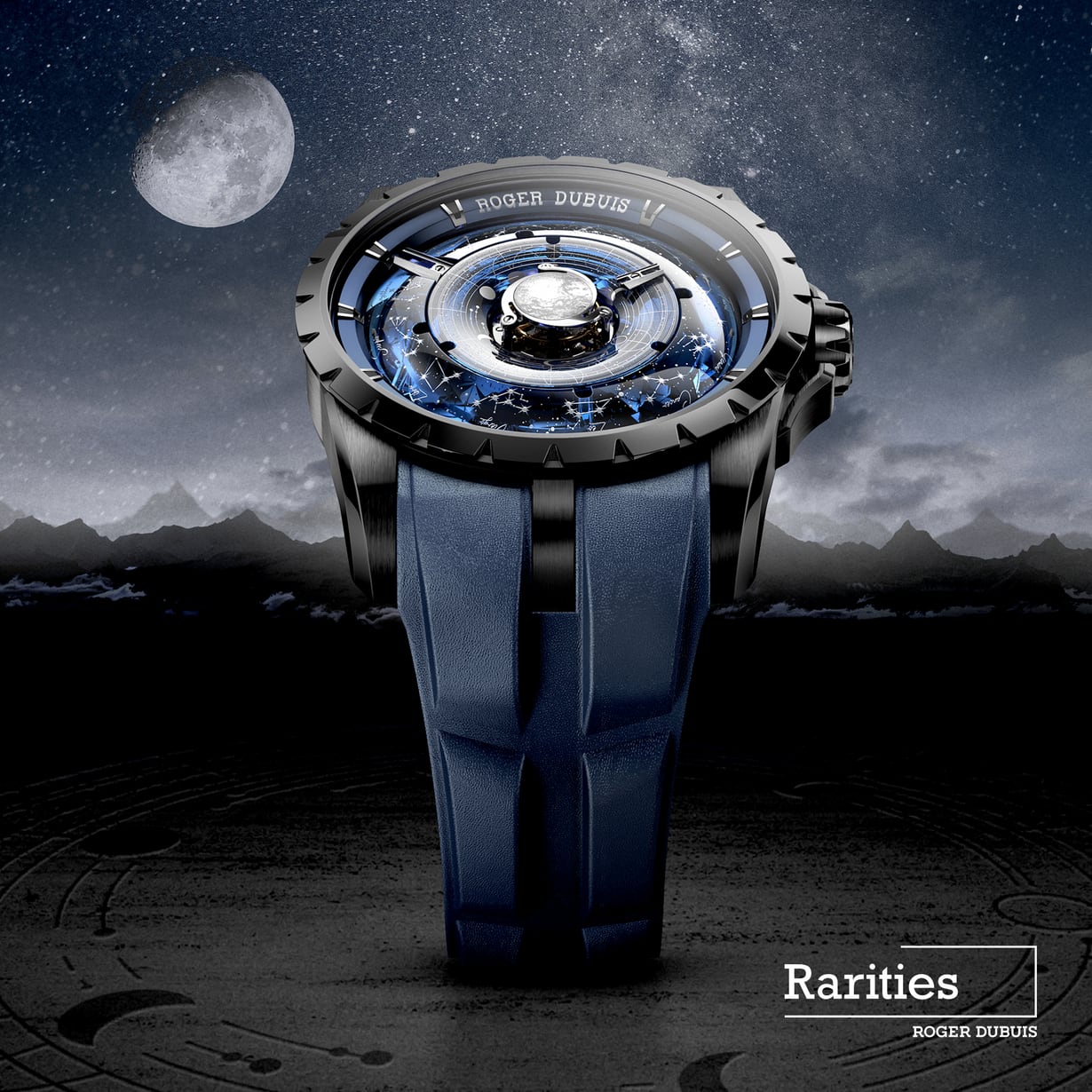
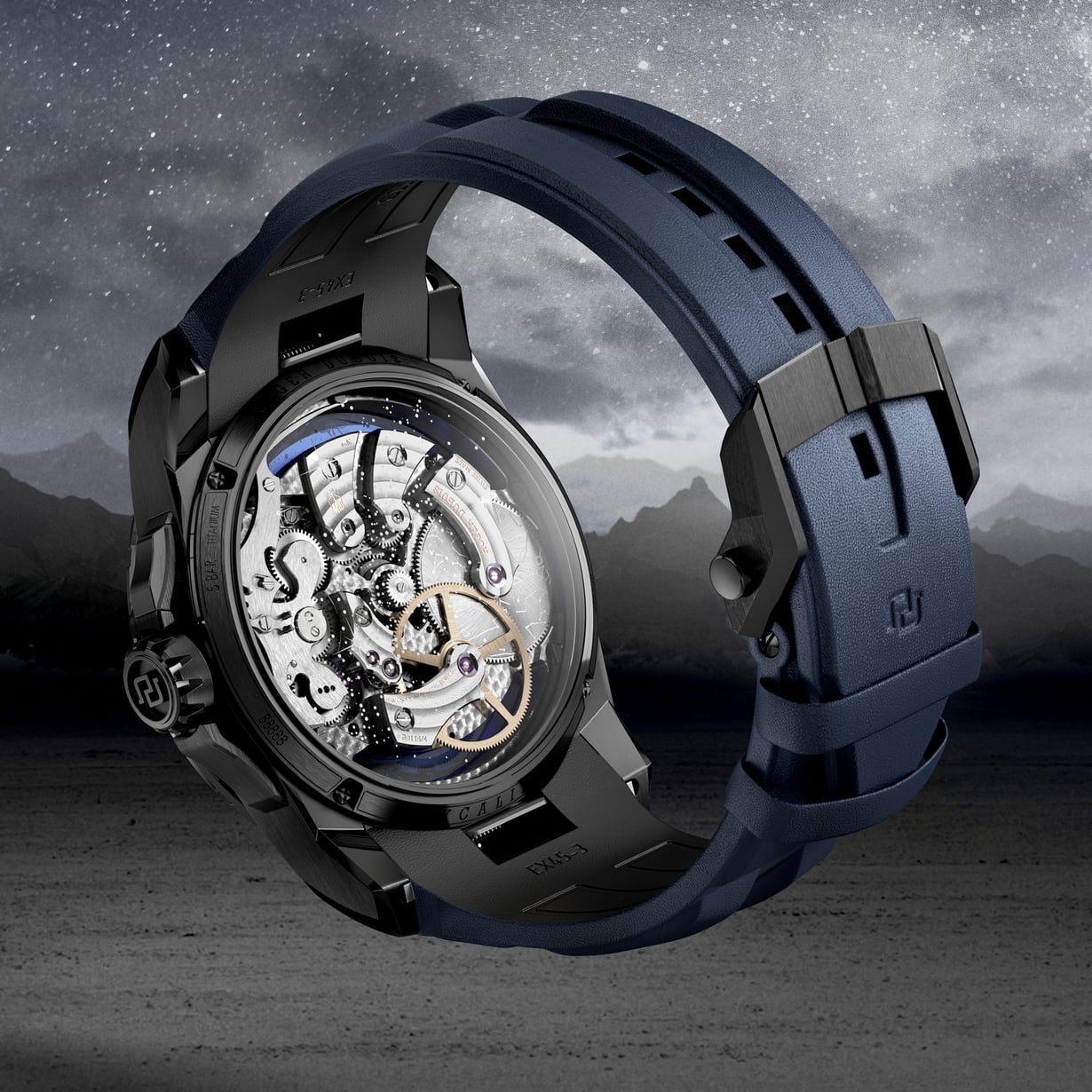
The Excalibur Moonlight is built around a single decision: placing a flying tourbillon at the absolute centre of the movement rather than its conventional position. That one choice cascaded into a complete redesign of the going train and the display architecture, generating two patents in the process. The RD115 calibre that resulted carries a 72-hour power reserve sustained by a planetary differential gear train, and is certified by the Poinçon de Genève across 283 components finished with 19 distinct techniques. The dial above it reads in four layers simultaneously: a blue brass flange with rhodium indexes at the outer ring, a rotating hours disc in translucent Murano-style blue glass depicting the twelve zodiac constellations named in full, a minutes disc with luminescent moon phases, and at the centre, a hand-engraved tourbillon cage reproducing the texture of the lunar surface, turning with the seconds. On the caseback, laser-engraved alveoli filled with luminescent material glow green in the dark. The constellation pattern on the barrel cover can be configured to reflect the night sky of any date the owner chooses. That last detail is the one that stays with you: a fully integrated manufacture using its finishing capability not just to decorate, but to personalise. Most watchmakers cannot offer that. Roger Dubuis can, and does.
Roger Dubuis Excalibur Brocéliande
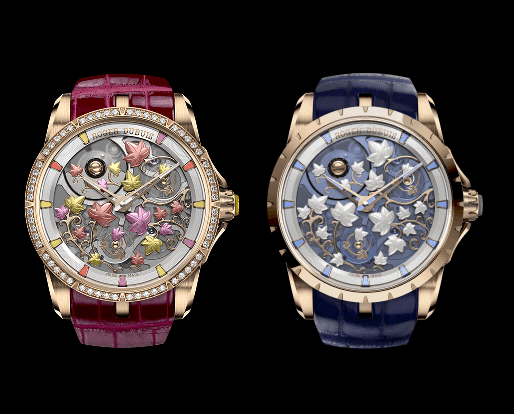
Roger Dubuis has been drawing from the Arthurian legend since 2015, when the original Excalibur Brocéliande used the mythical enchanted forest as the conceptual foundation for a 42mm skeletonised tourbillon. This year the Maison returns to that world in a more accessible dimension, bringing two new Excalibur Brocéliande pieces down to 38mm and introducing a brand new movement built specifically for them: calibre RD721SQ, an automatic skeletonised movement certified by the Poinçon de Genève and decorated with ivy leaves that extend the forest motif directly into the architecture of the movement itself. The two versions interpret the forest at dawn and at dusk, using the dial as a canvas for the kind of decorative craft Roger Dubuis has always treated as inseparable from its mechanical ambition. Brocéliande as a source of inspiration earns its place here because it is genuinely rich enough to sustain it: a forest from Arthurian mythology associated with Merlin, Viviane, and the Knights of the Round Table carries enough layered meaning to give a watch collection real imaginative depth rather than borrowed atmosphere. The 38mm sizing and the new automatic calibre suggest Roger Dubuis is building this range for the long term, with a movement and a case proportion that can carry the Brocéliande story across future iterations without being constrained by the 42mm grand complication format that started it.
The Ladies' Piece: Excalibur Lady of the Lake (RDDBEX1193)
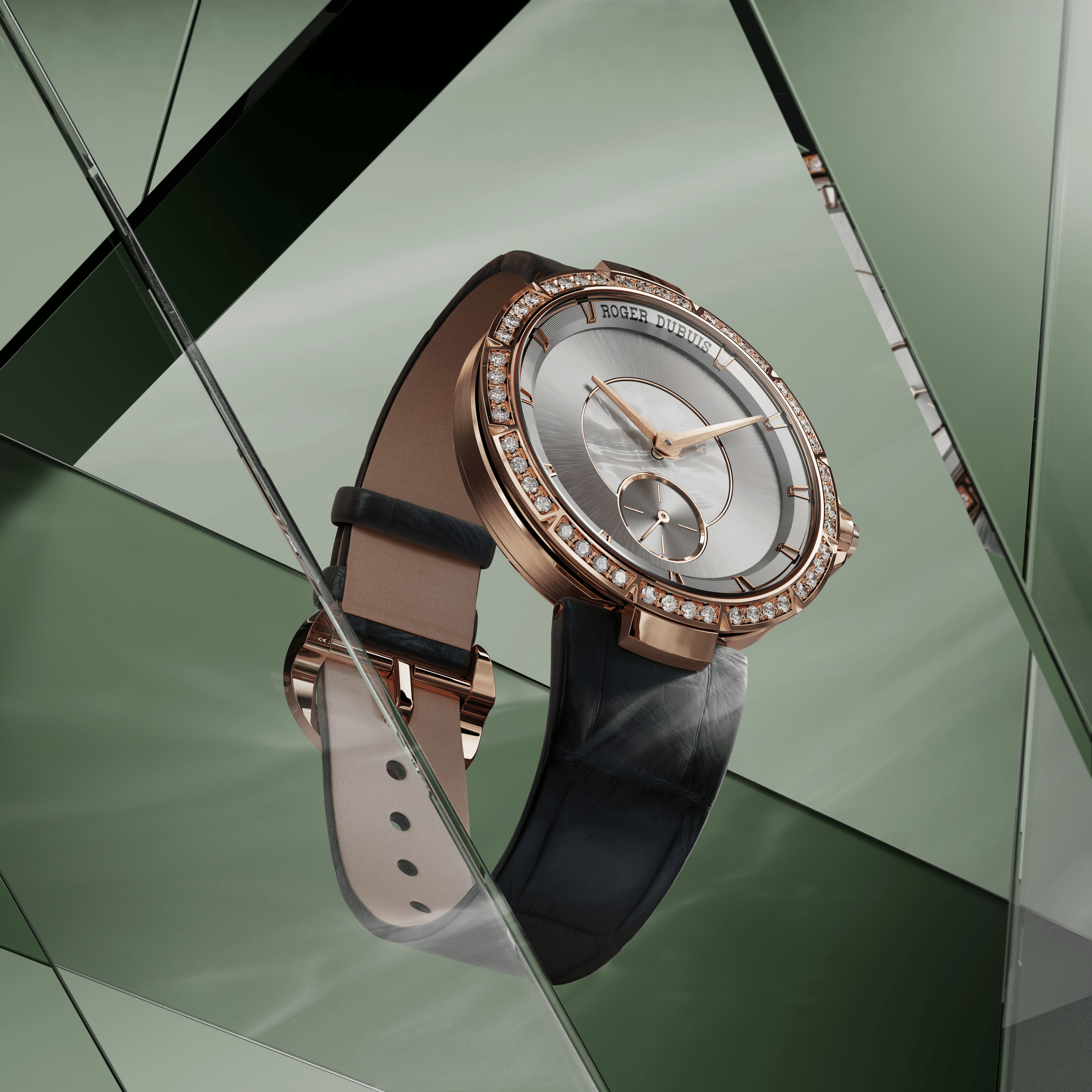
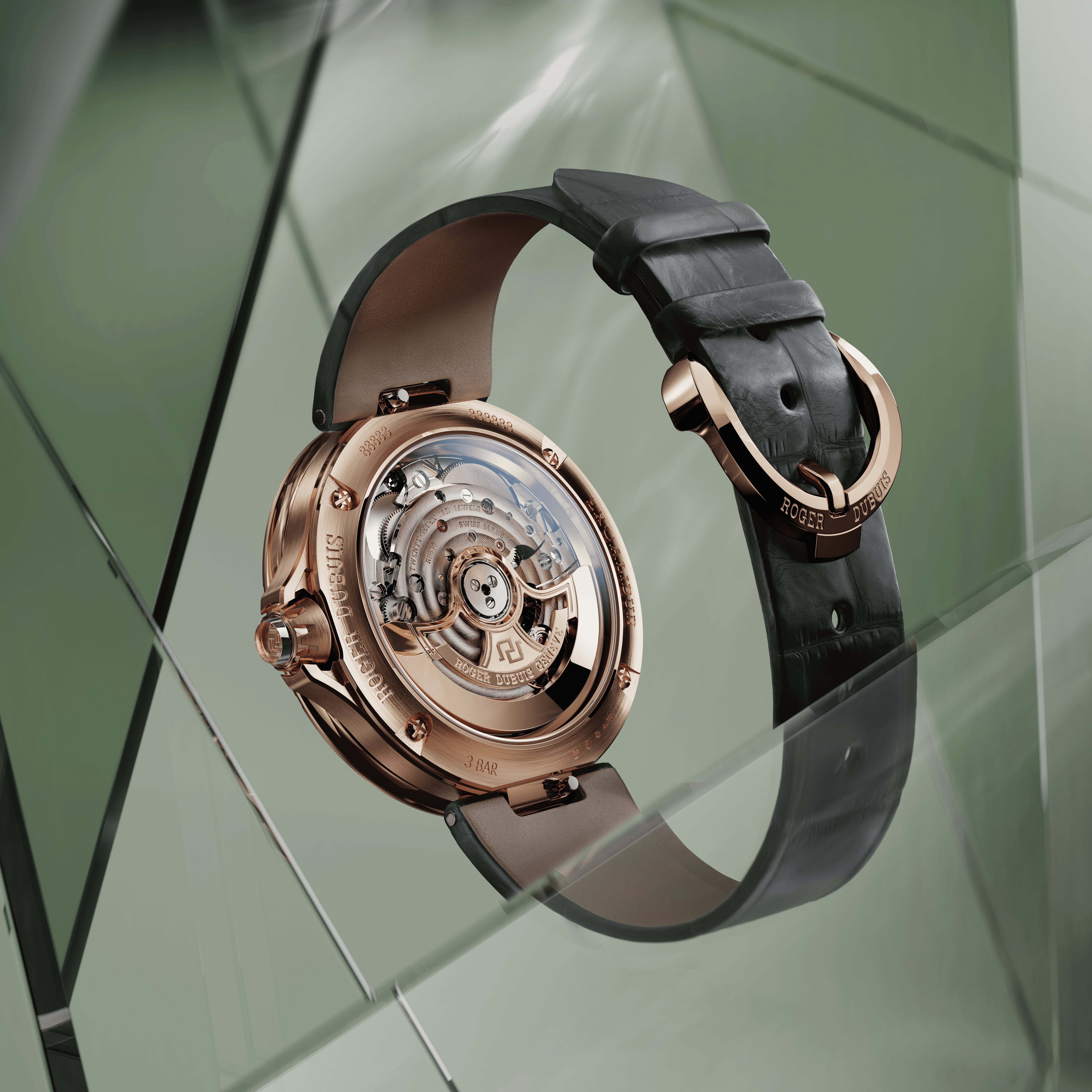
Roger Dubuis pulls from Arthurian mythology for the name Excalibur, and this year the Maison has gone deeper into that story with a piece dedicated to Vivian, the Lady of the Lake, guardian of the sword. In the legend, she is the figure who both grants and reclaims Excalibur. It's a fitting character for a watch that is simultaneously powerful in its jewellery construction and refined in its complications. The case is 36mm in 18K pink gold, set with 48 white round-cut diamonds totalling approximately 0.66 carats around the bezel. The dial has two layers: an azuré-finished silver flange with pink gold-plated hour markers, and a sun-brushed main plate with a mother-of-pearl centre. The movement is the RD830 - automatic, with a 22K pink gold rotor, 48 hours of power reserve, and hour, minute and small seconds display. It's not a complicated movement in the traditional sense, but it carries Côtes de Genève decoration on NAC-coated bridges and 27 jewels across 183 components. The strap is lamb leather with a perlato effect, a textured finish that suits the jewellery ambition of the piece. This is a watch that Roger Dubuis designed as an object of desire first, and a precision instrument second. Both things are true simultaneously.
The Through-Line
What Roger Dubuis presented at Watches & Wonders 2026 is a coherent range spanning from an eight-piece statement piece for collectors of extreme complications, through a pink gold moonphase perpetual for the serious enthusiast, down to a steel biretrograde daily wearer, and across to a diamond-set ladies' piece rooted in mythology. The sky theme holds all four together - not as decoration, but as a genuine horological argument: that the universe's rhythms are what mechanical watchmaking has always been trying to keep pace with. The Quatuor fights gravity. The perpetual calendar tracks the lunar cycle to within 122 years of accuracy. The steel biretrograde brings celestial blue to an everyday wrist. Mr. Roger Dubuis believed that complexity should feel playful, that high watchmaking should provoke joy rather than intimidate. Looking at this lineup, that philosophy still runs the place.


