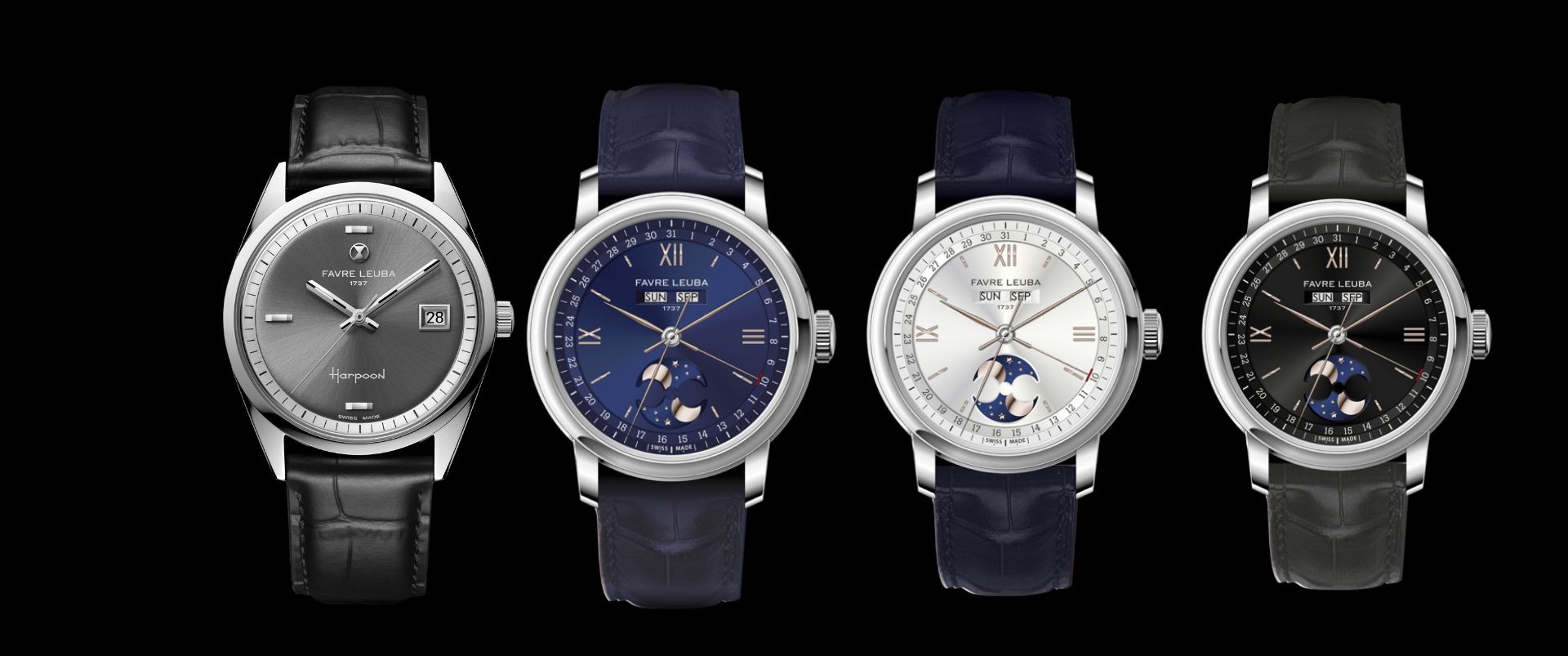
Watches And Wonders 2026: Favre Leuba’s Debut With The Harpoon Revival and 1737 Triple Calendar
 6 min read

Favre Leuba has been making watches since 1737. To put that in context: Abraham Favre started his workshop in Le Locle twenty years before Mozart was born. The brand outlasted empires, survived the quartz crisis, went quiet, and relaunched in 2024. This week, for the first time in its nearly three-century history, it has a booth at Watches & Wonders Geneva. And it showed up with two watches, a revival and a new collection opener - both priced in a range that most fair exhibitors don't go near. CHF 1,800 and CHF 3,500. In a hall where entry-level complications routinely clear CHF 20,000, that's either a provocation or a statement of intent. Probably both. What Favre Leuba is doing in 2026 is worth paying attention to, not because of engineering spectacle, there isn't any, but because of something rarer at this fair: restraint with a point of view. Two watches. One archival revival done faithfully. One new collection that reaches back to 1946 for its horological credentials. No noise, no limited edition of eight. Just watchmaking that knows what it is.
The Harpoon Revival: 1966, Faithfully
The original Harpoon launched in 1966. It was a clean, balanced dress watch — 36.8mm, slim, with a particular dial detail that nobody else was doing: the applied hour markers at 12, 6, and 9 o'clock sit horizontally rather than vertically. It's a small thing. You notice it and then you can't un-notice it. Sixty years later, the Revival keeps that detail exactly as it was. The case dimensions are unchanged: 36.8mm diameter, 10mm thick, 43.5mm lug-to-lug. Polished stainless steel, steel bezel, closed caseback engraved with the same medallion layout as the original — hourglass emblem centred, period-correct circular typography. The crown carries the Favre Leuba hourglass monogram in relief. The gray dial has a modern sunray-brushed finish, which is the one concession to the present — the 1966 original had a flatter surface. Here, the brushing catches light in a way the vintage piece didn't, giving the dial a quiet dynamism that suits it. The "Harpoon" signature at six o'clock is set in the same stylized typeface as 1966. These are the decisions of people who looked carefully at the original and chose not to editorialize.
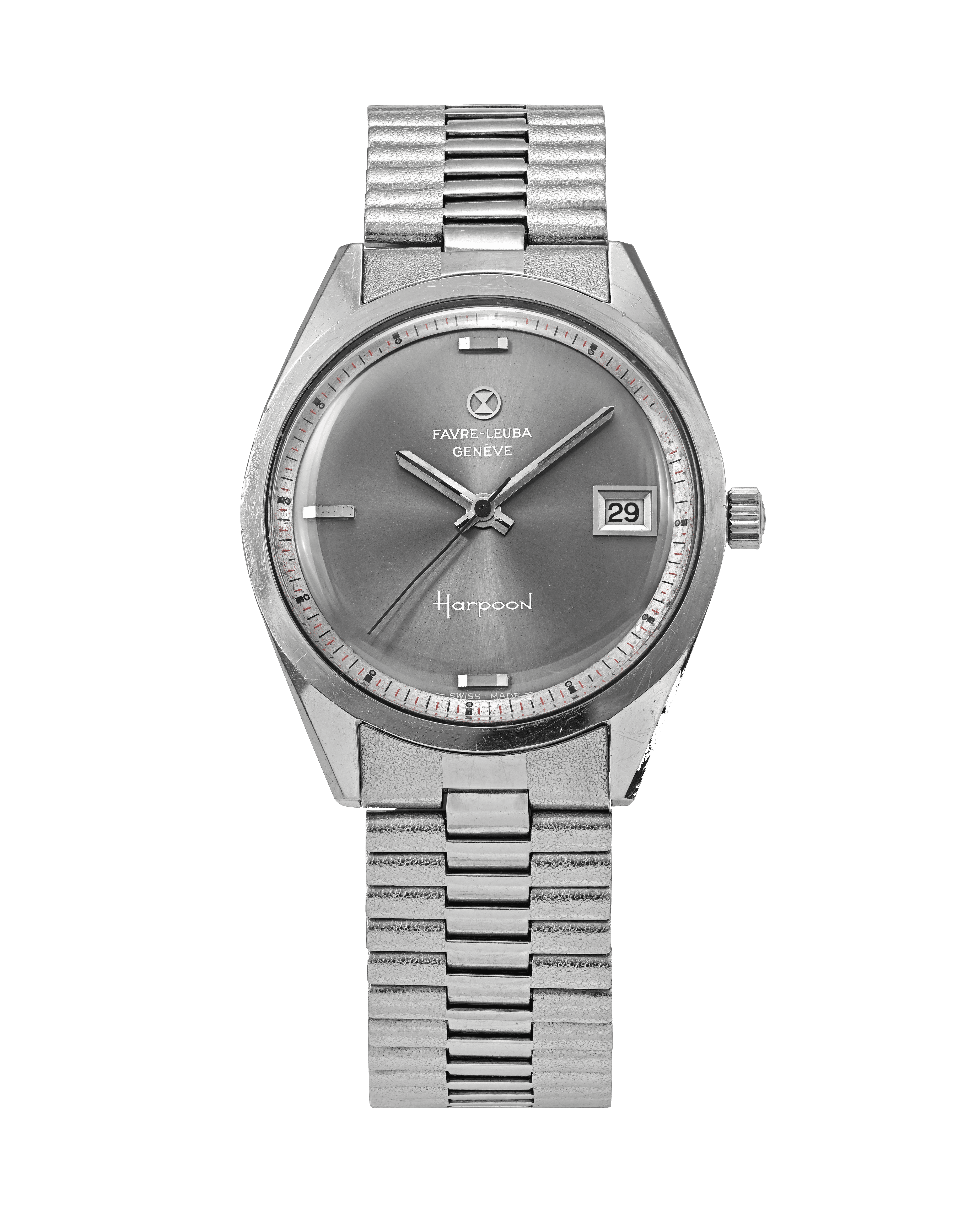
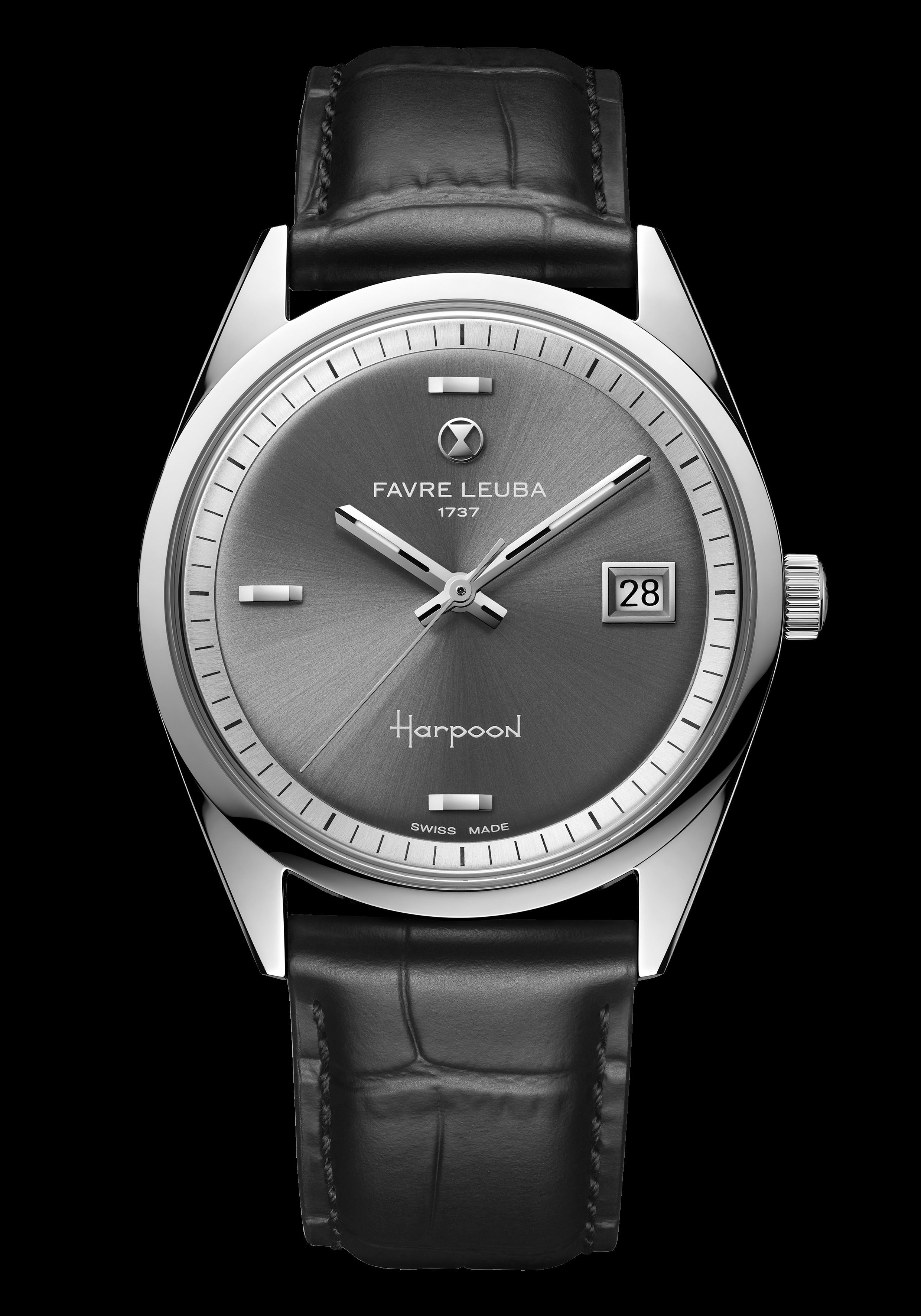
Inside is the FLD04 calibre, based on the La Joux-Perret G100 automatic. It runs at 28,800vph and delivers 68 hours of power reserve, meaningfully more than a weekend's worth, which is exactly what a watch in this price range needs to offer its owner. Favre Leuba isn't pretending this is an in-house movement; they're using a reliable Swiss base calibre and being transparent about it. At CHF 1,800 with sapphire crystal, anti-reflective coating, SuperLumiNova-filled rhodium hands, and a quick-release leather strap, the Harpoon Revival is a watch that makes sense on its own terms. It doesn't need you to compare it to anything.
What it does need — and what it delivers — is that horizontal index at 12, 6, and 9. That single design decision connects this watch to 1966 in a way that matters more than any marketing copy.
The 1737 Triple Calendar: A New Pillar With Old Roots
The 1737 is a new collection named for the founding year, which is either the most obvious name Favre Leuba could have chosen or the most honest. Given everything else they've done here, I'll give them honest. This is the fifth pillar in the revived brand's architecture, alongside Chief, Sea Sky, Deep Raider, and Harpoon, and it's the one that reaches furthest into the archive for its legitimacy. Here's what that legitimacy looks like: in 1946, Favre Leuba launched the Datora — a triple calendar with moonphase and, in some versions, a chronograph. That placed the brand among a very small group of Swiss manufacturers capable of producing genuinely complicated timepieces in the immediate postwar period. In around 1950, they followed that with a triple calendar moonphase produced in collaboration with Bovet & Frères using calibre 1162. These aren't footnotes. They're the actual foundation of what the 1737 collection is claiming to continue.
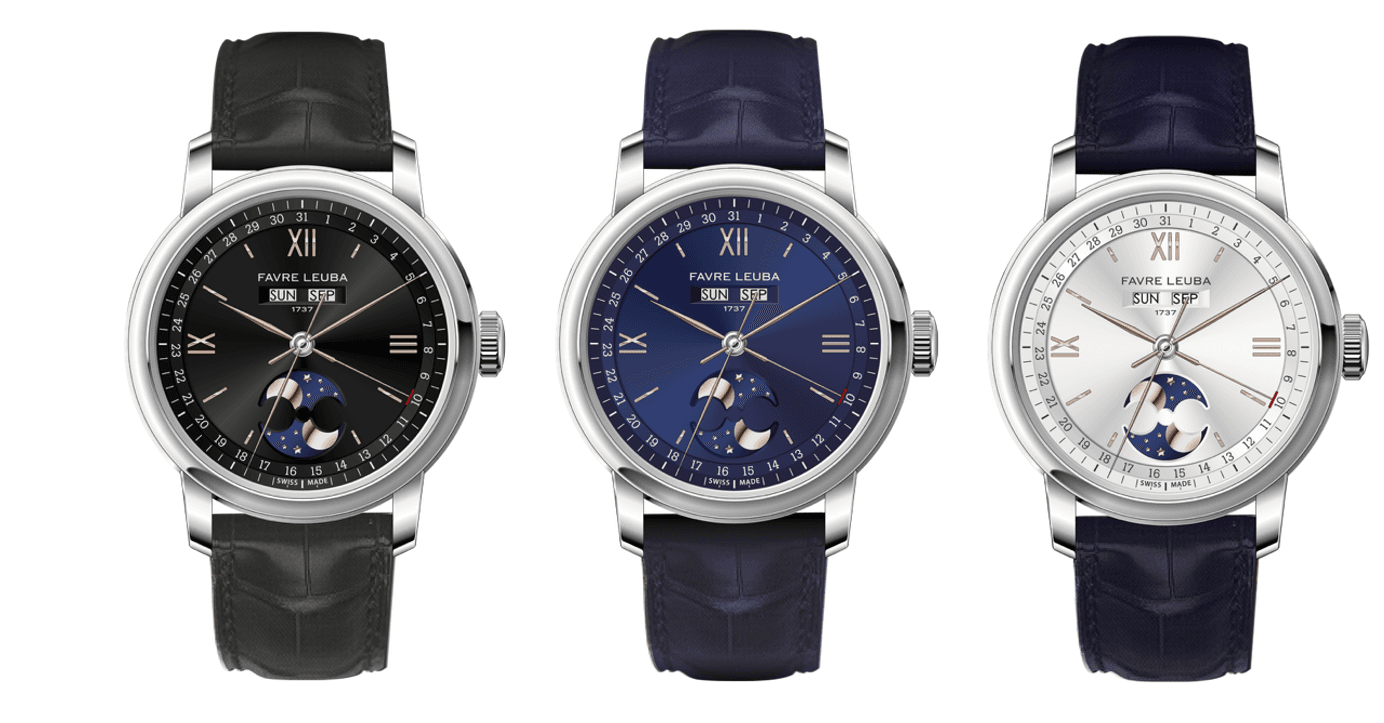
The watch itself is 39mm in stainless steel with a 12.11mm case thickness - not thin, but proportionally sound for the complications it carries. Day and month are displayed through twin apertures at 12 o'clock. The moonphase sits at 6. A pointer date track runs the perimeter of the dial, with a brushed circular finish that reads clearly against the sunray centre. The minute track carries a snailed pattern — one of those finishing details you genuinely need to look for, and that rewards the looking. Applied 4N gold-finished hour markers mix Roman numerals and stick indexes, mirror-polished. The overall composition is classical without being stiff.
Two flush correctors are integrated into the caseband at 2 and 10 o'clock for adjusting day and month. No pusher tubes protruding from the case, no separate tool required. It's a practical decision that also keeps the case profile clean — the kind of thing that takes effort to engineer and produces a result that most people will never consciously notice. Through the exhibition caseback, the FLD06 automatic calibre is on full display. It's decorated with Côtes de Genève, perlage, blued screws, and diamond snailing. The skeletonized rotor carries its own Côtes de Genève and paper snailing, with the sablier logo engraved at the centre. The 4N gold finish gives the movement a warm tone that sits well against the dial's colour choices — available in black, blue, and silver. Power reserve is 56 hours. The movement specifies a maximum deviation of ±5 seconds per day, which is an honest number at this price point rather than a marketing figure.
At CHF 3,500, the 1737 Triple Calendar offers a day-date-month-moonphase display in a finished, calibre-visible package. The triple calendar moonphase has been a benchmark complication for Swiss watchmaking since the 1940s. Favre Leuba made one in 1946. The fact that the 2026 version costs CHF 3,500 is not a coincidence — it's the strategy.
Why This Matters at Watches & Wonders
Favre Leuba's first appearance at this fair is modest by every measurable standard. Two references. A combined total of CHF 5,300 if you bought both. No tourbillons, no proprietary movements, no world records. What they have instead is a coherent story across 289 years, two watches that know exactly who they're for, and price points that open the door for a generation of collectors who are interested in history but can't yet spend five figures to access it. The watch world needs more of this. Not every brand at Geneva should be competing on complication density or case material exoticism. Favre Leuba is making the argument that longevity, design faithfulness, and accessible pricing are their own kind of statement. At a fair that can feel like it's speaking exclusively to the top percentile, that argument has value.


