Did You Know? Tutima Built The Last True Military Pilot's Watch Before Quartz Won The Cockpit
 8 min read

The year was 1984. Seiko had just introduced the world's first analog quartz chronograph. The British Royal Air Force immediately adopted it. The Royal Navy had already replaced their legendary Rolex Submariners with quartz CWC dive watches. The writing was on the wall: mechanical watches were being engineered out of military service. Then NATO selected the Tutima Military Chronograph reference 798 as the official service watch for its pilots. Not a quartz watch. A mechanical watch powered by the legendary Lemania 5100 movement. This timing accident of history makes the 798 arguably the last purpose-built mechanical pilot's watch designed when these instruments were still genuinely vital equipment rather than lifestyle accessories. If the West German government's procurement process had started just 12 months later, NATO would almost certainly have chosen quartz like everyone else. The Tutima 798 exists because it was the right watch made at the exact moment before technology rendered its category obsolete. Survey modern fighter pilots at MCAS Miramar, home to TOPGUN, and you'll find exactly zero wearing mechanical watches. They wear Garmin D2 smartwatches that monitor oxygen levels and serve as backup navigation systems.
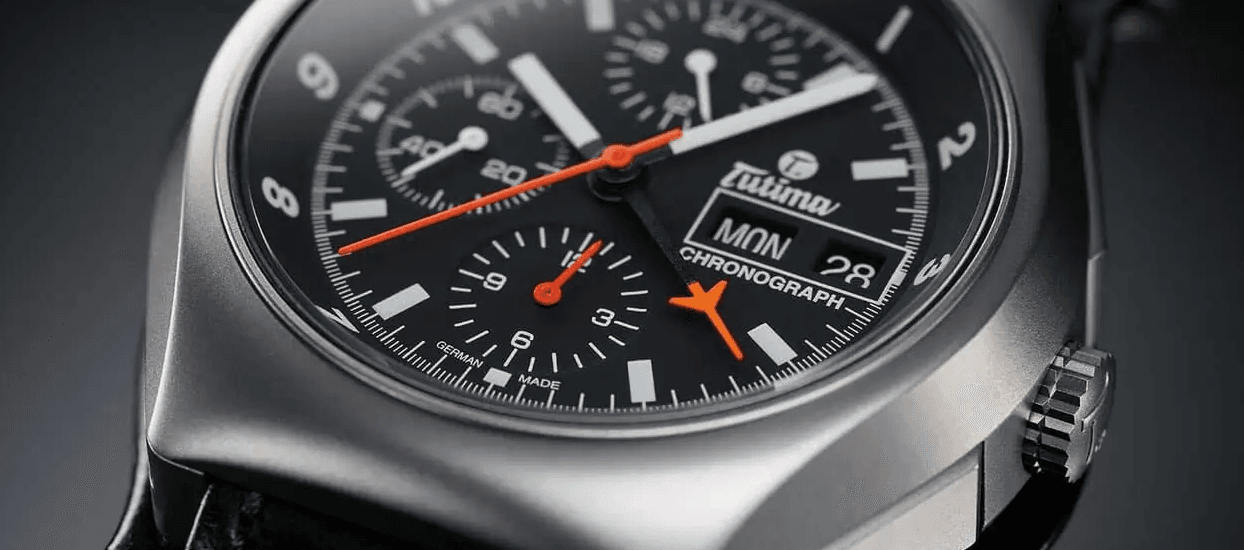
The 798 earned its NATO Stock Number 6645-12-194-8642, classified under "Instruments and Laboratory Equipment" rather than accessories. Military watches were stamped with issuing authority markings. The ones that went to the U.S. Air Force in 1989 became known as the NATO chronograph, an ironic name given they were made for American forces to honor European pilots who'd been wearing them since 1984. The contract didn't last. The German-made watches were too expensive for force-wide deployment. But individual units, training schools, and recognition programs kept ordering Tutimas for decades after.
Reverse Engineering a Legend With No Blueprints
Dr. Ernst Kurtz founded two companies in Glashütte in 1927: Uhren-Rohwerke-Fabrik Glashütte AG (UROFA) for movements and Uhrenfabrik Glashütte AG (UFAG) for finished watches. The name Tutima, from the Latin tutus meaning safe or secure, was reserved for the best pieces coming out of these factories. By 1941, UROFA had developed Caliber 59, which powered the Tutima Fliegerchronograph. This became the first German flyback chronograph, breaking the Swiss monopoly on the complication. The Fliegerchronograph featured something called "Tempostopp" in German watchmaking parlance, the flyback function that allowed pilots to instantly restart timing sequences without stopping, resetting, and restarting manually. From 1941 to 1945, roughly 30,000 of these chronographs came out of Glashütte workshops destined for Luftwaffe pilots. These originals are among the most sought-after pieces in vintage military watch collecting today.
Then came the air raid. Hours before the war ended, Allied bombing destroyed the factory. Soviet occupation followed. Dr. Kurtz made it west just before the border sealed. He rebuilt in Ganderkesee, Lower Saxony, preserving Glashütte techniques far from their birthplace. Dieter Delecate joined in 1954, bought the company in 1960, and kept it alive through the quartz crisis by building instrument watches with Swiss movements. When Germany reunified and other Glashütte brands rushed back immediately, Delecate moved deliberately. He established a parallel operation starting in 2005, bought the former railway station maintenance depot near the original factory, and didn't fully relocate until 2008. On May 14, 2008, the new Glashütte facility opened for business. Three years later, on May 12, 2011, Tutima unveiled something no one expected from a pilot's watch company.
The First German Minute Repeater Since Reunification
Rolf Lang designed it. Lang had served as Chief of Restoration at A. Lange & Söhne and his son Marco runs Lang & Heyne. He knew repeater mechanisms from restoration work on historical pieces. But no complete minute repeater movement had ever been fully conceived, designed, and manufactured in Glashütte. Historical Glashütte repeaters used Swiss ébauches from Audemars Piguet or LeCoultre, specially made in what LeCoultre catalogues called the "genre allemande." Lang hired young watchmakers in 2007. For three years they developed the Tutima Hommage, Caliber 800, comprising 550 components. The movement features traditional Glashütte finishing: matte frosted gold plating, three-quarter plate, jewels held by gold chatons, hand-engraved balance cock in relief method. The minute repeater gongs were tuned at the Institut für Musikinstrumentenbau at Dresden's technical university to produce notes in a major third interval for what Tutima called a "joyful" sound.
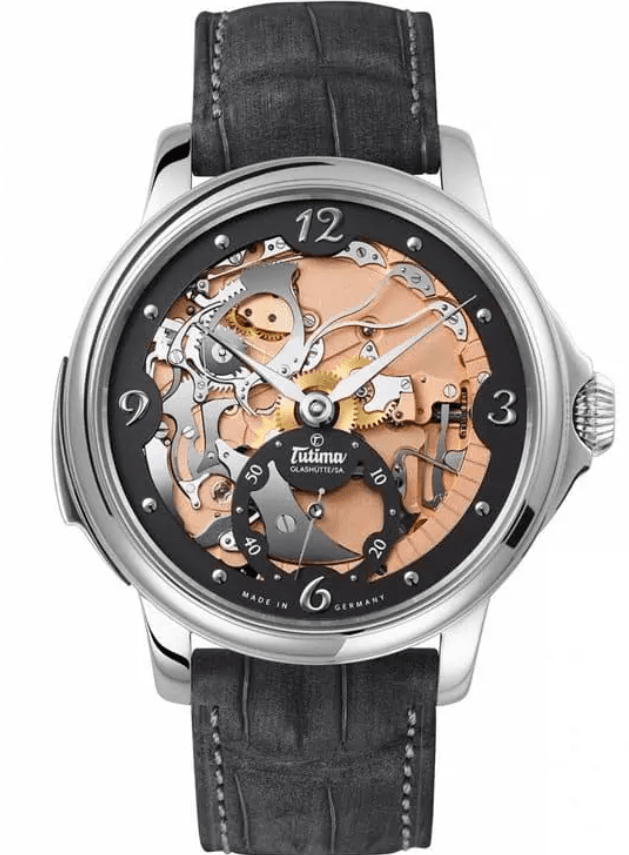
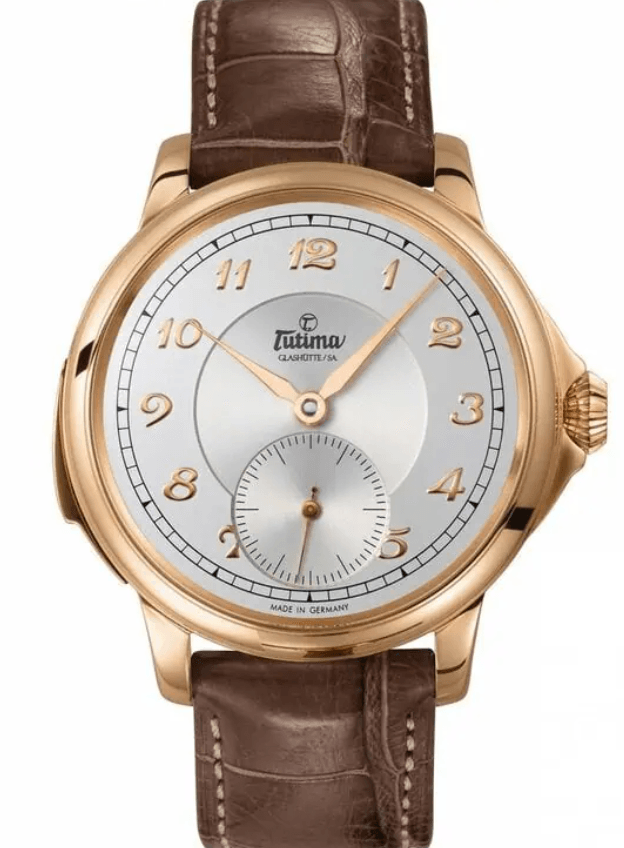
The Hommage launched at 168,000 euros in rose gold, 179,000 euros in platinum. Twenty examples in rose gold, five in platinum. Total production: 25 pieces. This from a brand known for robust tool watches priced for working professionals, not oligarchs. Tutima won the Couture Time Award in 2013. The movement wasn't just technically accomplished. It represented strategic intent. Tutima was back in Glashütte to do serious manufacture work, not just assemble Swiss movements in Saxon cases.
Rebuilding UROFA 59 From Memory
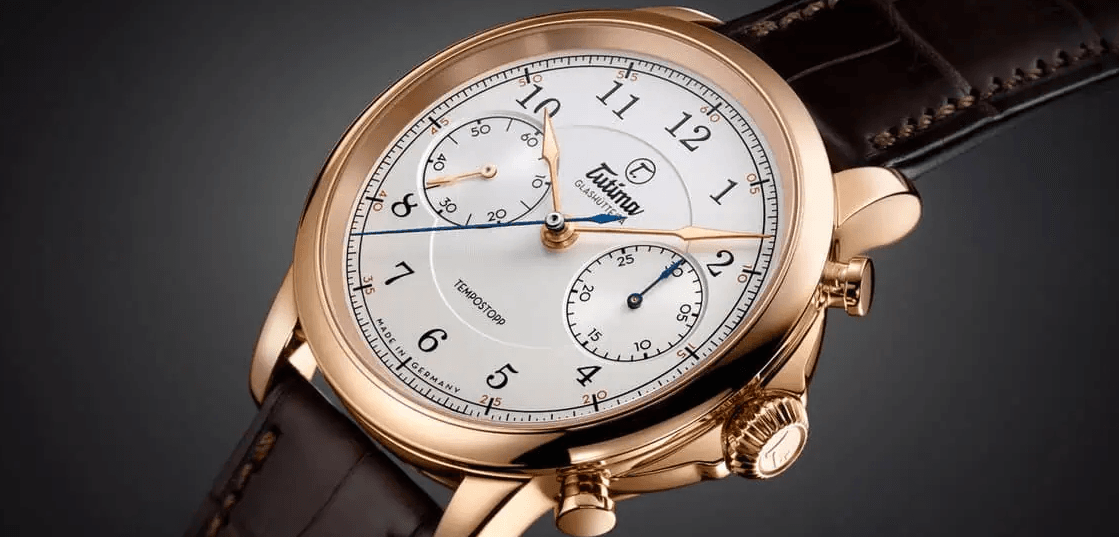
For Tutima's 90th anniversary in 2017, the brand introduced the Tempostopp, powered by Caliber T659. This movement is a modern reconstruction of the original UROFA Caliber 59 from the 1940s Fliegerchronograph. The problem: no blueprints survived the war. Everything had to be reverse-engineered from the handful of surviving vintage movements. Caliber T659 is a hand-wound column wheel chronograph with horizontal clutch. It measures 33.7mm diameter, 6.6mm thick, containing 237 components. The balance features gold adjustment screws and a Breguet hairspring. It beats at 21,600 vibrations per hour with 65 hours of power reserve. Compare this to the original: 34mm diameter, 5.4mm height, 17 jewels. The modern version has 28 jewels and nearly doubles the power reserve while maintaining almost identical dimensions. The flyback function works exactly as it did for bomber pilots: press the top pusher to start, press the bottom to instantly reset to zero while running, press top again to stop, then bottom to return to zero when all intervals are timed. The chronograph lives behind a 43mm rose gold case with mushroom pushers and a fluted crown with crown guard. The movement is gold plated with sand-blasted finish, anglage on all components, straight-grained steel parts. It's haute horlogerie finishing on a movement designed to honor utilitarian military instruments. Limited to 90 pieces. Priced at 28,600 euros. Every component designed, manufactured, and finished in the Glashütte workshops. This is not modified ETA. This is manufacture-level chronograph development, a capability only a handful of German watchmakers possess.
Why German Watchmaking Resonates in India
Indian collectors have developed increasingly sophisticated appreciation for German watchmaking over the past decade. The market values technical substance over marketing spectacle, genuine manufacture capabilities over badge prestige, and brands that deliver serious complications without luxury markup. This describes Tutima's positioning precisely. Glashütte watchmaking carries a particular appeal in India's collector community. Where Swiss brands dominated through colonial history and post-independence aspiration, German watchmaking represents a different value proposition: engineering discipline, manufacture integration, and pricing that reflects capability rather than positioning. Cities like Mumbai, Delhi, and Bangalore host growing communities of enthusiasts who can distinguish between movement decoration and genuine technical achievement. Tutima occupies interesting territory for Indian collectors looking beyond entry-level German brands like Nomos or MeisterSinger toward manufacture-grade complications without reaching A. Lange & Söhne pricing. The brand offers in-house chronograph movements, minute repeaters, and dual-time calibers at fractions of equivalent Swiss manufacture pricing. For collectors who understand what reverse-engineering UROFA 59 without blueprints actually required, or who appreciate that NATO selected the 798 through competitive military procurement rather than marketing, Tutima delivers authenticity.
India's watch market has matured past simple luxury consumption toward informed collecting. German brands with legitimate manufacture credentials and military/aviation heritage find receptive audiences here. Tutima brings both, along with living connection to Glashütte's watchmaking traditions that survived war, division, and near-extinction to continue producing genuine high horology.
The Delecate Family Legacy
Dieter Delecate ran Tutima from the 1960s through German reunification and the return to Glashütte. His children Jörg and Ute now manage daily operations. This family ownership creates continuity impossible in corporate-managed brands chasing quarterly metrics. The decision to spend three years developing Caliber T659 with no guaranteed return, or to build a minute repeater when the brand's reputation rested on pilot's chronographs, reflects long-term thinking. Manufacturing operations remain in Glashütte where Tutima produces its own base calibers like the 617 used in Patria models and develops complicated modules like the chronograph caliber. The company employs traditional hand-finishing: straight graining, anglage, beveling, polishing. Components are produced on CNC machines then finished by hand to Glashütte standards.
Tutima will be participating at India Watch Weekend 2026, bringing their manufacture chronographs and Glashütte finishing to Indian collectors who understand the difference between modified movements and genuine in-house calibers. It's an opportunity to examine the hand-engraving on balance cocks, see the three-quarter plates finished to Saxon standards, and handle watches that represent living connections to one of watchmaking's most storied regions. For a market increasingly sophisticated about German horology, Tutima's presence represents exactly the kind of technical substance Indian collectors have been seeking.


