
Glashütte's Hidden Master: Moritz Grossmann Brings Three Grand Complications To India Watch Weekend 2026
 6 min read

Three names define Glashütte watchmaking. Everyone knows A. Lange & Söhne. Most recognize Glashütte Original. But the third name, the one that founded the German School of Watchmaking in 1878 and wrote textbooks that shaped an entire industry, disappeared for 123 years. Karl Moritz Grossmann died unexpectedly in 1885 after giving a speech about introducing World Time. His manufacture was liquidated. His legacy faded into archives and museum collections. Then in 2008, a trained watchmaker named Christine Hutter, who had worked at Wempe, Maurice Lacroix, Glashütte Original, and A. Lange & Söhne, discovered the name in historical records and registered it. She founded Grossmann Uhren GmbH on November 11, 2008, exactly 130 years after Moritz Grossmann established his watchmaking school.
Seventeen years later, the brand produces roughly 200 watches annually. Their movements are built twice, first to test all functions, then disassembled completely and rebuilt with full finishing. They manufacture their own hands, the only Glashütte manufactory still doing this work in-house. And they're bringing three of their newest grand complications to India Watch Weekend 2026 on January 17th and 18th, marking what appears to be their first significant showing in India.
The Perpetual Calendar: 401 Parts, 17 Years in the Making
Moritz Grossmann celebrated its 17th anniversary in November 2025 by unveiling a perpetual calendar. Not a simple annual calendar requiring adjustment five times per year. Not a semi-perpetual that needs correction every century. A true perpetual calendar that accounts for different month lengths, leap years, and the Gregorian calendar's peculiarity of skipping leap years every 100 years except when divisible by 400. The next manual adjustment won't be necessary until 2100.
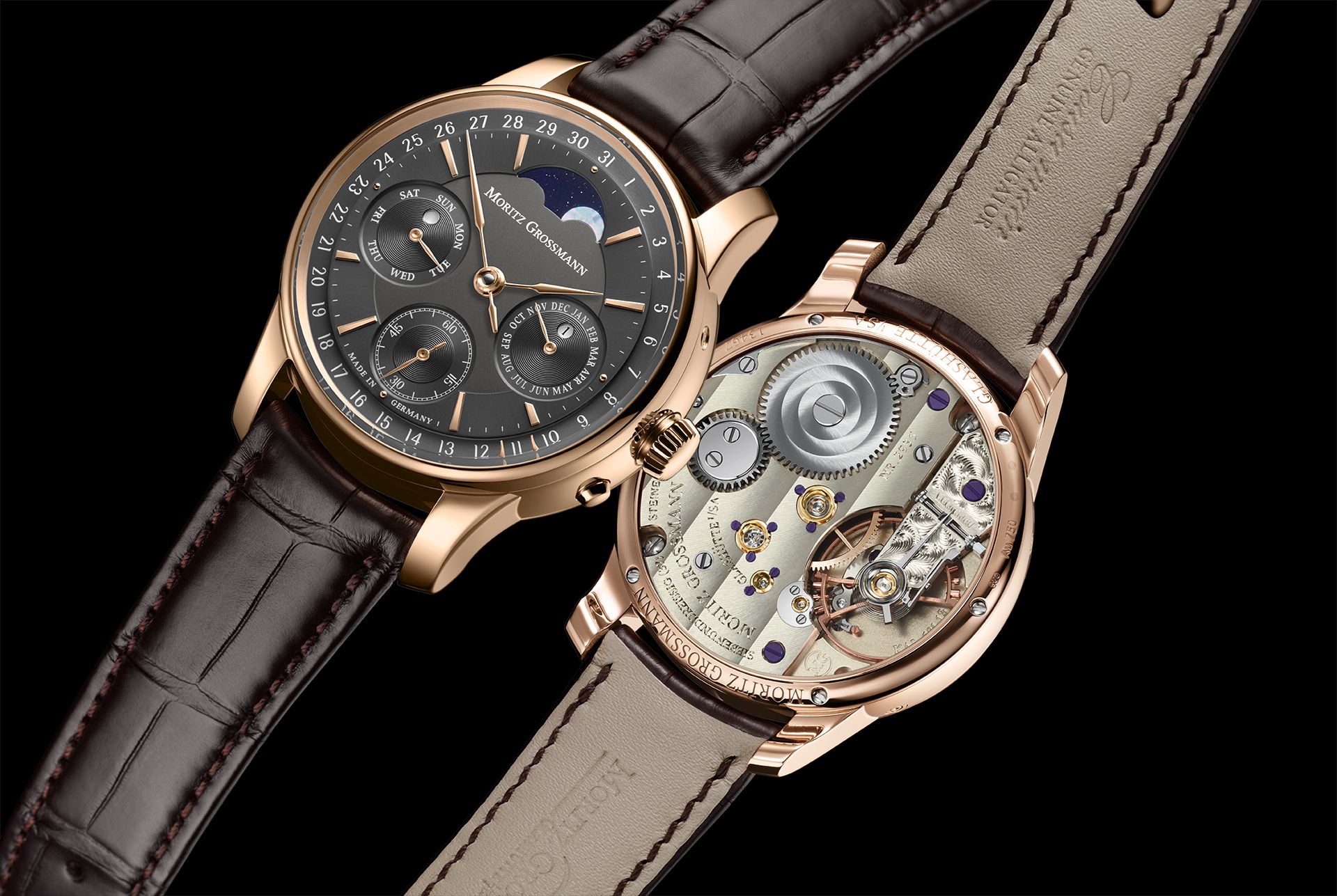
The calibre 101.13 sits at the heart of this complication. It's a hand-wound movement consisting of 401 components, 190 in the base movement and 211 in the perpetual calendar module alone. The movement runs at 18,000 semi-oscillations per hour with 42 hours of power reserve. Thirty-seven jewels, including four gold chatons with three screwed in place. The Grossmann balance measures 14.2mm in diameter with four inertia screws and two poising screws, suspended on a Nivarox 1 balance spring with a No. 80 terminal curve following Gustav Gerstenberger geometry. The dial arrangement solves the perpetual calendar's traditional problem of information overload. A date ring runs around the perimeter with numbers from 1 to 31, marked by a cup-shaped indicator that frames the current date. Month and day of the week appear on subsidiary dials at 3 and 9 o'clock, decorated with Azurage technique creating circular patterns of ultra-thin grooves that catch light. Small windows at the center of these dials show the leap year indicator and day-night display. At 12 o'clock sits a moon phase display using mother-of-pearl against a goldstone background with copper crystals simulating a starry night.
The Tourbillon: Three Minutes, Not One
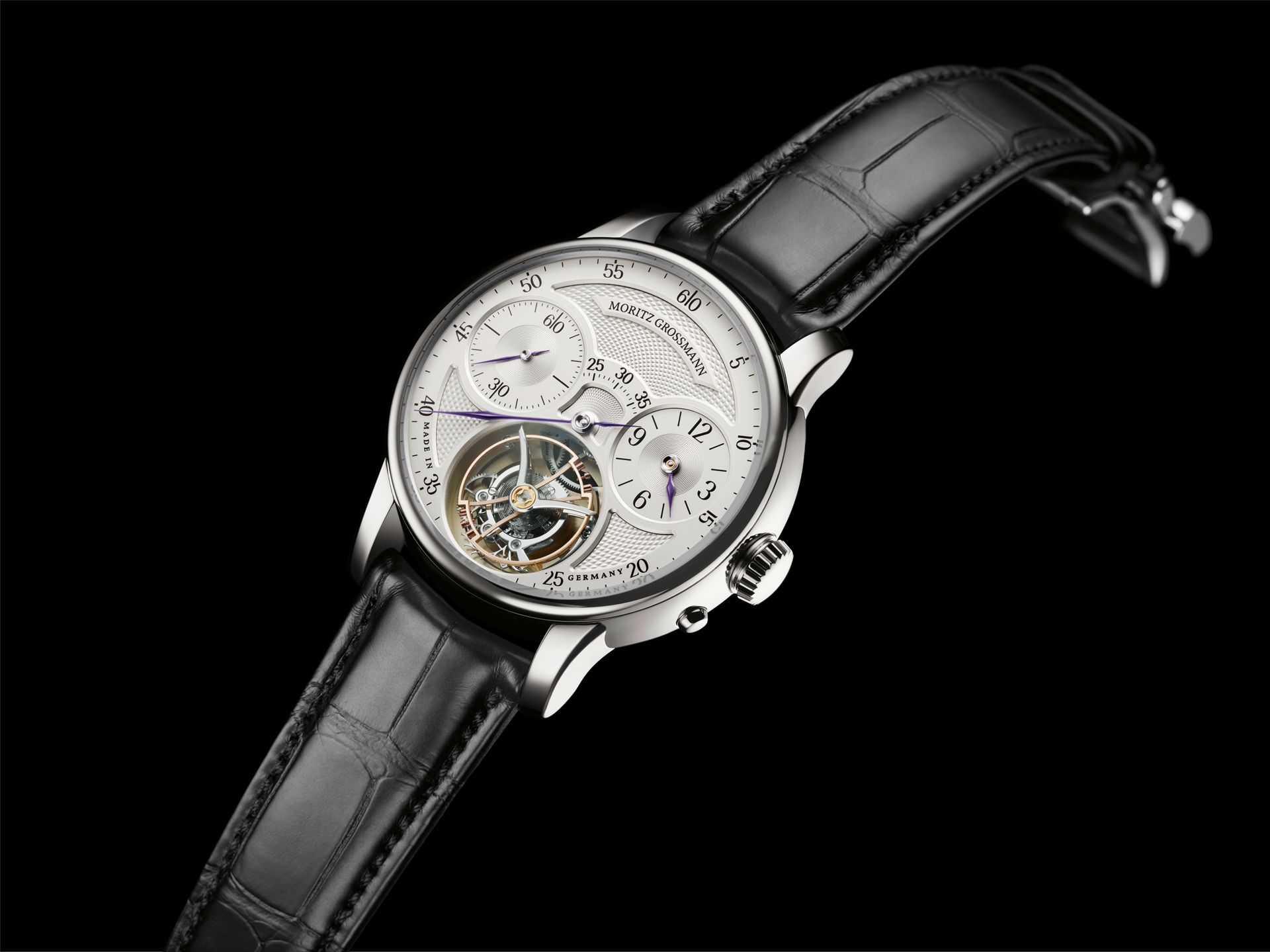
Most tourbillons complete one rotation per minute. Abraham-Louis Breguet designed it that way in 1795 to average out positional errors in pocket watches carried vertically. Moritz Grossmann's calibre 103.0 tourbillon takes three minutes for a full rotation, following Alfred Helwig's flying tourbillon principles from the early 20th century. The tourbillon cage measures 16mm in diameter, unusually large for a wristwatch. It's mounted on one side with a V-shaped balance bridge, putting the construction on full display through the dial at 6 o'clock. The Grossmann balance inside measures 14.2mm, running at 18,000 semi-oscillations per hour. The cage itself contains 59 parts. The complete movement uses 245 components total, 30 jewels, four of them set in screwed gold chatons.
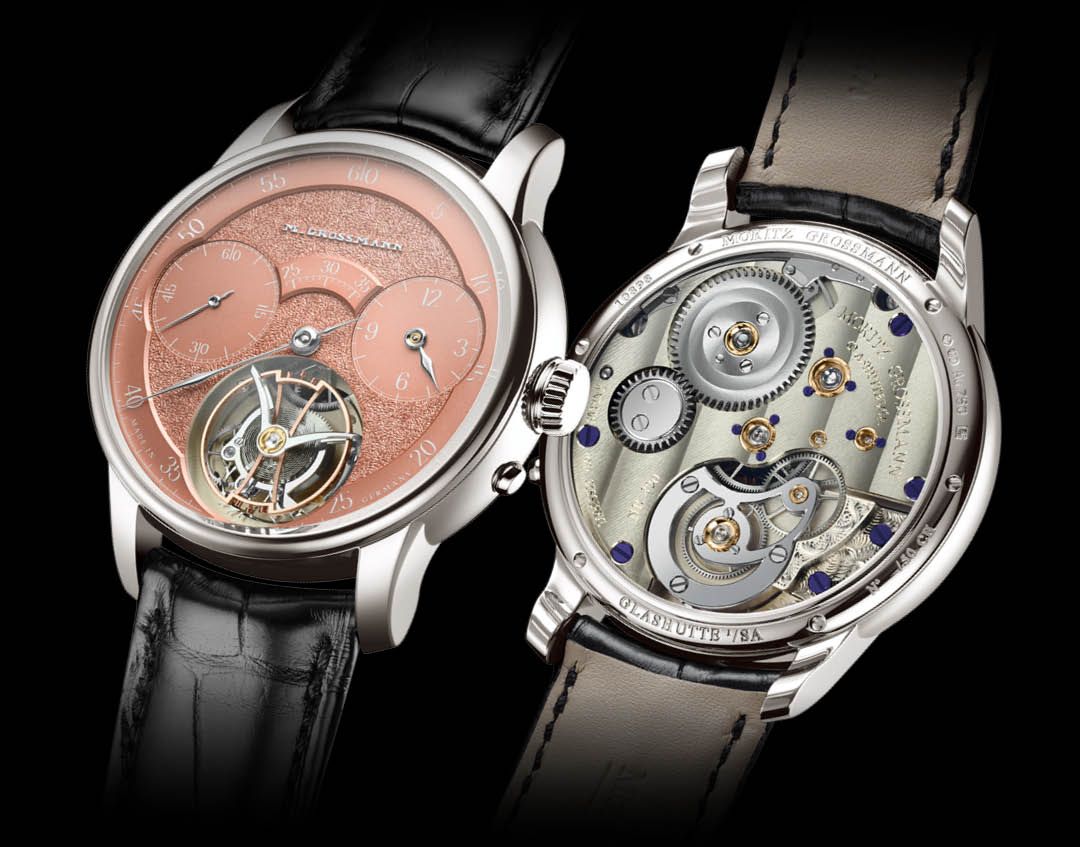
The TOURBILLON Tremblage takes a different approach. The dial surface uses tremblage engraving, a technique where cutters of varying sizes are guided by hand across metal with a trembling movement, creating fine even grain that softens incident light. The result appears beautifully matte. Moritz Grossmann finishes this surface in a warm rosé shade, unusual for traditional watchmaking but distinctly contemporary. Hours and seconds subdials rise from the surface along with the historical M. Grossmann logo from 1875. White printed numerals and scales combine with polished steel hands crafted in-house. The case is white gold, 44.5mm diameter, 13.9mm thick. Limited to eight pieces on black alligator leather with white gold folding clasp.
The BENU Power Reserve: Linear Display, New Decoration
The BENU Power Reserve represents Moritz Grossmann's approach to a fundamental complication. Hand-wound movements require regular winding. Knowing how much power remains prevents the watch from stopping unexpectedly. Most power reserve indicators use an arc on the dial, a hand sweeping through 180 degrees or less. Moritz Grossmann uses a linear aperture below 12 o'clock showing a blue and white bar element driven by a differential gear train. Fully wound displays a completely white bar. As power decreases, more blue appears. The calibre 100.2 inside consists of 227 parts and 26 jewels, three set in screwed gold chatons. The movement builds on the 100.1 base with the differential mechanism added for the power reserve display. It includes Grossmann's manual winding with pusher, a cantilevered balance cock with micrometer screw for regulation, and the mass-optimized Grossmann balance. Power reserve runs 42 hours. The balance operates at 18,000 semi-oscillations per hour. Regulation occurs in five positions.
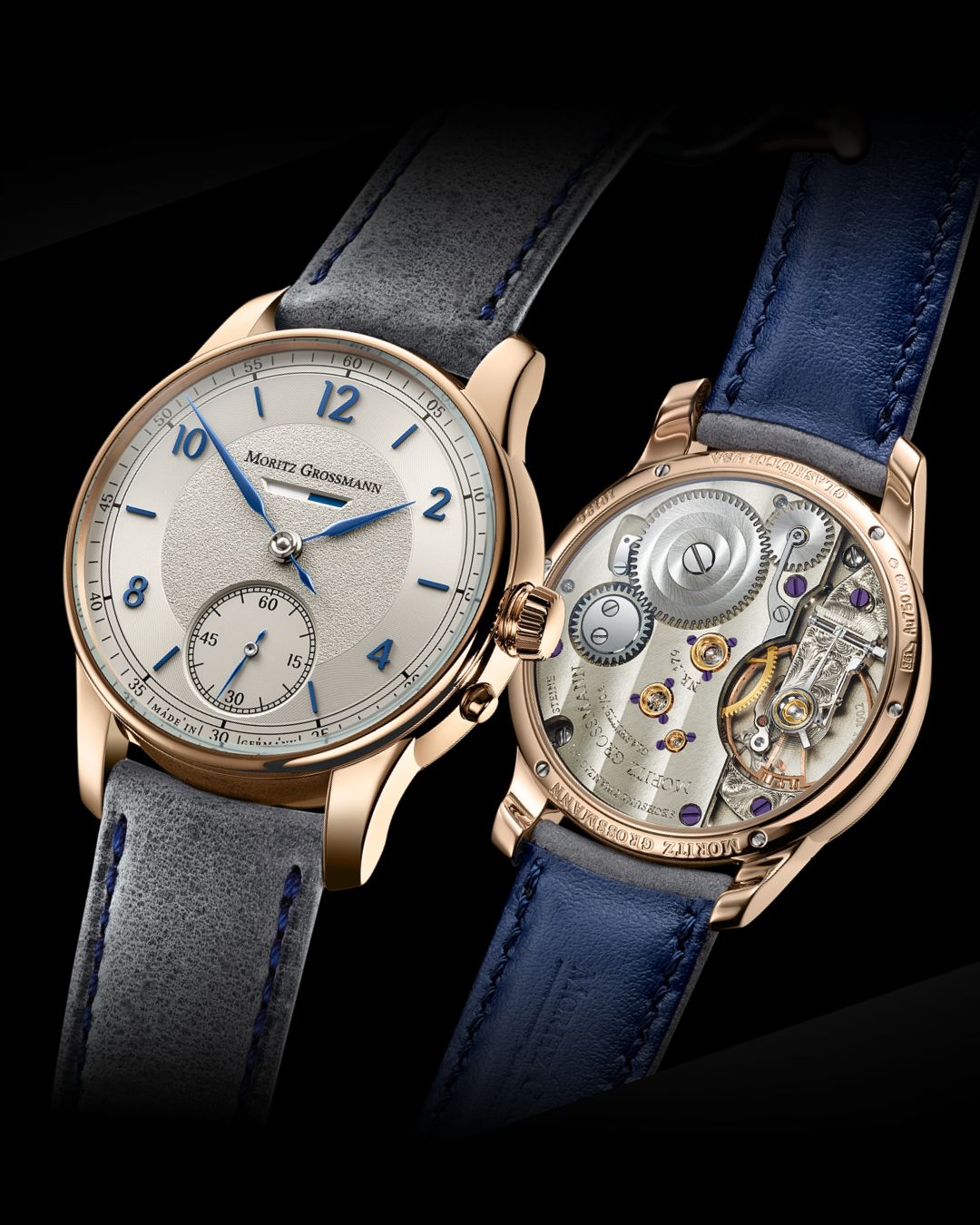
Recent updates refreshed the BENU Power Reserve's appearance. The outer ring of the dial now features Azurage decoration, the same circular pattern of ultra-thin grooves used on the perpetual calendar's subsidiary dials. This ring surrounds a center section with soft matte texture finished in argenté silver. The logo and minute scale print in dark grey. Blue digits and indices attach as appliqués. New hand design debuts here, steel crafted in-house with a slight curve extending to an exceptionally fine tip. After beveling and polishing, the hands receive thermal tempering to achieve their blue color.
What Makes Grossmann Different
Every Glashütte manufacturer claims traditional finishing. Most use ETA or Sellita base movements with additional decoration. Some manufacture certain components in-house. Moritz Grossmann takes a different path.They build movements twice. The first assembly tests all functions and allows watchmakers to perfect the mechanism. Then they disassemble everything completely. The second build incorporates full finishing on every component: hand beveling, polishing, engraving, specialized decoration techniques. This doubles the labor but ensures nothing gets overlooked. Moritz Grossmann operates in the space between accessible luxury and haute horlogerie's stratosphere. A perpetual calendar in rose gold or platinum. A three-minute flying tourbillon in titanium or white gold with hand-engraved dials. A power reserve indicator with new Azurage decoration and in-house-made hands. These aren't entry-level pieces. They're not mass-produced. And they're coming to India Watch Weekend 2026 because the brand believes Indian collectors have reached the point where German finishing standards, in-house hand manufacturing, and movements built twice find appreciation. The three watches represent three different facets of what Moritz Grossmann does.
India Watch Weekend 2026 on January 17th and 18th represents the first significant opportunity for Indian collectors to see these watches in person. Handle a 41mm perpetual calendar with 401 parts inside. Compare the 44.5mm titanium tourbillon against its white gold tremblage sibling. Examine the linear power reserve display on the BENU and see how Azurage decoration catches light differently than traditional engine turning.
Christine Hutter brought Moritz Grossmann back from 123 years of oblivion. Seventeen years later, the name carries weight among collectors who care about German finishing standards, in-house hand manufacturing, and movements built to the same specifications Moritz Grossmann outlined in his textbooks 150 years ago. Whether India's collector base responds to that particular combination of history, craftsmanship, and exclusivity will become clear over two days in January.


