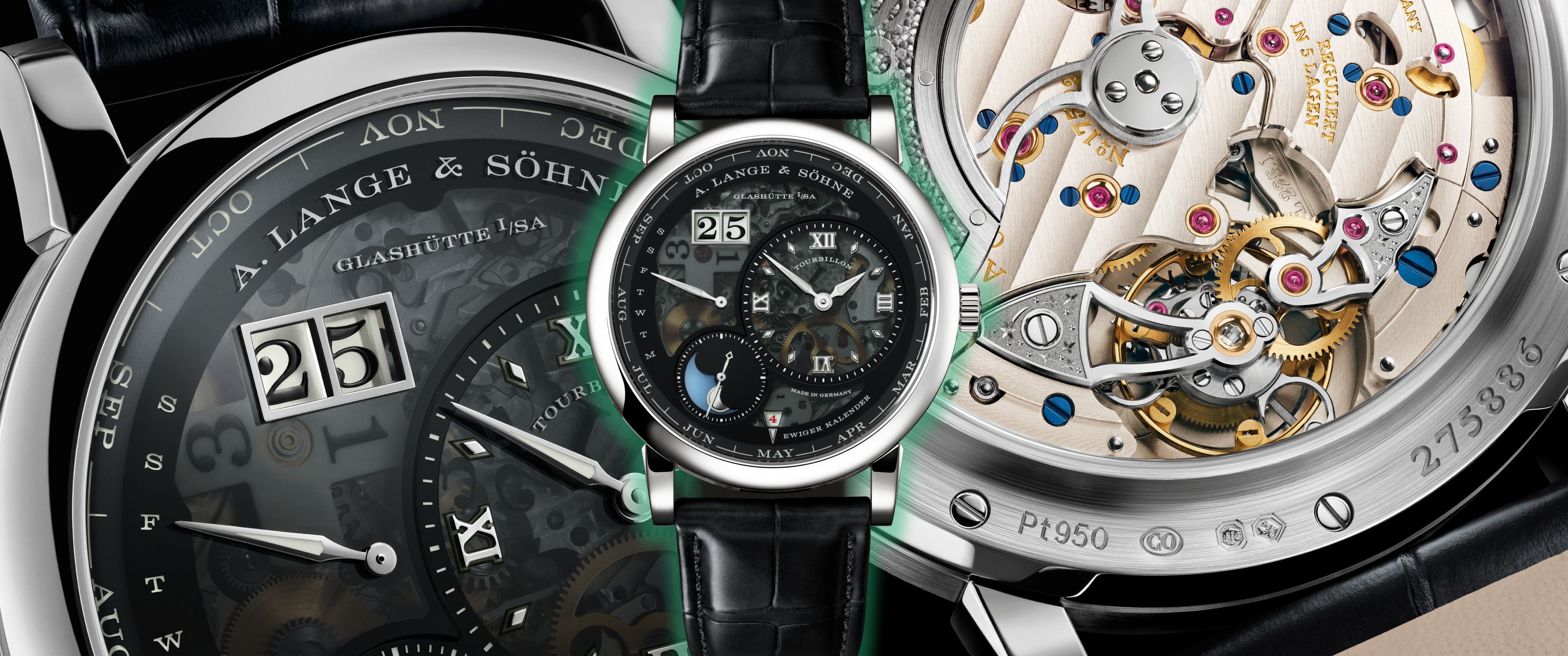
Watches And Wonders 2026: Introducing The A. Lange & Söhne Lange 1 Tourbillon Perpetual Calendar “Lumen”
 5 min read

There is a particular breed of mechanical wonder that transcends the mere measurement of time. It operates in a liminal space, where the cold, hard physics of precision engineering meets the warm, soulful art of Handwerkskunst. Every so often, a timepiece emerges that doesn't just advance the conversation - it rewires the very language of the dial. At Watches & Wonders 2026, A. Lange & Söhne has done exactly that with the new Lange 1 Tourbillon Perpetual Calendar “Lumen”. And in doing so, they have produced what is arguably the most compelling nocturnal spectacle in high horology.

Limited to a mere 50 pieces in a 950-platinum case, this is not simply a new reference. It is a manifesto. It dares to ask: What happens when the Saxon manufacture takes its most iconic asymmetrical layout - the Lange 1, packs it with a tourbillon and a perpetual calendar, and then renders the entire mechanism visible, legible, and luminescent in the dark? The answer is the reference 720.035FE, and it is a masterclass in layered complexity.
The Lumen Principle: Architecture of Light
The “Lumen” family, first introduced in 2010, has always been about controlled revelation. But with this new caliber L225.1, the concept has evolved from a party trick into a functional triumph. The semi-transparent dial, that smoky, dark canvas, is not merely an aesthetic choice. It is a prerequisite for the watch’s primary function: unambiguous legibility in total darkness.
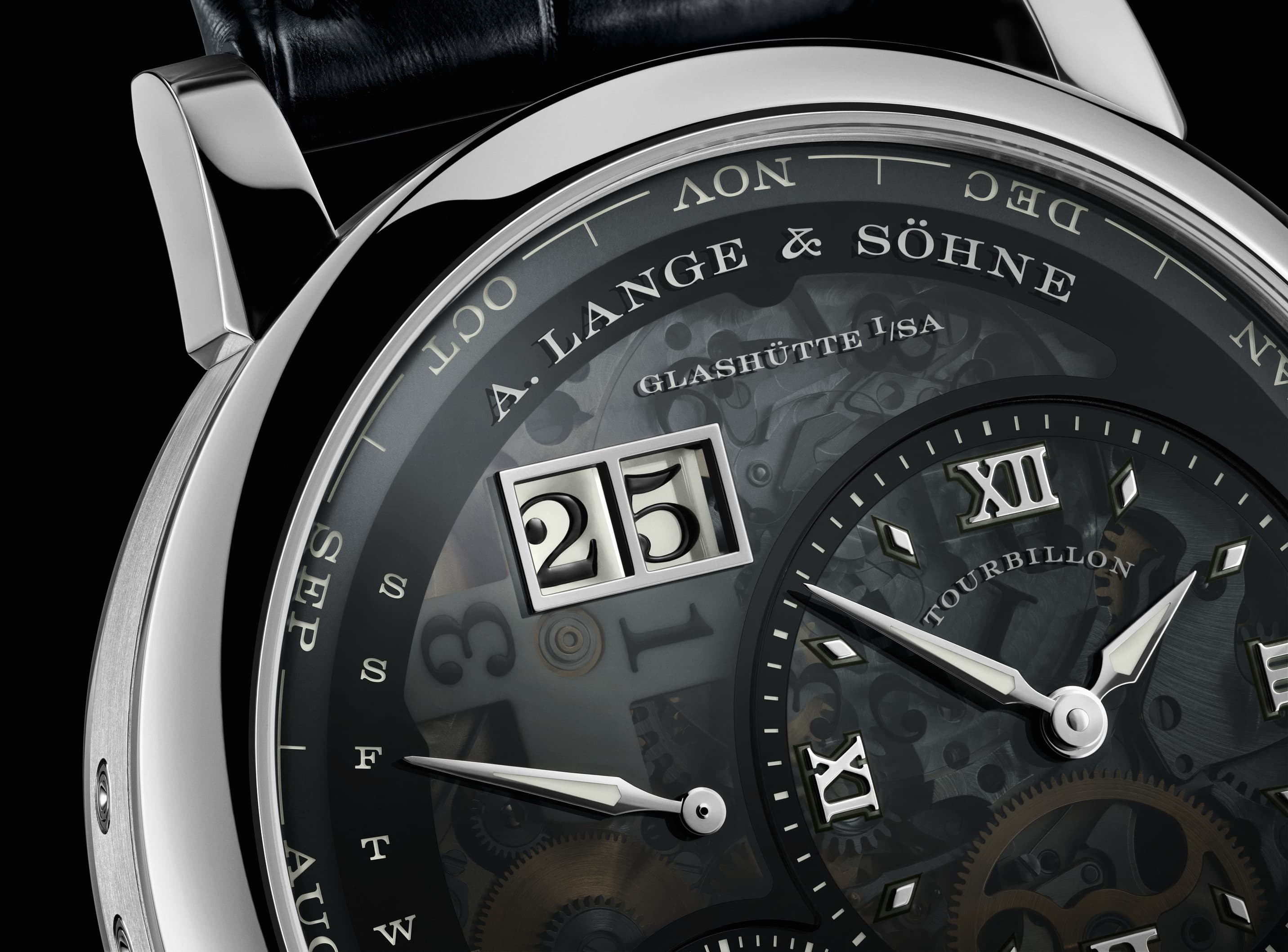
Look closer. The engineers have orchestrated an "ambience of light" rather than just slathering on superluminova. The moon-phase display, for the first time in a Lumen watch, integrates a day/night indication with a celestial disc that rotates once every 24 hours. During the day, you perceive a light, starless sky. At night, that disc reveals a dark firmament studded with luminous stars. Above it, the moon, coated on its reverse side with a luminous compound, glows with an almost ethereal contour.
Even the iconic outsize date, the hallmark of the brand, is fully luminous. The leap year aperture at 6 o'clock, the retrograde day-of-week, the month ring, all of it glows with a nuanced, graded intensity. This is not legibility; this is choreography.
The Dial: Geometry as Grammar
Before we descend into the movement, we must appreciate the stage. The Lange 1 layout is a study in the Golden Ratio, and the perpetual calendar introduced in 2012 remains the most intellectually honest integration of high complication into that design. Where others stack sub-dials haphazardly, Lange uses a peripheral month ring. It switches instantaneously at month's end, preserving the off-center harmony of the hours and minutes.
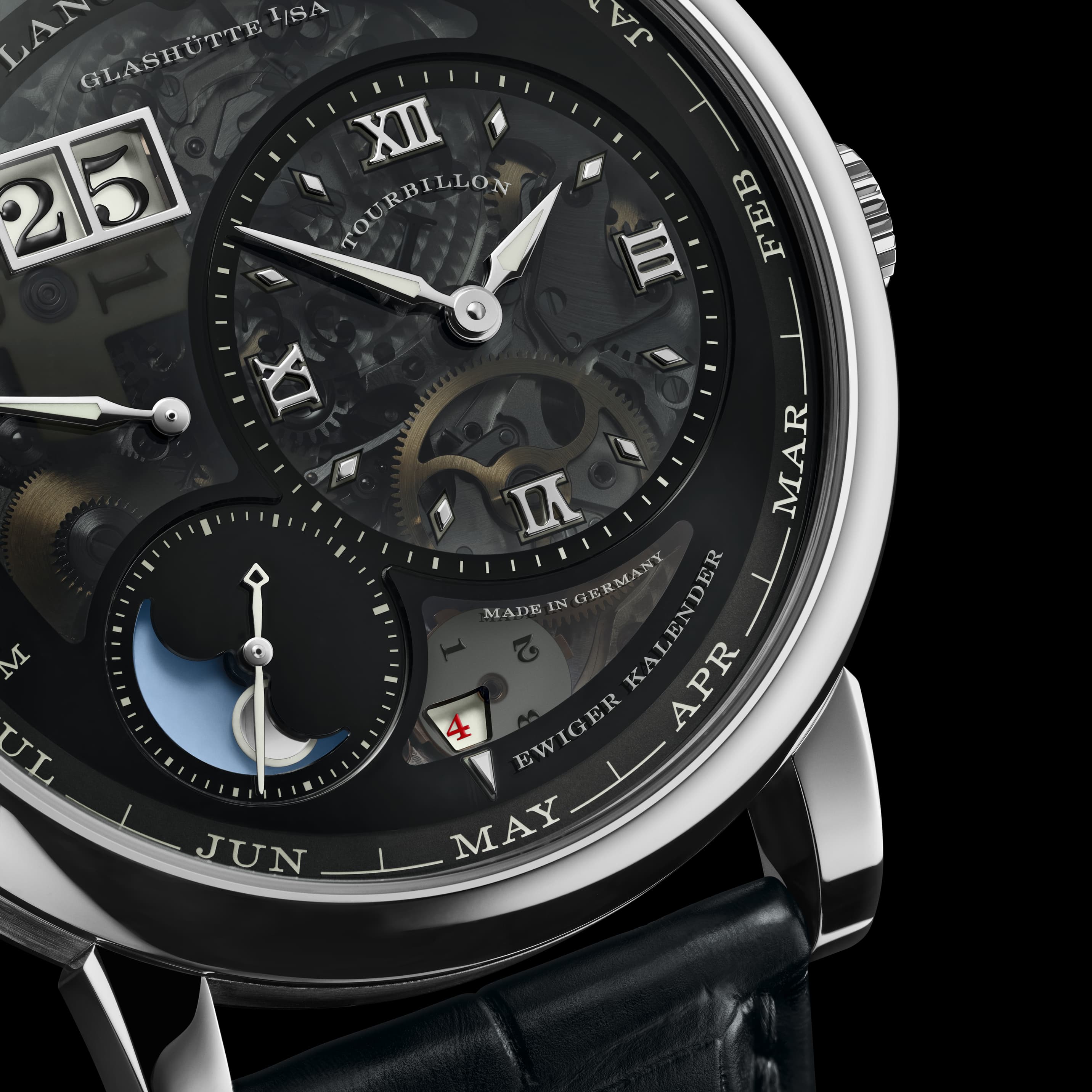
The platinum case (42mm, by estimation of proportions) provides a stark, cool counterbalance to the dark dial. The rhodiumed gold hands and appliques are white against black - daytime legibility is a given. But it is the retrograde day-of-week display on the left, sweeping its arc, that provides the kinetic theatre. The calendar is programmed correctly until 2100, a secular year that will require a single push-piece correction. For the next 74 years, it is effectively set-and-forget.
The Caliber L225.1: A Symphony of Patents
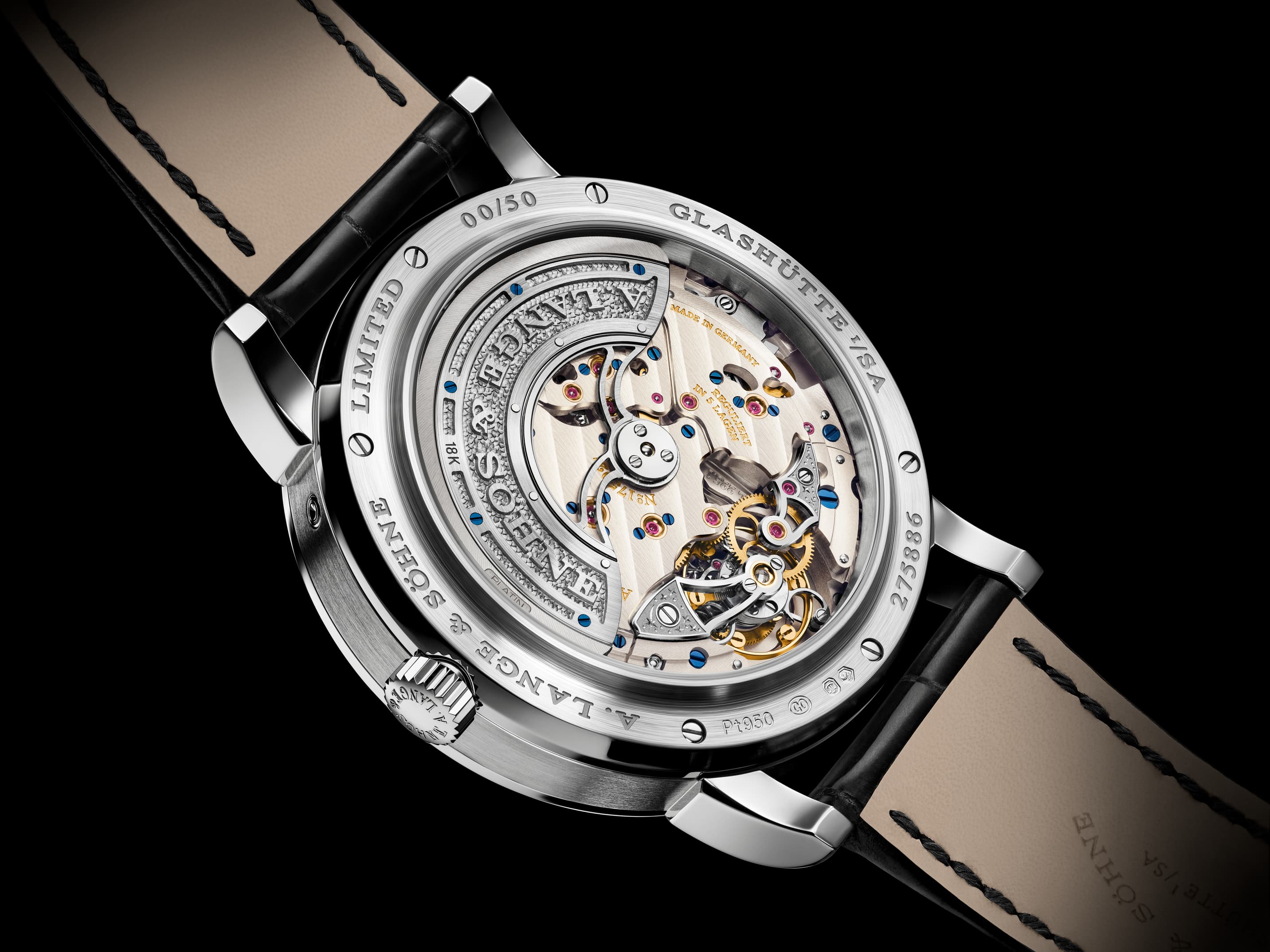
Turn the watch over. If the front is a chiaroscuro painting, the rear is a cathedral of German silver, hand-engraved cocks, and black polish. This is the new self-winding manufacture caliber L225.1, the 77th movement developed since the brand’s 1990 rebirth.
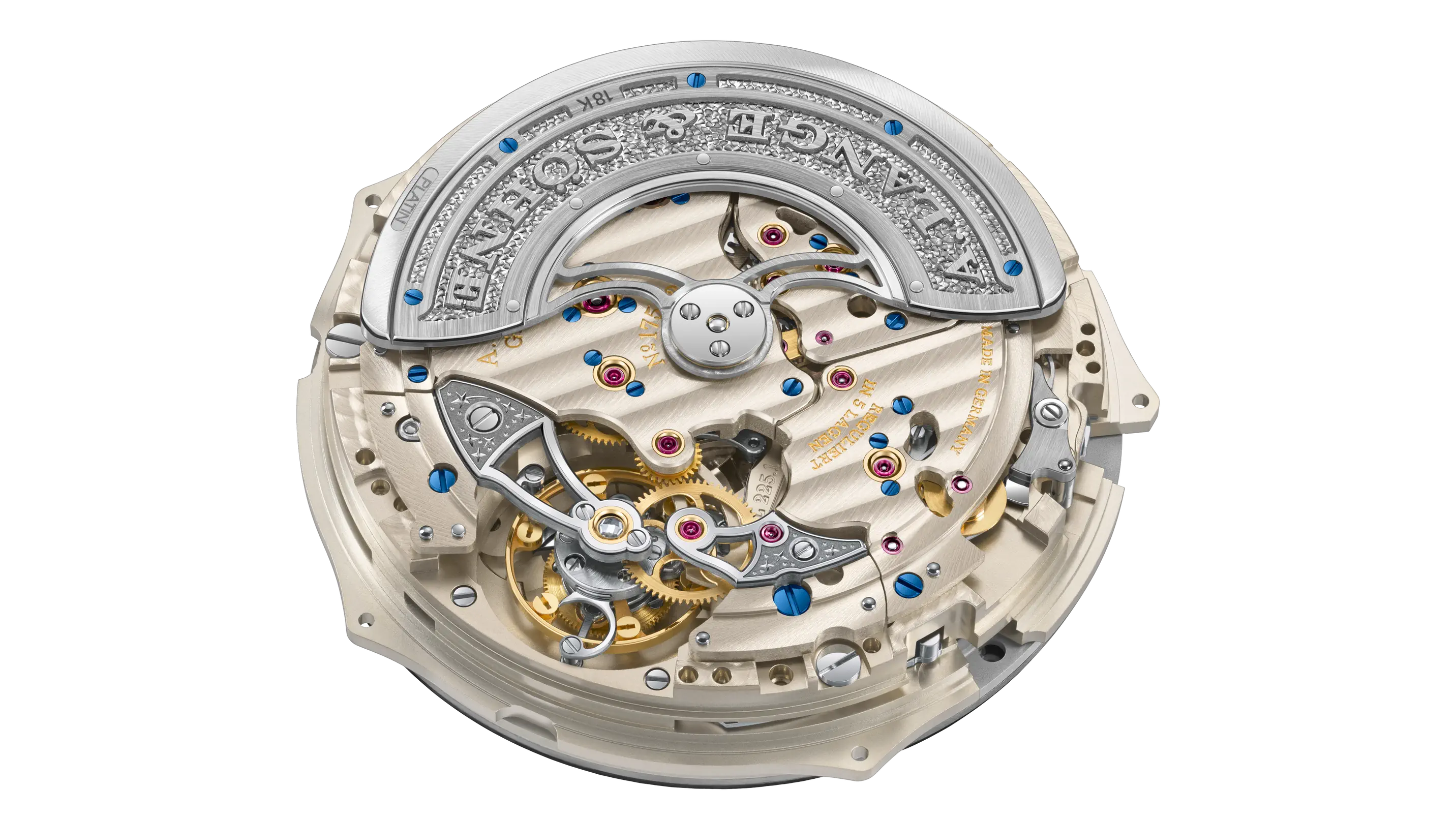
Let’s discuss the rotor first. It is a central rotor in 18-carat white gold, but Lange has added a twist: an external centrifugal mass in 950 platinum. This bimetal configuration ensures remarkably efficient winding. A few moments on the wrist generates the maximum 50-hour power reserve. The rotor itself is dark, black-rhodiumed in the center, contrasting with the lighter platinum mass, adhering to the watch’s monochromatic design language even where you cannot see it.
But the soul of this watch is the tourbillon.
The Tourbillon: Beyond Gravity, Into Art
From the dial side, the tourbillon is humble, signaled only by a discreet inscription at 12 o’clock. But through the caseback, it dominates the view. The filigreed cage rotates once per minute. However, Lange has done something that separates engineering from art: the stop-seconds mechanism for a tourbillon.
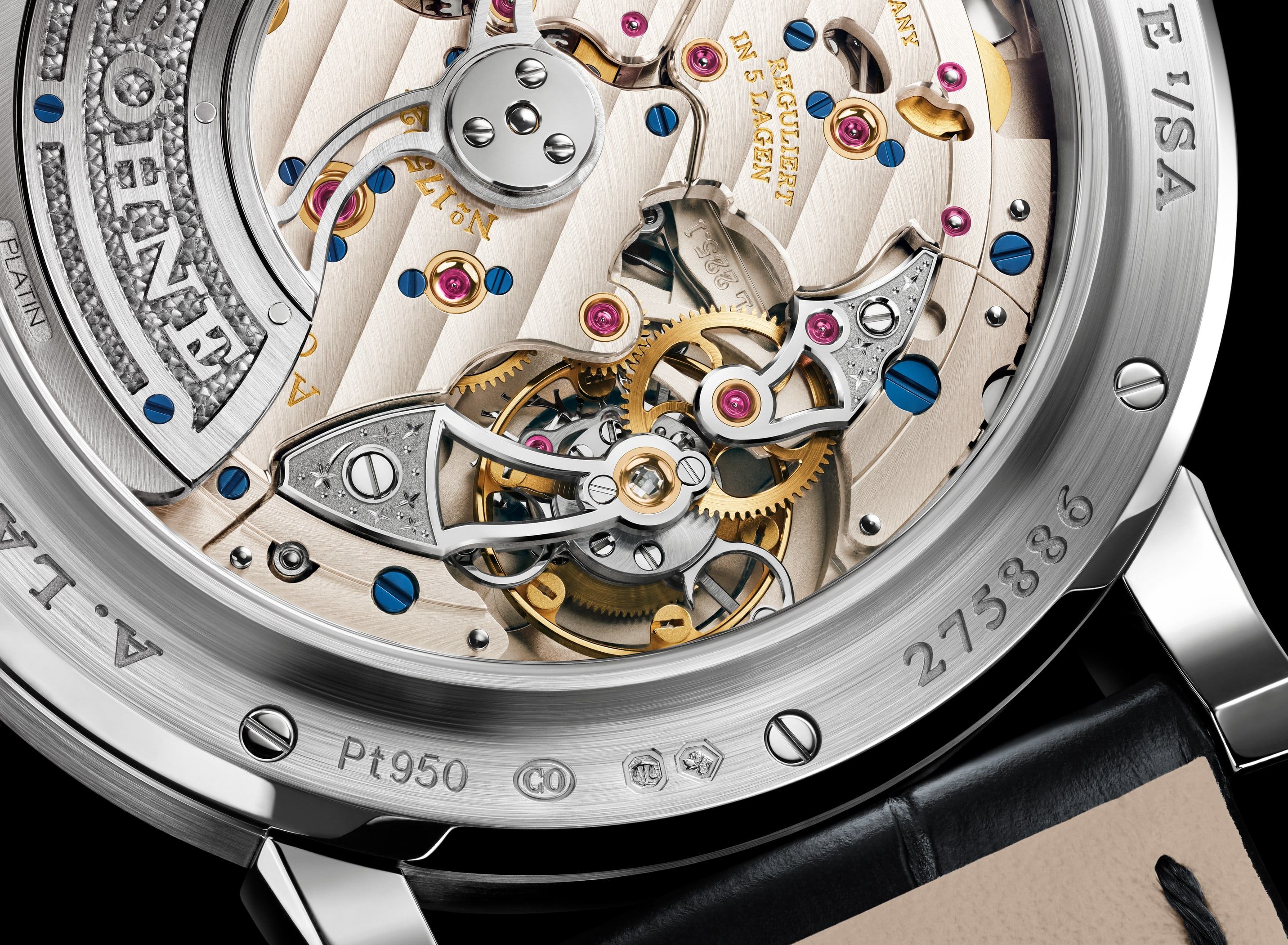
Patented in 2008, the V-shaped arresting spring allows the wearer to halt the balance inside the tourbillon cage instantly by pulling the crown. On a standard tourbillon, stopping the seconds hand is a mechanical nightmare due to the rotating cage. Here, you can set the watch to one-second accuracy. It is the kind of solution that makes other watchmakers nod silently in respect.
And then, there is the finishing. The tourbillon cock and the intermediate-wheel cock are crafted from stainless steel - a material notoriously harder to work than German silver. They are executed in black polish, a mirror finish so deep it appears to absorb light. Hand-engraved with tiny stars and a shooting star, these cocks are then polished to create a matte/gleaming transition that is nothing short of virtuosic. The bearing is capped with a diamond endstone, a direct lineage to the fabled 1A-quality pocket watches of Lange’s golden age.
The Verdict: A Phantom of Precision
The A. Lange & Söhne Lange 1 Tourbillon Perpetual Calendar “Lumen” is not a watch you wear to tell the time. It is a watch you wear to feel the time. It is for the collector who has moved past the need for validation and seeks instead the quiet satisfaction of absolute mechanical integrity.
By day, it is a stealth titan - dark, monochromatic, serious. By night, it transforms. The moon glows, the stars emerge, the dates advance with a crisp snap, and the tourbillon beats silently in its platinum cage.
It is rare (limited to just 50 pieces) and it is perfect. In a week full of novelties in Geneva, the “Lumen” stands alone. It is a reminder that in the digital age, the most advanced technology is often the one that glows in the dark.


