Complications Without Compromise: Modern Movements For Conscious Collectors
 5 min read

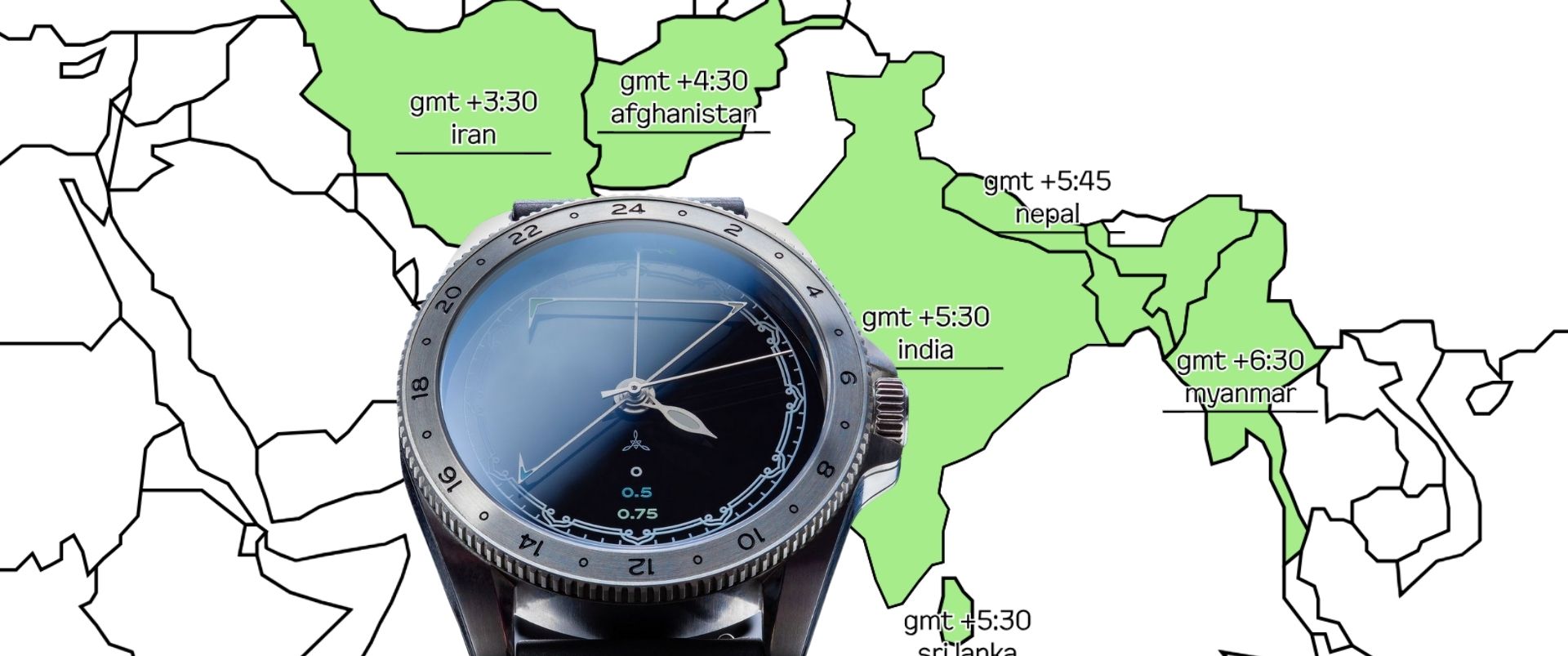
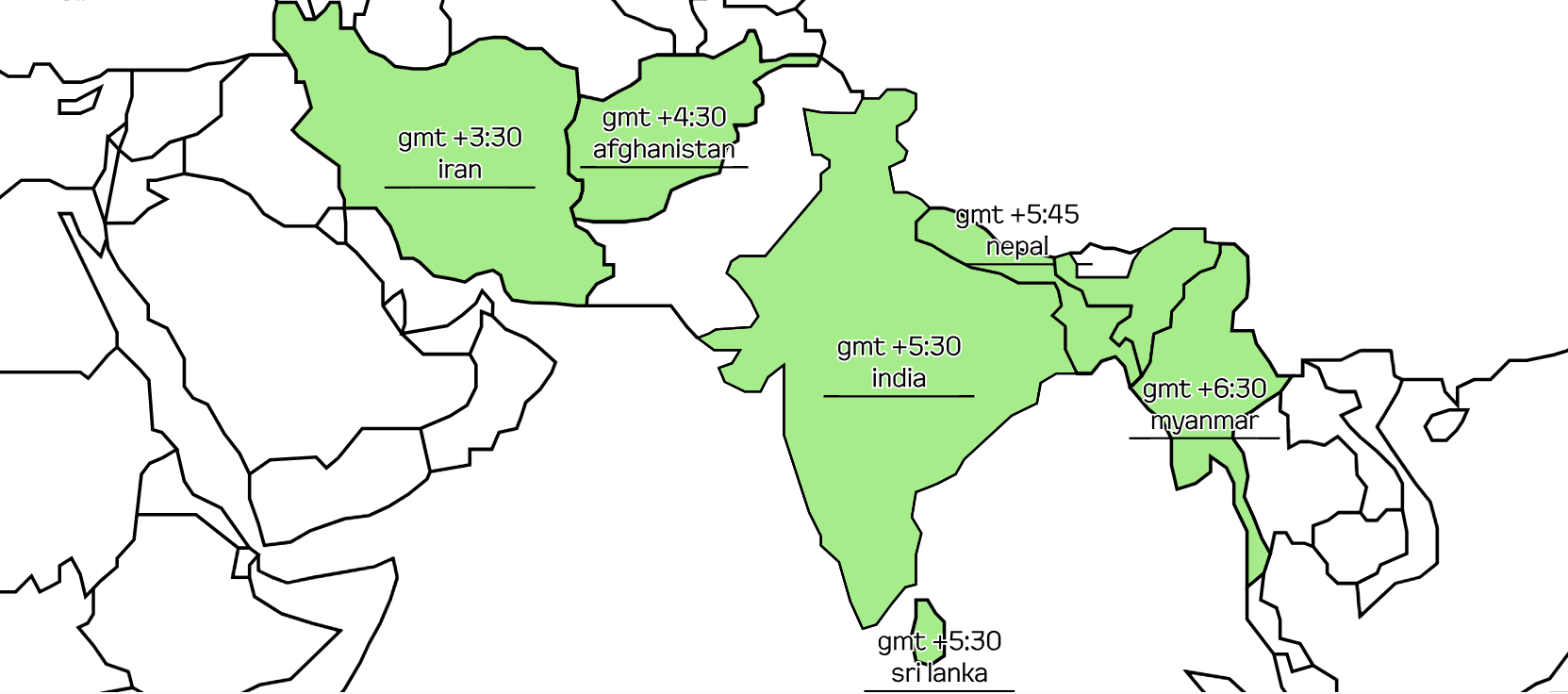
The mechanical GMT complication turned seventy in 2024. For seven decades, it has operated on an elegant but incomplete premise: that the world divides neatly into hourly segments radiating from Greenwich. For roughly 1.7 billion people living in ten countries with half-hour or 45-minute offsets, this has always been a polite fiction. Indian Standard Time runs at GMT+5:30. Nepal sits at GMT+5:45. Australian Central Standard Time operates at GMT+9:30. Traditional GMT movements simply cannot display these zones accurately.
Horology has made occasional attempts to address offset time zones over the years, but always as workarounds grafted onto existing architecture. The solutions felt apologetic, as though acknowledging these zones was a concession rather than a proper engineering challenge. Nava Krishnan, founder of Ardra Labs, approached the problem differently. Rather than asking how to modify a GMT movement to accommodate offsets, he asked what a complete GMT system would look like if designed from first principles. The answer is the PAN-GMT complication, now patented and fitted to the Delta Type, Ardra Labs' first watch. It will make its Indian debut at India Watch Weekend 2026, where collectors can finally see whether the mechanism works as elegantly in practice as it does in theory.
The Base Movement: Sellita SW330-2
The Delta Type uses the Sellita SW330-2, a proven GMT caliber measuring 26.2mm in diameter. It delivers 42 hours of power reserve at 28,800 vibrations per hour with 25 jewels. The movement is based on the ETA 2893-2 architecture, which means it benefits from decades of refinement and widespread availability of parts and service knowledge. Nothing exotic. This matters because Krishnan is not building watches as an exercise in proving technical prowess. The Sellita SW330-2 is reliable, serviceable, and available to independent brands without requiring manufacture-level capital investment. The choice reveals something about Ardra Labs' priorities. Rather than sinking resources into developing an entirely new movement, Krishnan focused engineering effort where it actually solves a problem: the display system. The PAN-GMT complication sits on top of the SW330-2 as a module, modifying how time information displays without rebuilding the movement itself. This is smart resource allocation. Patent the innovation, not the entire caliber.
How the PAN-GMT Display Functions
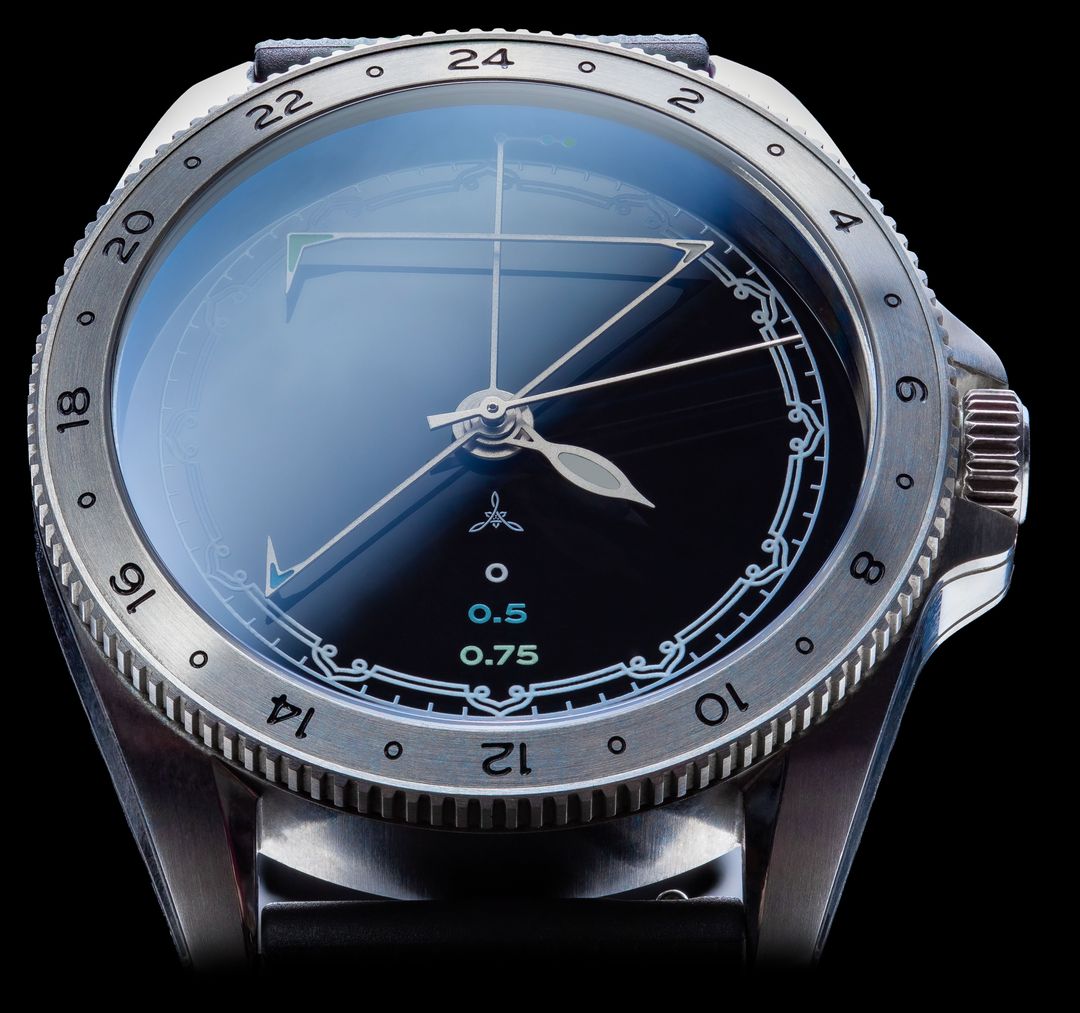
Traditional GMT watches use three elements: a local hour hand, a shared minute hand, and a 24-hour GMT hand pointing to a rotating bezel. The system works cleanly until you need to read GMT+5:30, at which point it simply fails. The Ardra Labs approach eliminates standard hour indices entirely. Instead, the Delta Type uses a three-vertex minute hand where each vertex is color-coded: white for whole-hour offsets, blue for 30-minute offsets, green for 45-minute offsets. The 24-hour bezel carries corresponding colored dots for each offset type. To read time in an offset zone, you match the colored GMT dot on the bezel with the corresponding colored minute vertex on the dial. Local time reads conventionally through a central hour hand and the white minute vertex against 12-hour indices. Alternate time zones are read using the tri-color GMT hand on the 24-hour bezel for hours, with corresponding minute vertices indicating precise offset time. This means the Delta Type can simultaneously display up to four time zones: local time plus three alternate zones with different offset types. The mechanism is unconventional enough that it only makes sense through physical interaction, which is precisely why India Watch Weekend matters for this watch. Photos cannot convey how quickly you learn to read the three-vertex system or whether the colored vertices create visual confusion in practice.
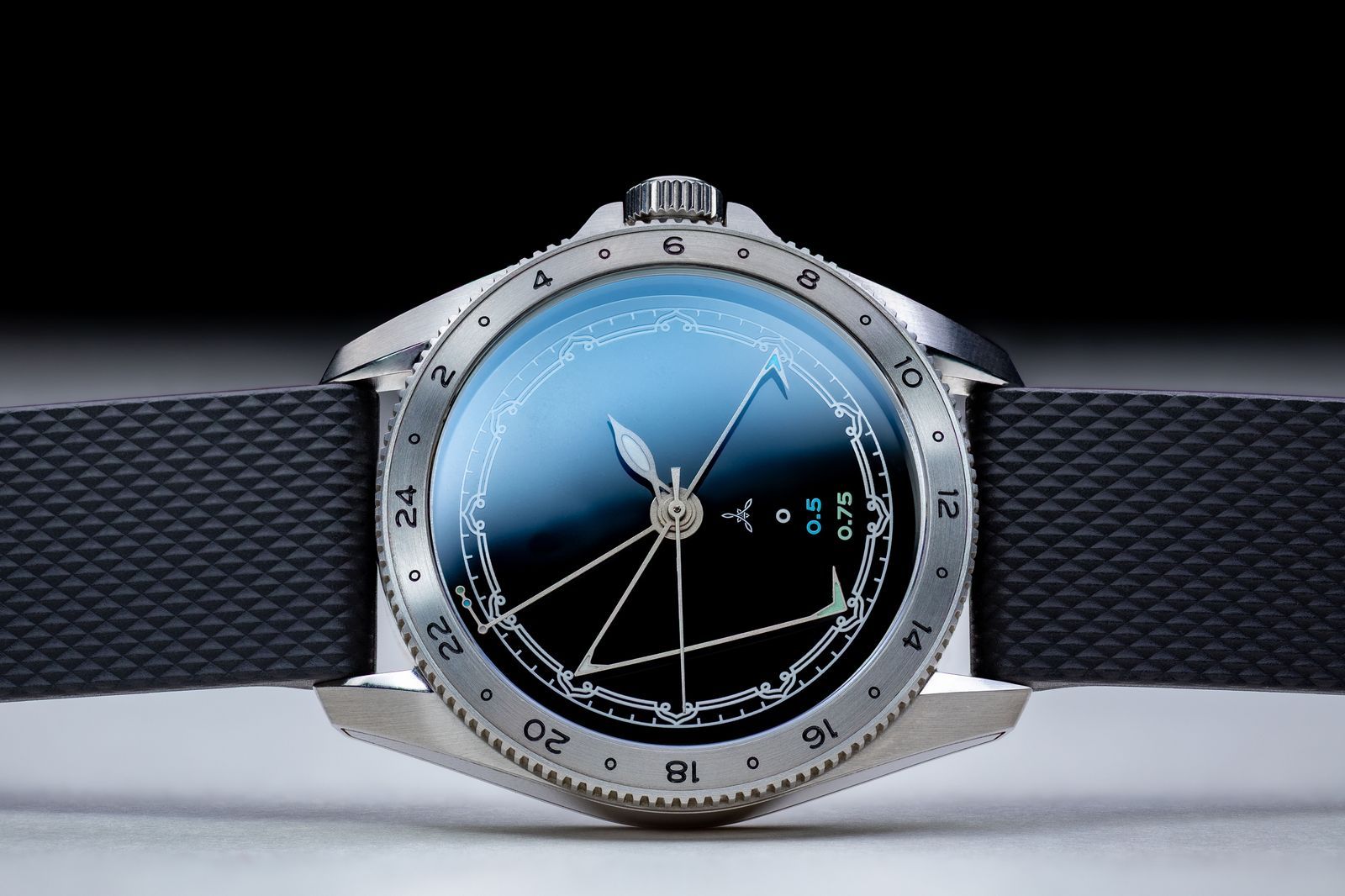
The Delta Type measures 39mm in diameter with an 11mm case thickness and 20mm lug width. The case is stainless steel fitted with a flat sapphire crystal carrying anti-reflective coating. The bezel is bi-directional with 120 clicks, offering finer resolution than the more common 60-click systems found on many GMT watches. Water resistance is rated to 100 meters, which positions this as a travel watch rather than a dive instrument. The dimensions are carefully considered. At 39mm, the Delta Type sits comfortably on smaller wrists while providing enough dial real estate for the unconventional display to breathe. The 11mm thickness is acceptable for a GMT complication, though not particularly slim. The flat crystal maximizes legibility, which matters significantly given the information density on the dial.

What Collectors Should Evaluate
If you are considering the Delta Type, or simply curious about whether the PAN-GMT complication represents genuine innovation or clever marketing, there are specific things to examine.
First, dial legibility under varied lighting conditions. The three-vertex minute hand and color-coded system introduces more visual information than a traditional GMT display. Does this enhance functionality or create cognitive load? Can you read offset time zones quickly after familiarization, or does it remain effortful?
Second, bezel action and index alignment. The 120-click bezel offers theoretical precision, but actual usability depends on tactile feedback and whether clicks align cleanly with printed indices. A misaligned bezel undermines the entire offset system.
Third, movement finishing and regulation. The SW330-2 is a workhorse caliber, but execution varies between watchmakers. Check timekeeping accuracy across positions and power reserve states. Inspect rotor finishing and overall movement cleanliness through the caseback if accessible.
Fourth, build quality relative to the $2,400 price point. At this level, you should expect clean case machining, properly finished edges, and solid bracelet or strap integration. The Delta Type competes with established microbrands and entry-level Swiss pieces where manufacturing standards are mature.
India Watch Weekend 2026 offers the first opportunity for Indian collectors to evaluate this in person. The Delta Type will be produced in a limited series of 300 pieces, which creates scarcity but also limits how widely the PAN-GMT system can be tested in the field. For a complication this unconventional, broader adoption would provide valuable feedback about whether the design succeeds beyond the prototype stage. Krishnan has stated that the PAN-GMT module can theoretically be fitted to any standard GMT movement, not just the Sellita SW330-2. If the system proves functionally sound, that opens possibilities for licensing or broader implementation. Whether that happens depends entirely on execution. Clever complications earn attention. Useful complications earn adoption.


