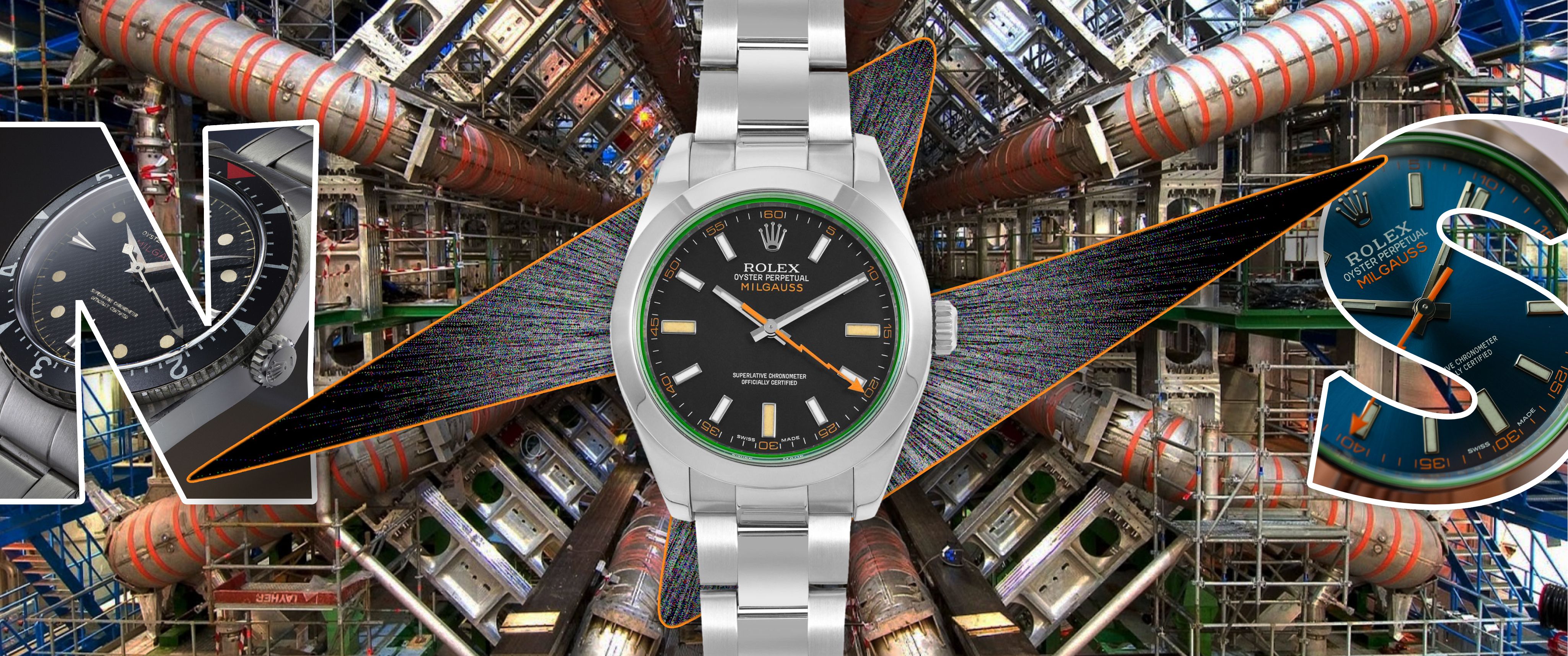
The Complete History Of Rolex Milgauss
 7 min read

When we talk about electric watches, typically we’re talking about quartz or smart watches. For reasons well known, that’s exactly when a lot of us start to tune out of the discussion. But wait. What if we’re actually talking about electrifying watches for electrified workplaces.
Yup. That’s the Rolex Milgauss.
A Problem Of Attraction
The Milgauss dawned in the 1950s, when the promise of civilian nuclear energy - a cold war consequence, was starting to take a realized form. This was the age of “big science” - a composite of large-scale industrial research and hefty government funding. The most ambitious of its undertaking came about in the field of sub-atomic physics and no research laboratory was more intensive in the said than CERN, or Conseil Européen pour la Recherche Nucléaire. This sprawling campus in a western suburb of Geneva dedicated to particle physics, building accelerators and colliders had powerful electromagnets as signature scientific infrastructure.
Over subsequent decades, CERN’s infrastructure would peak in the world’s largest particle accelerator - the Large Hadron Collider, a 27‑kilometre ring of superconducting magnets where scientists discovered the Higgs boson. CERN is also the birthplace of the World Wide Web. In this environment, the problems of a balance spring seem small, but for the physicists whose watches were being dragged off rate or ruined outright by magnetism, they were not theoretical.


With magnetism becoming a practical problem for precision timekeeping, Rolex developed its original Milgauss, validated in CERN’s own laboratories, for the scientists at CERN. This product conceived to counter watchmaking’s long-standing nemesis was part of a tech-scramble inviting participation from the likes of IWC, Jaeger-LeCoultre, Omega, and even Patek Philippe, with a consequent opus of the category of “engineer’s watches.”
The Milgauss wore the same Oyster case and screw‑down crown as the brand’s sports icons, but one which could survive magnetic fields of 1000, or mille, gauss without sacrificing chronometric performance. In doing so, Rolex created a watch that represents its alter-ego and a surprising sense of humor as well. If there’s a streak inside of Rolex that’s a little bit iconoclastic, the Milgauss is definitely a product of that mentality.
Engineering Against An Invisible Enemy
Magnetism has long been the mechanical watch’s silent assassin. Steel components - particularly the hairspring, can become magnetized, causing coils to stick together and dramatically accelerating the rate. Rolex’s solution, introduced in the mid-1950s, was not to fight magnetism piecemeal but to shield the movement wholesale.
The Milgauss employed a soft-iron Faraday cage, formed by an inner caseback and a movement-encasing cap, diverting magnetic fields around the caliber rather than through it. This approach, used in varying forms by other anti-magnetic watches of the era, allowed Rolex to maintain conventional steel components while achieving remarkable resistance. Resistance to 1000 gauss of magnetic flux density was ambitious for the time and meaningfully higher than the practical requirements of most wearers - precisely the point. Rolex was specifically building for the scientific frontier.
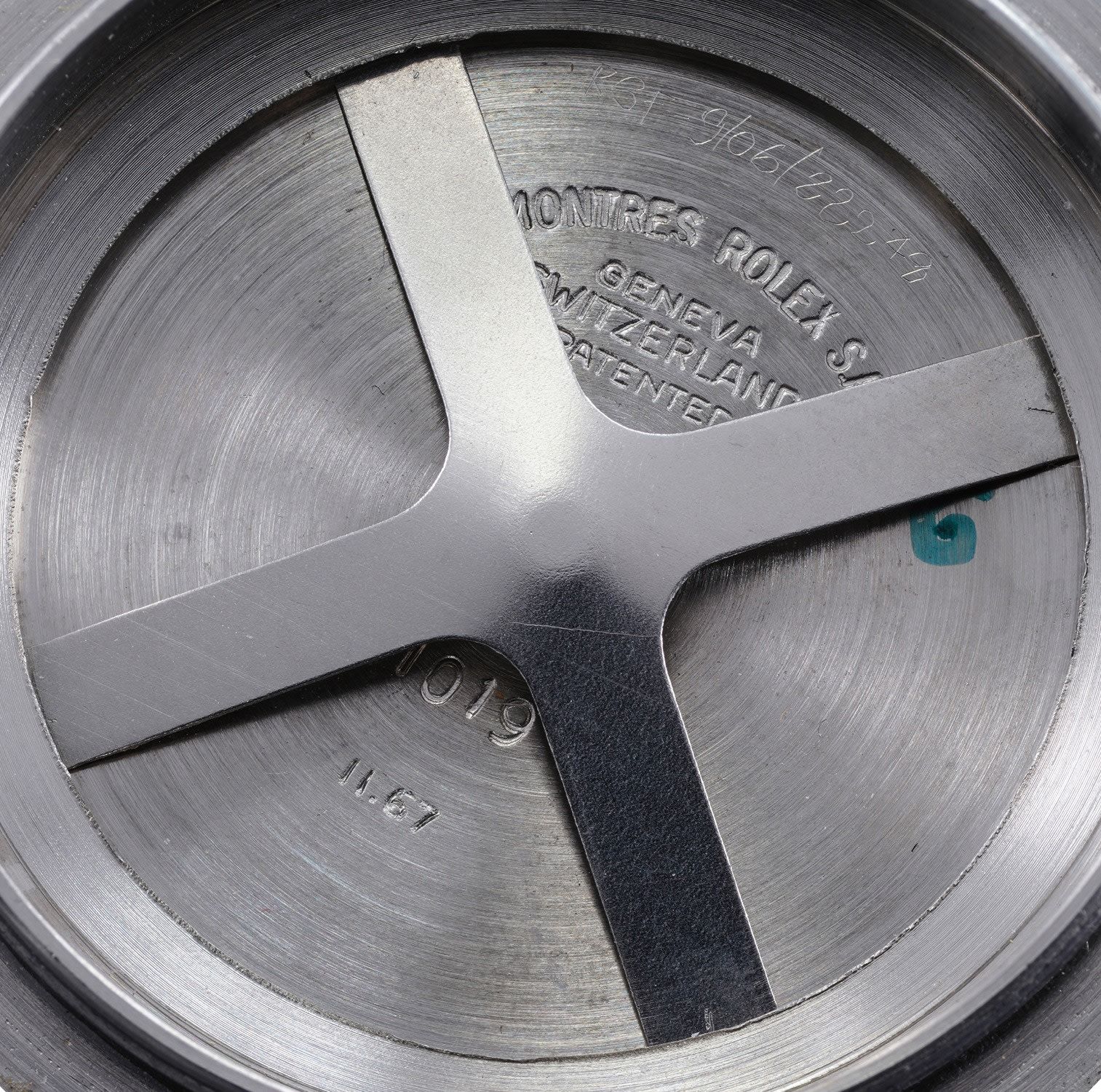
Inside beat an automatic movement derived from Rolex’s proven architecture, tuned for chronometric performance and protected rather than fundamentally altered. This distinction matters. The Milgauss was not an experimental curiosity - it was a professional instrument built with the same philosophy that governed Rolex’s tool watches across domains: over-engineer, test relentlessly, and package the result in a watch that could be worn every day.
1954: The Milgauss Proof Of Concept Via Ref. 6543
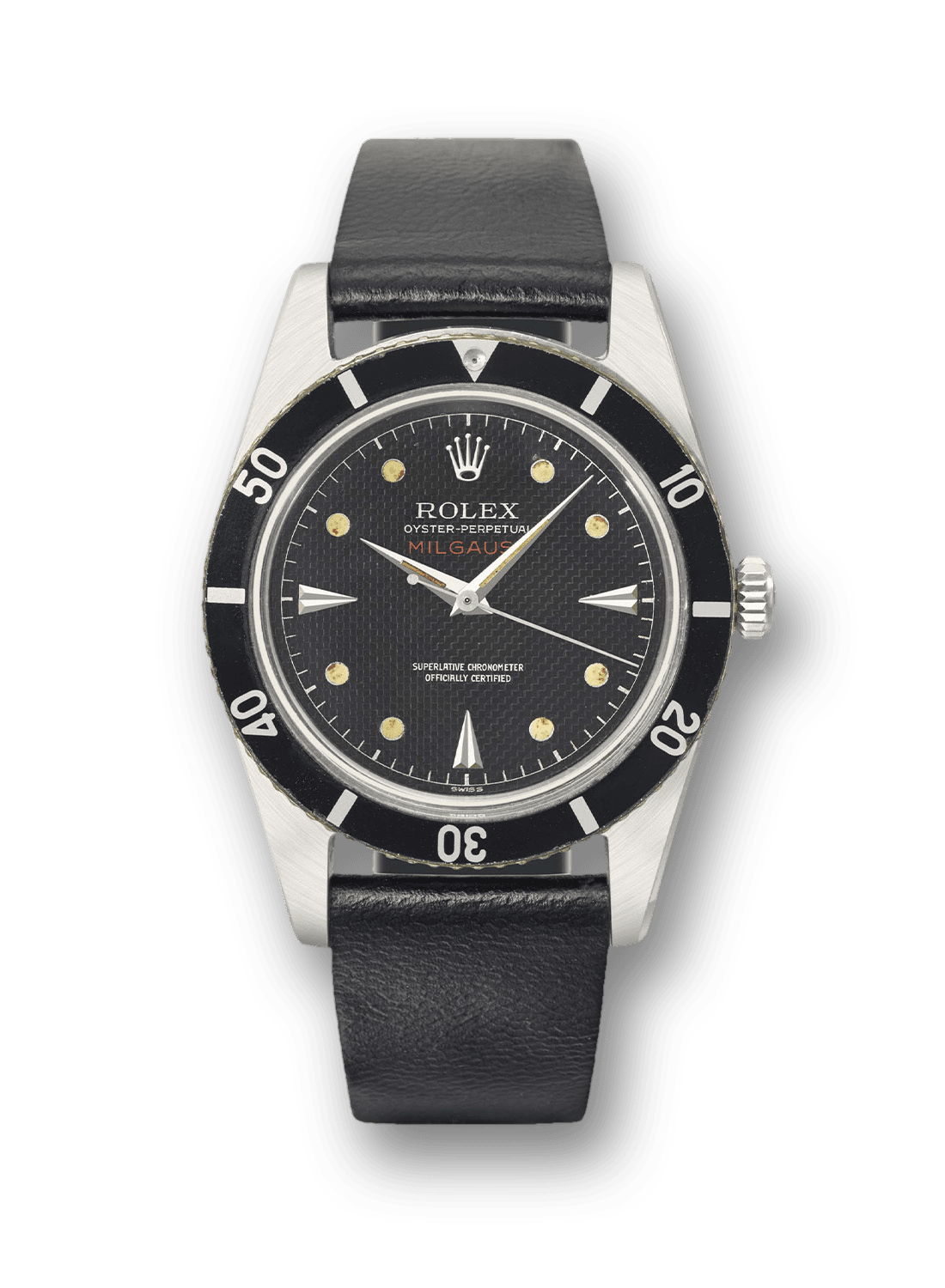
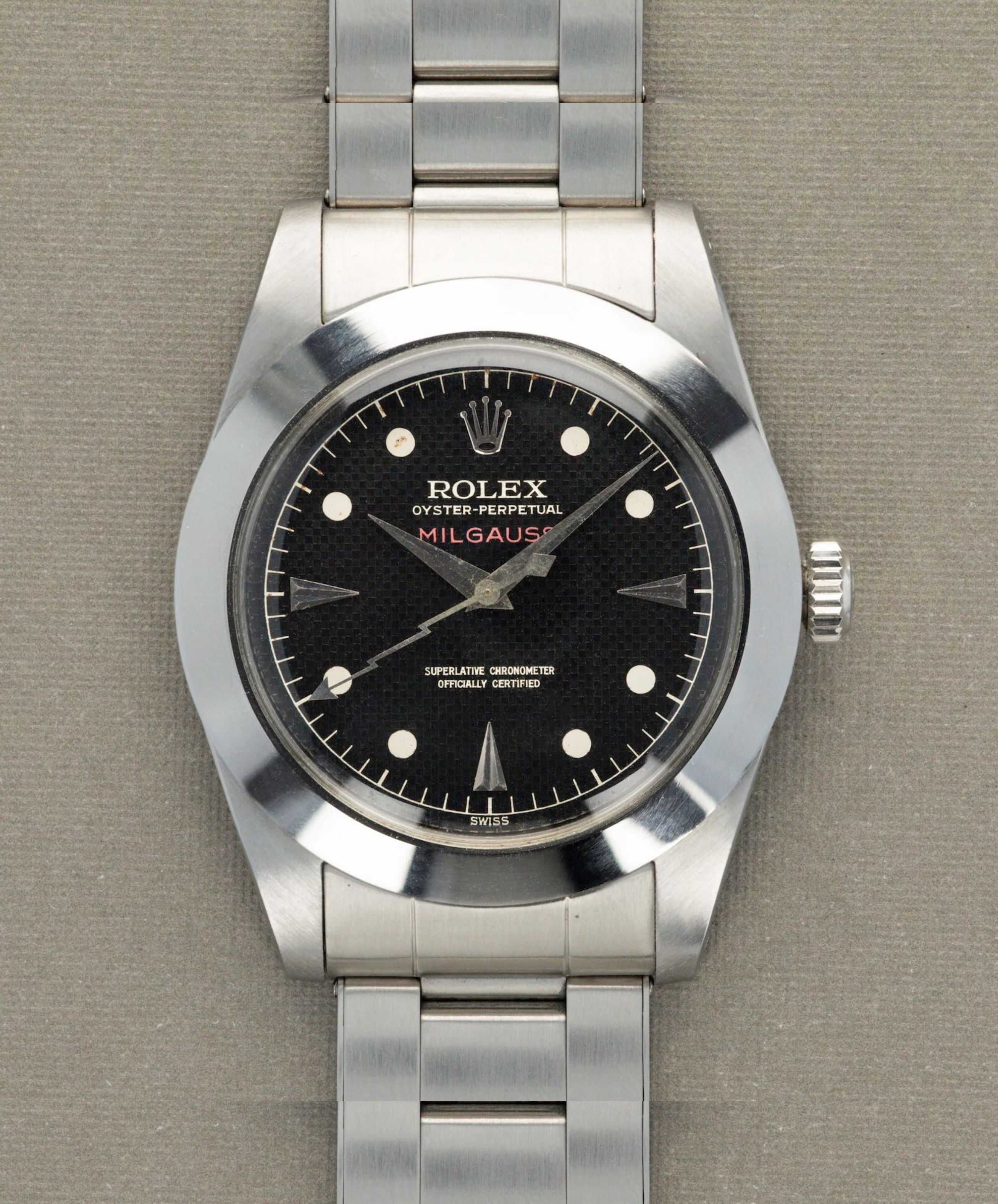
The first Milgauss, reference 6543, was less a fully realized product than a proof of concept. Produced between 1954 and 1957 in tiny numbers (common estimates are 75 and 200 examples), it used the 38 mm Oyster case, automatic caliber 1080 and a soft‑iron band around the movement to achieve its anti‑magnetic rating. The dial was black and honeycombed, the luminous‑looking round plots were in fact non‑luminous, and the seconds hand was a straight needle rather than anything so theatrical as a lightning bolt. With oddities such as its 19.7 mm lug spacing and a Submariner‑type rotating bezel, it looked like a lab prototype that had strayed into a catalog.
1956: Ref. 6541 - The First Real Milgauss
The watch that’s widely regarded as the “first real Milgauss” is the reference 6541, introduced exactly 70 years ago in 1956 and produced, again in very small numbers, through around 1960. The case remained 38 mm, the caliber 1080 was retained, and the dial was still a metal‑woven honeycomb. Three key elements turned the 6541 into something unmistakable: a new bezel insert, divided into six sectors, triangular hour markers at three, six and nine, and most importantly, a central seconds hand stylized as a lightning bolt.
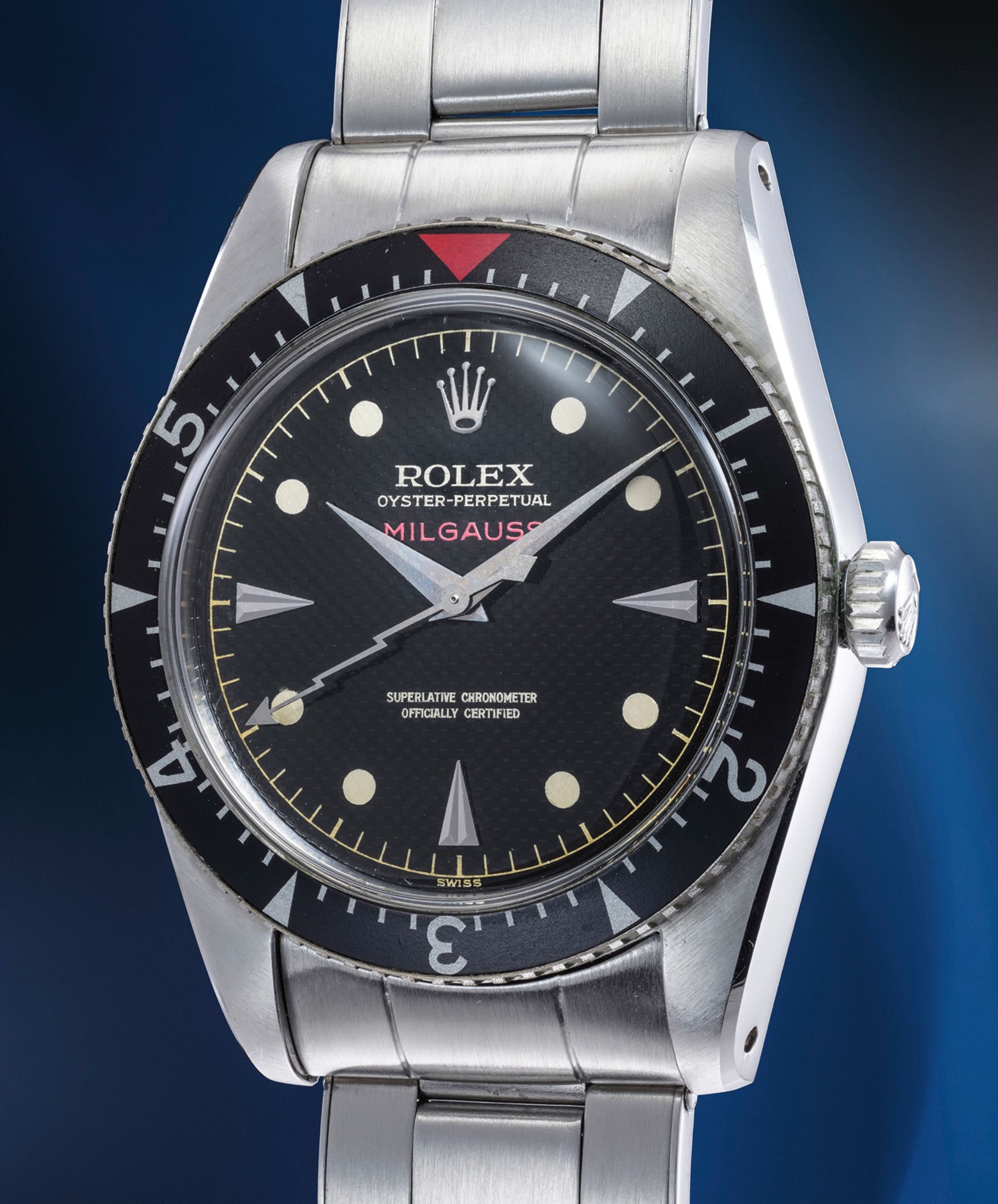
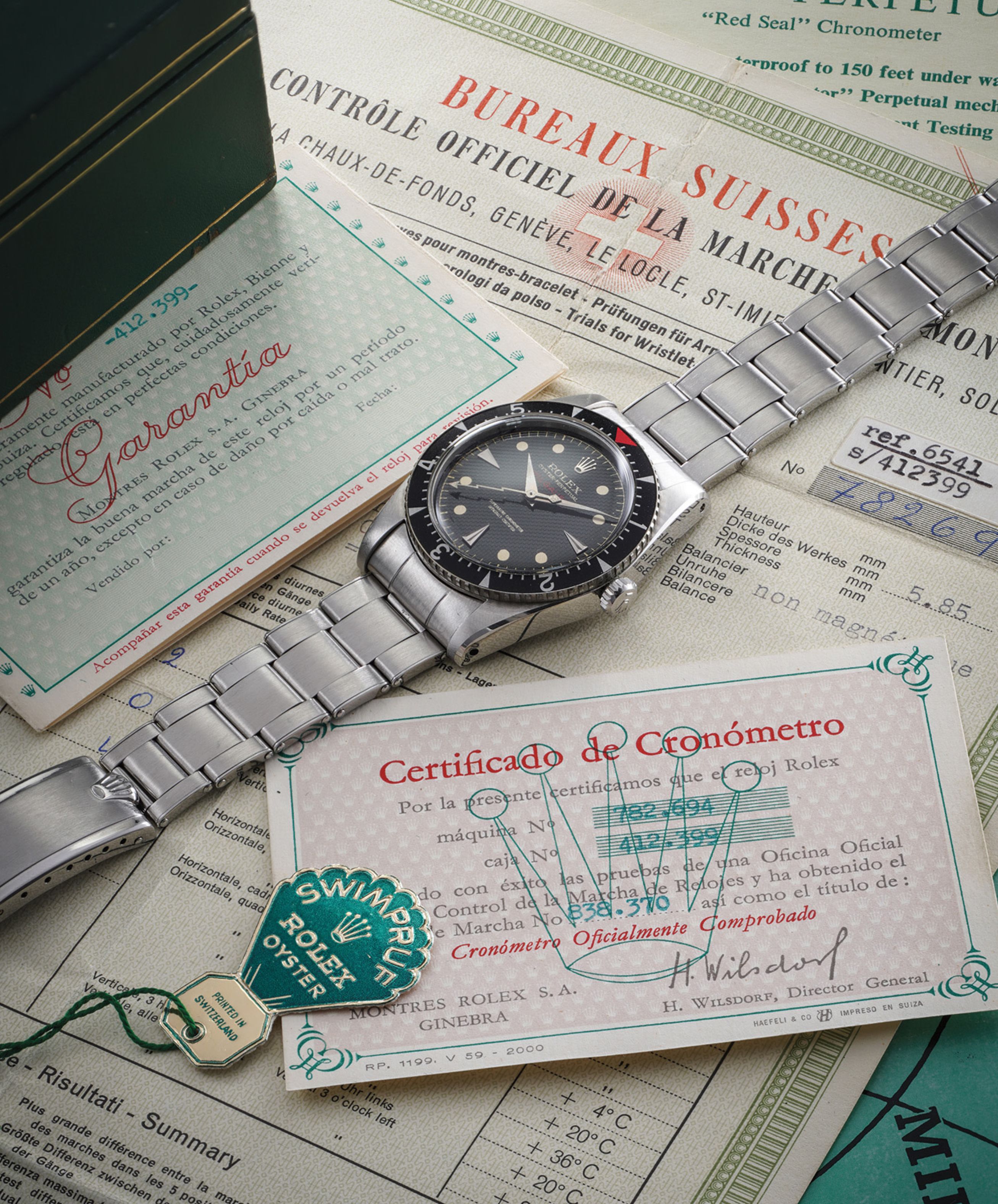
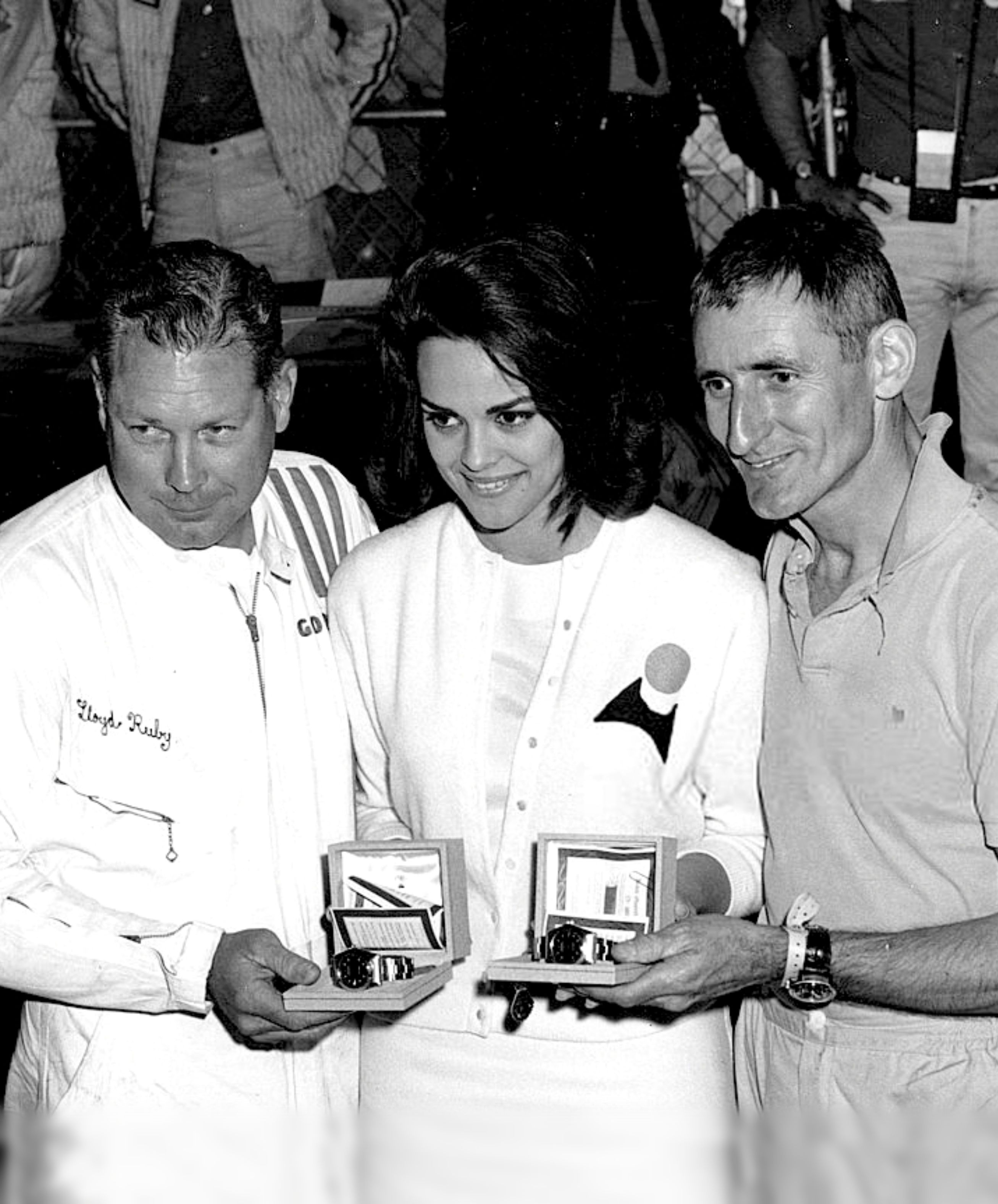
The commercially awkward Milgauss references 6543 and 6541 were overshadowed by their own brethren and struggled to sell. This prompted Rolex to popularize the Milgauss by offering the watch to NASCAR and Daytona winners. In the said objective, Rolex even converted some rotating‑bezel 6541 stock to smooth‑bezel pieces simply to move them. Today, the rarity that once made the early Milgauss hard to sell has made it one of the most coveted vintage Rolex references. In 2023, a Milgauss 6541 was auctioned by Phillips in Geneva for $2.5 million, with the buyer rumored to be Rolex itself.
1960-1988: The Enduring Reference 1019
In 1960, Rolex effectively rebooted the model with the Milgauss reference 1019. Gone were the rotating bezel, the honeycomb dial and the lightning bolt seconds hand in preference of a more conservative looking Rolex.
The 38 mm case remained, now with a fixed polished bezel and a rated water‑resistance of 50 meters. Inside, the purpose‑built caliber 1580 - an automatic movement exclusive to the 1019, beat at 19,800 vph with a 48‑hour power reserve, still shielded by a full soft‑iron inner case. Dials were typically vertically brushed silver or matte black, with applied baton markers, tritium lume at the tips (T‑SWISS‑T) and a straight seconds hand with a red arrowhead tip. “MILGAUSS” appeared in red beneath the Oyster Perpetual signature, while “Superlative Chronometer Officially Certified” was stacked at six.
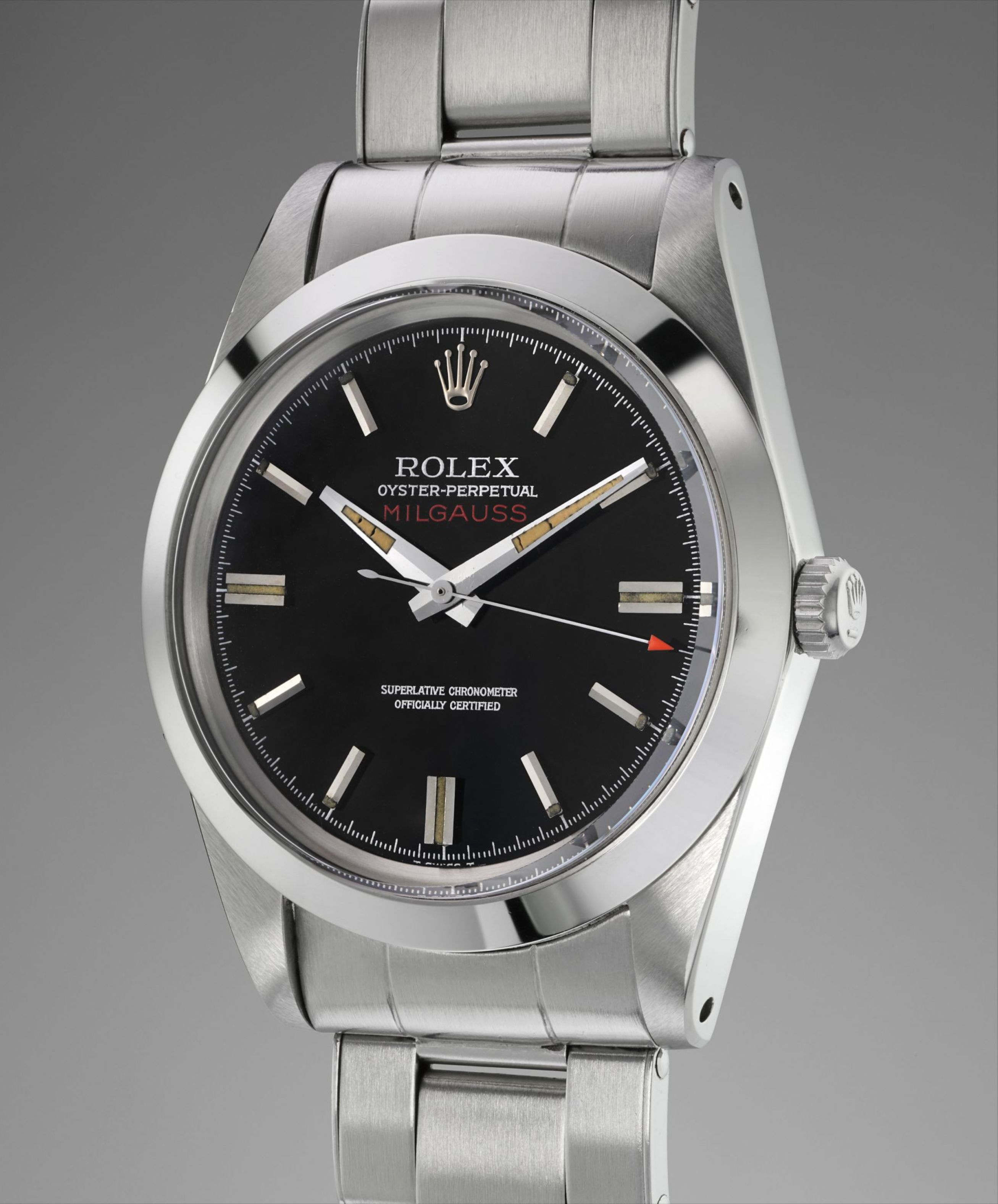
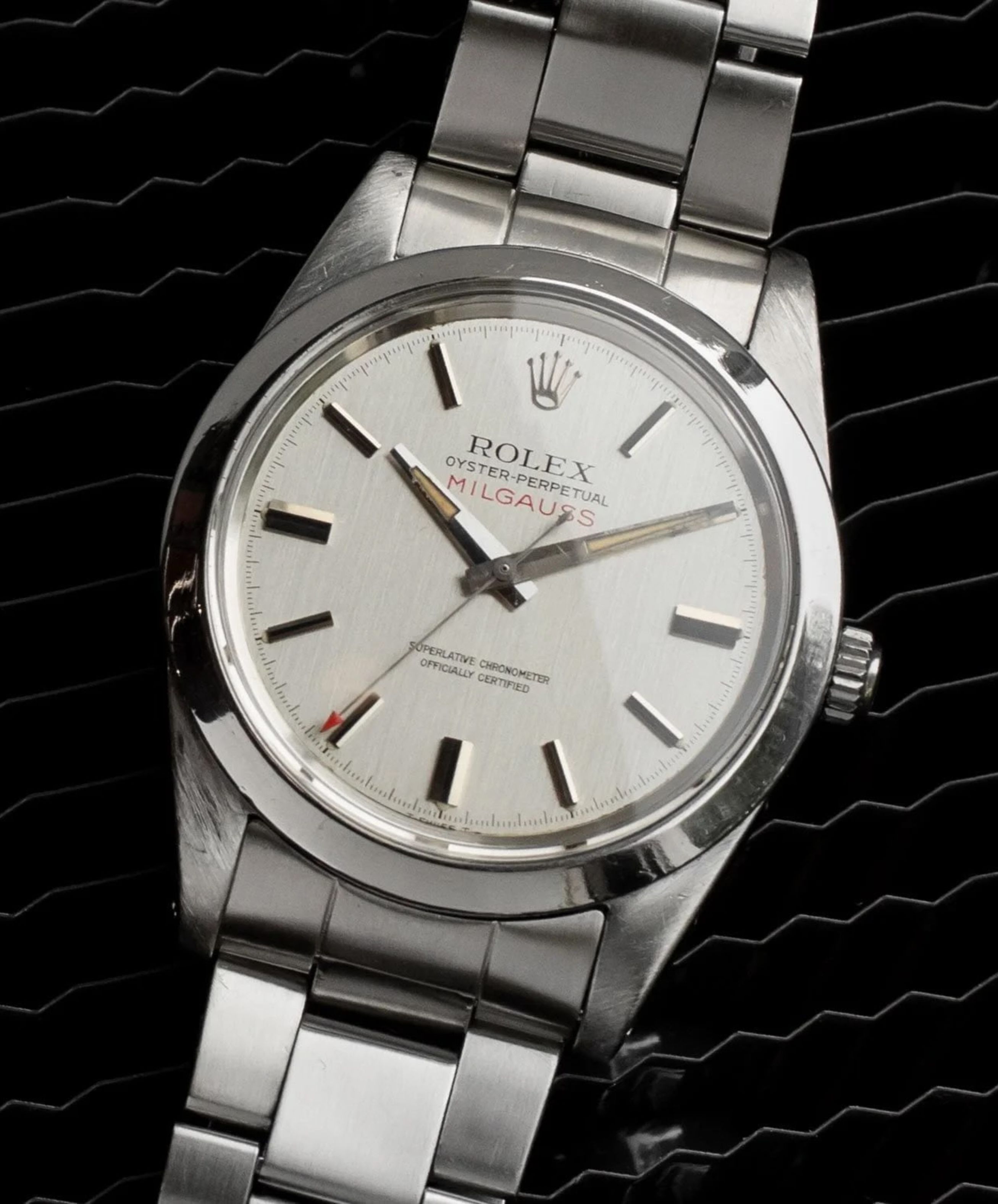
Within that basic template, Rolex iterated quietly for nearly three decades resulting in what’s impressively the longest-running Milgauss in particular and one of the longest-running Rolex references in general. Even for all that, the reference 1019 was never a strong seller and an unfortunate victim of the popularity of its siblings. It shared the fate of its predecessor and was finally discontinued in 1988, after roughly 28 years - one of the longest continuous runs of any Rolex reference.
2007-2023: Glace Verte, Z‑Blue And Rolex’s Alter‑Ego
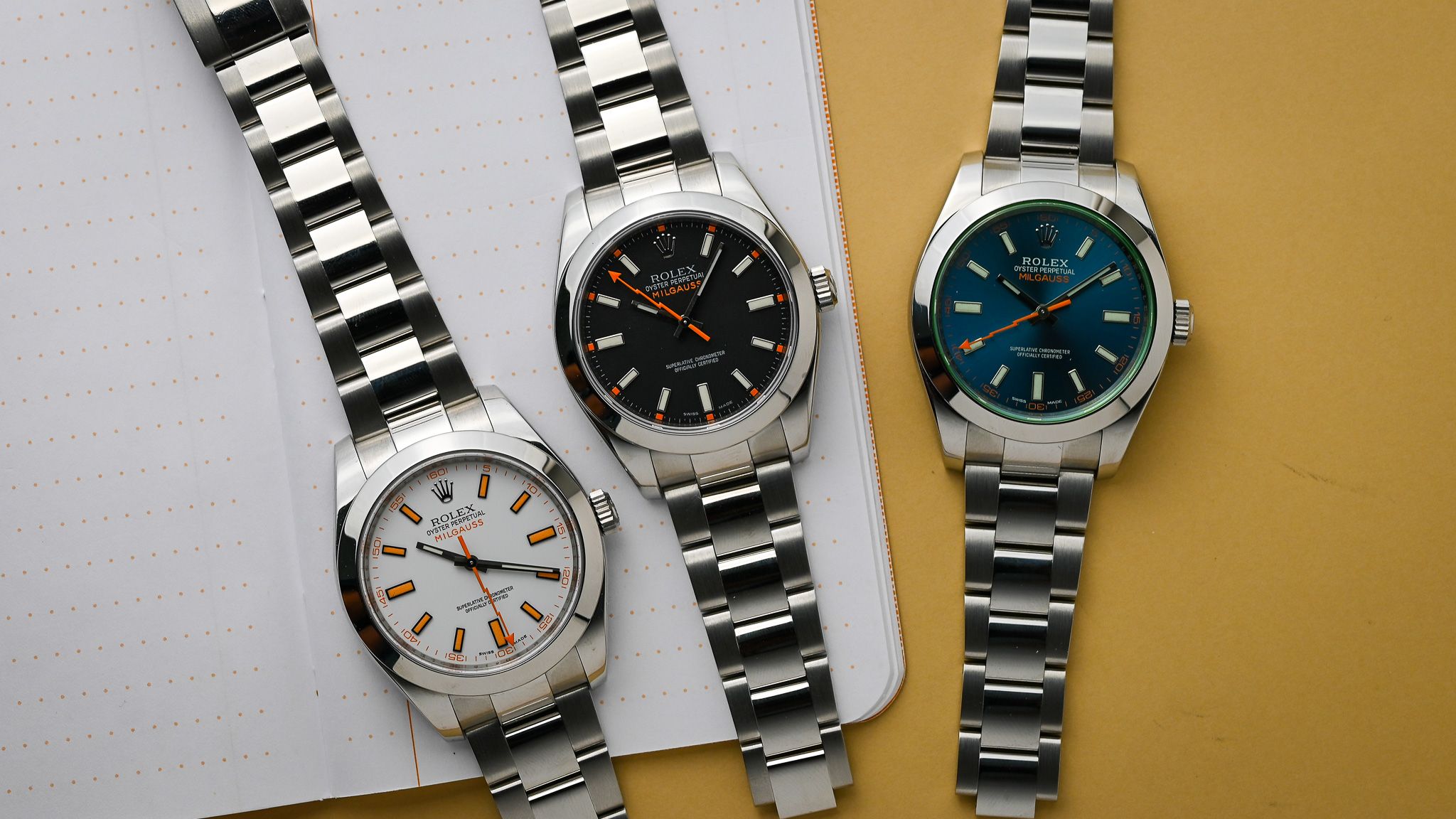
Rolex waited nearly two decades before revisiting the Milgauss, reintroducing it in 2007 as the six-digit reference 116400. Technically, the modern Milgauss doubled down on the original brief. The 40 mm Oyster case, in 904L steel and rated to 100 meters, housed the in‑house caliber 3131, a chronometer‑grade automatic movement running at 28,800 vph with a 48‑hour power reserve. The soft‑iron inner cage remained, but the movement itself adopted paramagnetic components including Rolex’s blue Parachrom hairspring, in a niobium‑zirconium alloy, and a nickel‑phosphorus escapement, to further shield it against magnetism. Rolex continued to quote 1000 gauss as the model’s rating, but given both the cage and the materials, the true threshold was possibly significantly higher.
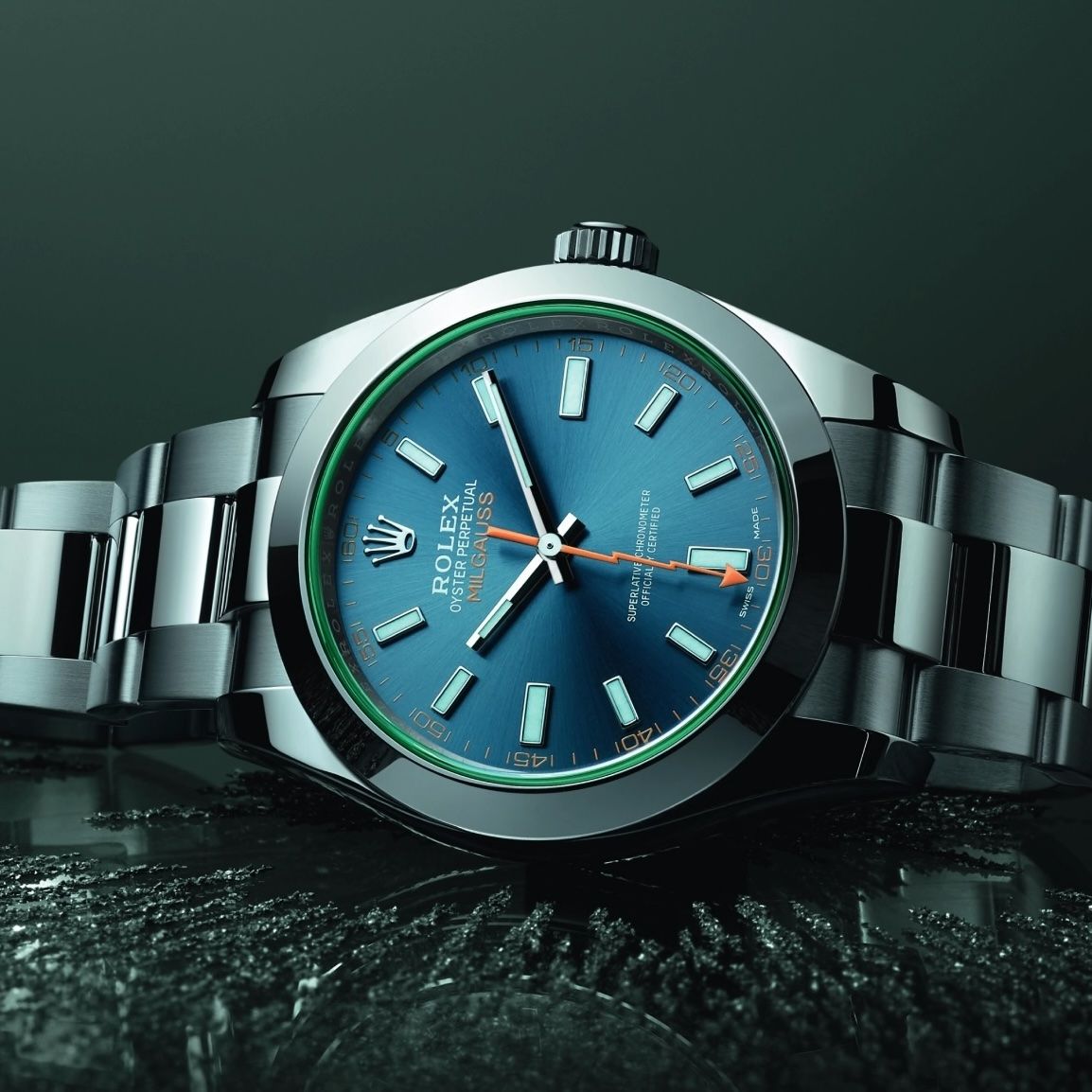
Aesthetically, however, the 116400 was anything but conservative. The lightning bolt seconds hand returned, now painted a vivid orange and paired with dial accents that made the watch, in some configurations, look almost defiantly un‑Rolex. At launch there were three versions: white and black dial models with orange details and an “Anniversary” 116400GV, with a black dial and a green‑tinted sapphire crystal - Glace Verte - that Rolex stated was so difficult to manufacture that it did not even bother to patent the process.
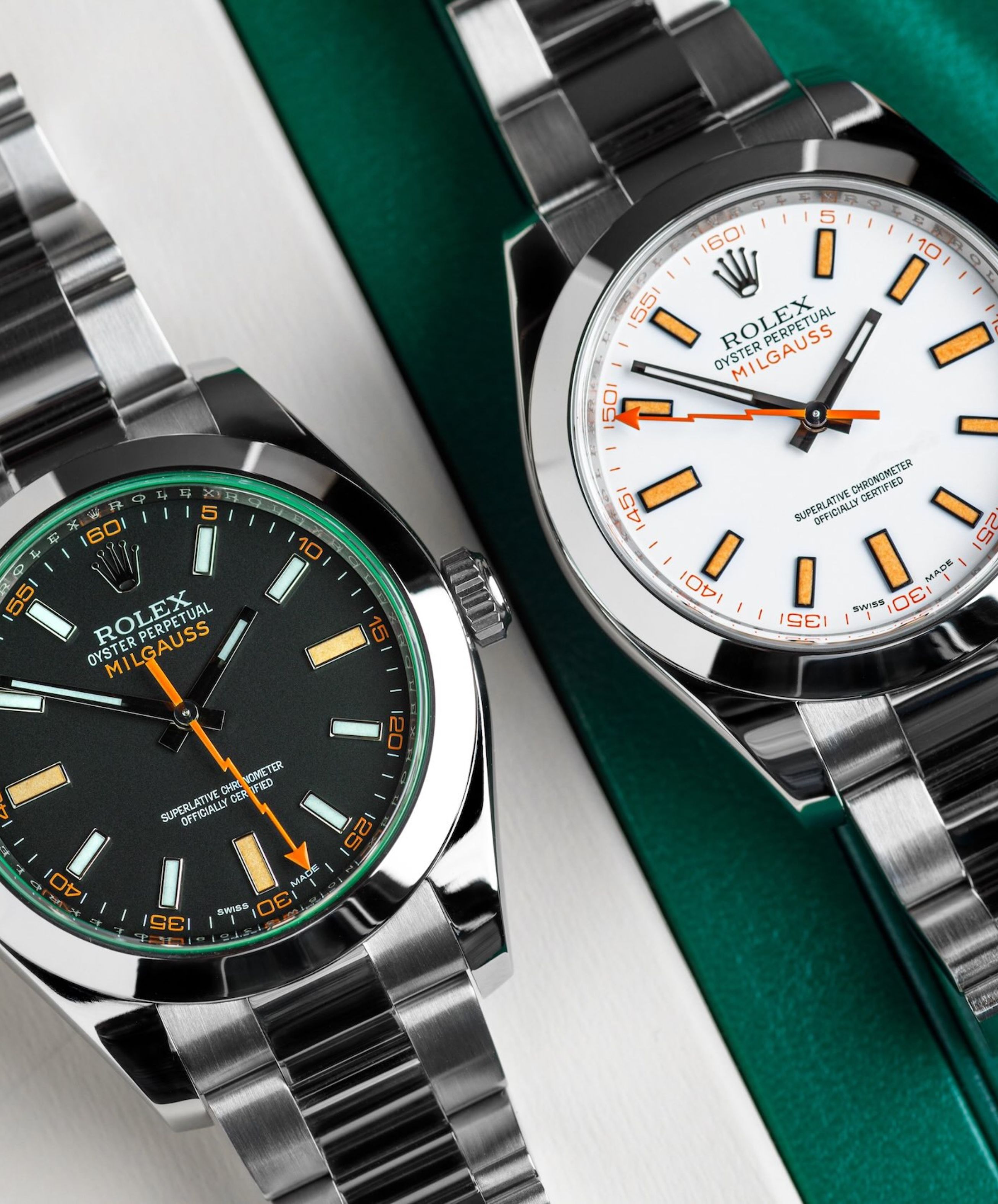
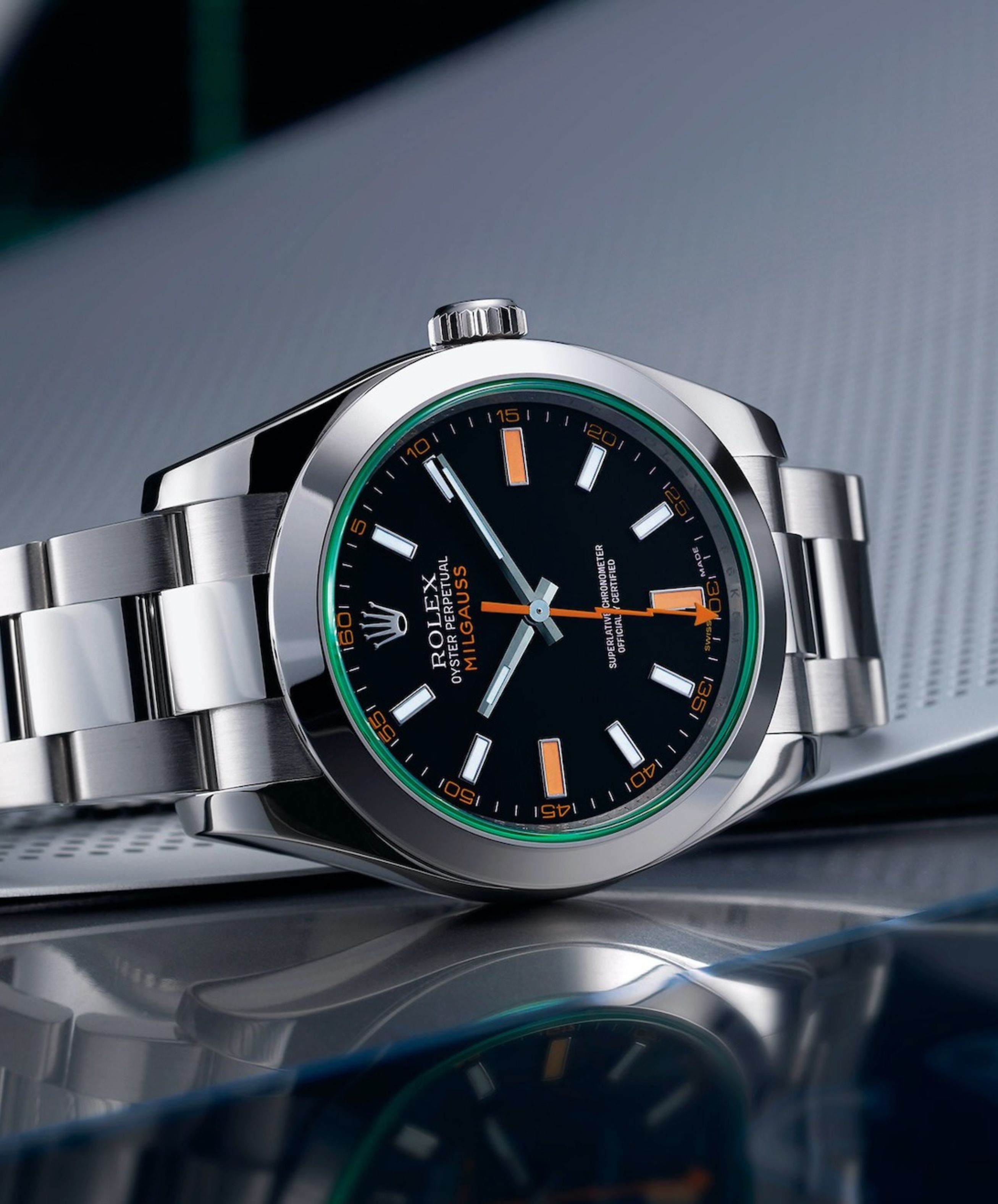
That green crystal, unique to the Milgauss, redefined the model’s personality. It added a neon halo to the dial at certain angles. In 2014, Rolex pushed the palette further by introducing the Z‑Blue dial: a metallic, zirconium‑coated “electric” blue sunburst paired exclusively with the green crystal, with orange printed minutes and lightning bolt hand floating above. The combination of blue, orange and green on a three‑hand Rolex was so improbable on paper that it bordered on parody. This was a product that sat completely at odds with the sobriety of a Datejust or the utility of a Submariner.
Over time, the clear‑crystal Milgauss variants were quietly retired, leaving only the GV versions - black and Z‑Blue - in the catalog. In 2023, the Milgauss was discontinued again, ending what had become one of Rolex’s longest‑lived six‑digit references.
A Legacy Beyond Nerd Attribution
More than a laboratory appliance, the Milgauss, especially in its departing Z-Blue iteration has forged its repute as an article of culture, fashion, and even wristwatch counterculture. It was long regarded as the most unconventional Rolex until the recent release of the emoji Day-Date. It has repeatedly been given design features that push against the brand’s own visual grammar and, twice now, has been discontinued just as the broader market began to realize how singular it is.
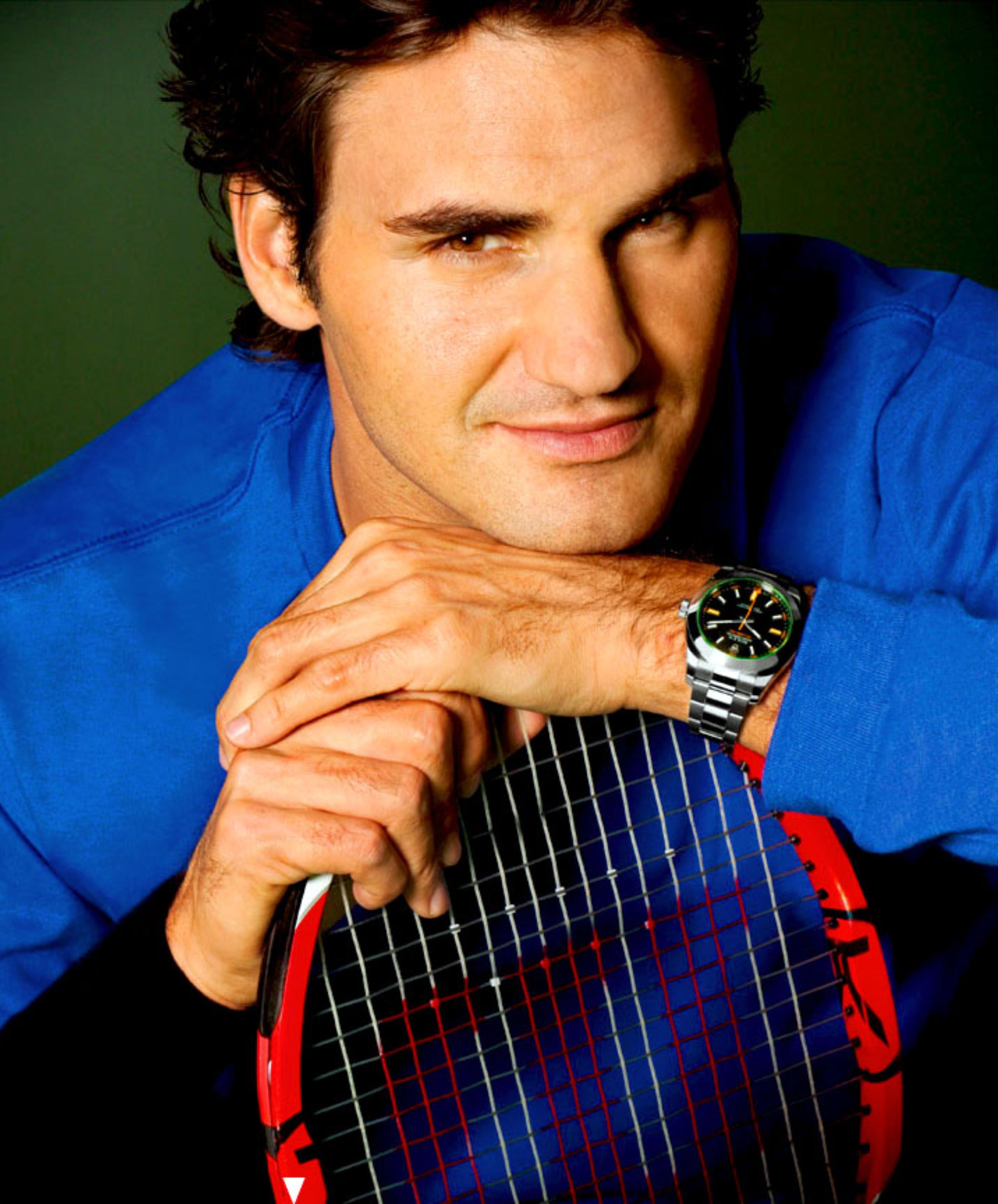

On many levels, the Z-Blue Milgauss offers a rare relief from the rigid culture of uniformity that’s dominant at Rolex. If the Milgauss is ever coming back, it should do so in 2026 for the model’s 70th anniversary year, as another satisfying aside to a stern Rolex tradition, that’s to disregard anniversaries.


